 People · Events · Communities

Quick answer: Chamber of commerce management is the day-to-day work of running a chamber: recruiting and keeping member businesses, collecting dues, hosting events, keeping the directory accurate, communicating, selling sponsorships and reporting to the board. It works best when those six functions share one record per business, so a small team spends its time with members.
Key takeaways
-
Chamber members are businesses, not individuals, and they join for visibility, connections and growth.
-
Six functions do the work: dues, events, directory, communications, sponsorships and reporting.
-
Non-dues revenue now funds most chambers, so sponsorship tracking matters as much as renewals.
-
Score 4 or more on the self-check below and it is time to look at one platform.
No two days at a chamber look the same. Monday might be a ribbon cutting and a stack of dues reminders. Tuesday brings a board report, a sponsor who wants more visibility and a member whose directory listing is out of date. Chamber of commerce management is the work of keeping all of that moving, so that businesses see real value in being part of your community.
This guide walks through what chamber of commerce management involves, the six functions every chamber has to cover, the challenges that slow small teams down, how to tell when you have outgrown your tools, and how to decide which ones fit.
What is chamber of commerce management?
Chamber of commerce management is the day-to-day work of running a chamber: recruiting and keeping member businesses, collecting dues, hosting events, keeping the directory accurate, communicating with members, finding sponsors and reporting to the board. It is part membership organization, part events company and part community connector, usually run by a small team with help from volunteers and ambassadors.
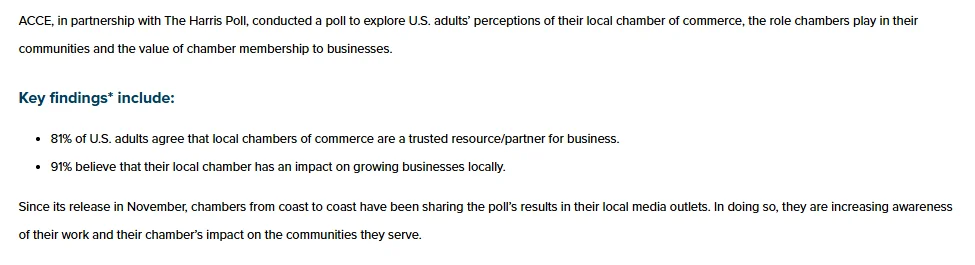
What makes it different from managing other associations is who the members are. A chamber’s members are businesses, not individuals, and they join for visibility, connections and influence in their local economy. The public sees that role too: in a 2024 ACCE/Harris Poll of more than 2,000 U.S. adults, 81% agreed that their local chamber is a trusted resource and partner for business. That trust shapes everything from how you invoice to how you plan a mixer.
What does a chamber actually manage?
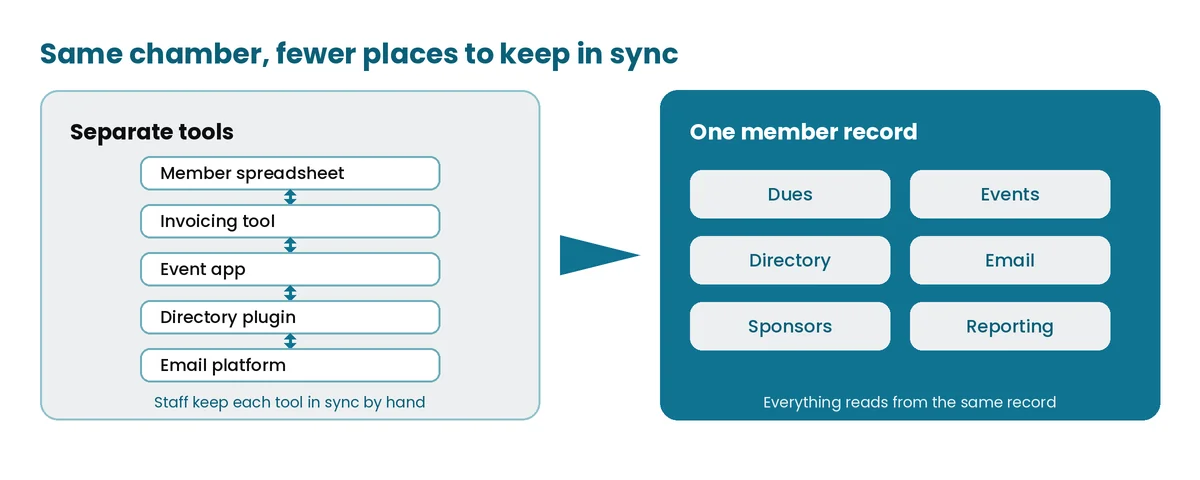
It helps to picture the work as six areas that all revolve around one thing, the member business. Each area touches the same record, which is why it hurts when the information is scattered.
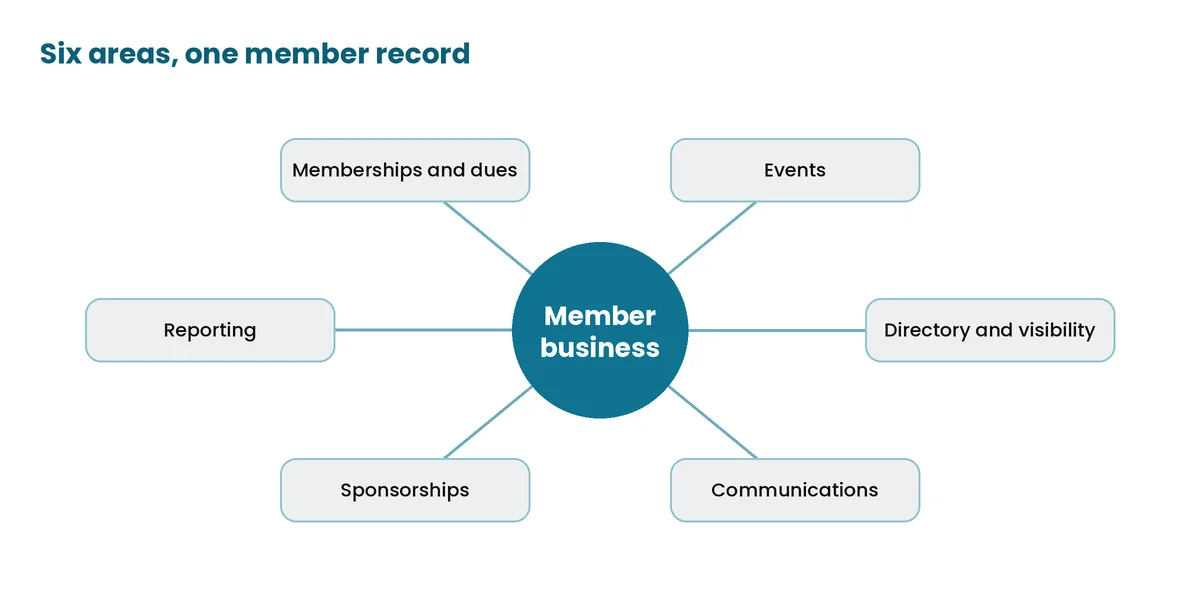
When those six areas share one record, a new member’s details are entered once and everyone sees the same picture. When they do not, the same business can exist in four places with four slightly different versions of the truth.
What is the chamber member lifecycle?
Chamber membership is not a single sale, it is a loop: a business joins, gets onboarded, takes part in events and programs, and then decides whether to renew. Every turn of the loop is a chance to earn the next one. What is membership management? explains the idea in more depth.
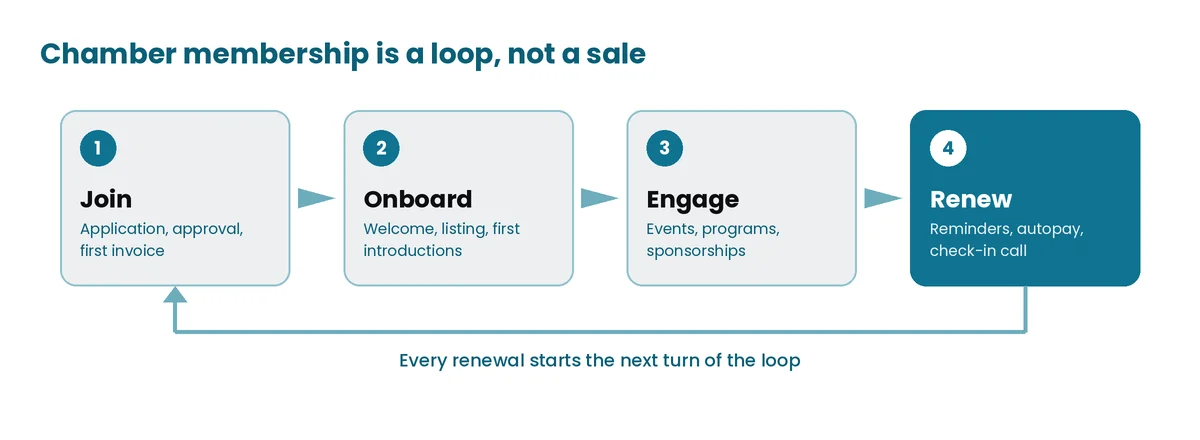
The loop is a useful lens for everything that follows. Ask of each function in your chamber: which stage of the loop does this support, and who is responsible for it?
What are the 6 core functions of chamber management?
The six core functions of chamber management are memberships and dues, events, the directory, communications, sponsorships and other revenue, and reporting to the board.
1. Memberships and dues
This is the backbone. It covers applications, membership levels, invoicing, renewals and payments. The aim is that dues arrive on time without staff chasing each one by hand. Automated reminders, card and bank payments and a clear view of who has paid make a real difference, and our guide on how to automate membership renewals covers the reminder schedule. When members lapse, it is worth understanding why members leave.
2. Events
Mixers, ribbon cuttings, luncheons, webinars and the annual gala are where members see the chamber’s value. Managing them well means simple registration, member pricing, group and table orders for galas, easy check-in and attendance that lands on the member’s record, whether the event is in a ballroom or online. Our event management software guide explains what to look for when you choose tools for this.
3. Directory and member visibility
For many businesses, the directory and the job board are what they are paying for. Listings should be easy for members to update themselves and should disappear when a membership ends. A stale directory quietly tells members and the public that the chamber is not paying attention.
4. Communications
Newsletters, event invitations, renewal notices and welcome messages all come from the chamber, and they work better when they are relevant. Grouping members by industry, size or involvement lets you send fewer, better messages. For ways to keep member businesses involved between events, see our guide to chamber of commerce member engagement.
5. Sponsorships and other revenue
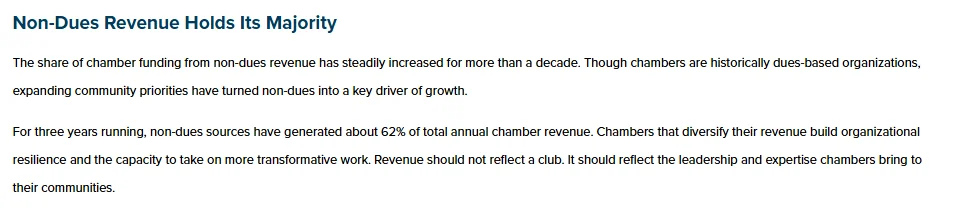
Dues are rarely the whole budget. ACCE’s 2025 Chamber Operations Survey found that non-dues sources have generated about 62% of total chamber revenue for three years running. Sponsorships, advertising, events and program fees fund many of the chamber’s biggest initiatives. Sponsors expect recognition at events, on the website and in emails, so track what each sponsor was promised and what has been delivered.
6. Reporting and board support
Boards want to know how many members joined, who is at risk, how events performed, and whether revenue is keeping up with costs. The same ACCE research found median revenue per member rose 31% since 2023 while expense per member rose 29%, a close margin boards will want to watch. If producing that report takes a day of copying between tools, the team loses time that could go to members. Live reporting from one record turns the board report into a quick check, not a project. Our guide to member engagement metrics shows which numbers are worth putting in front of the board.
Not sure what your current setup really costs? The free Chamber Tech Stack Cost Calculator totals your subscriptions, payment fees and staff time in about 15 minutes, so you know your number before you talk to any vendor. Open the calculator
Common chamber management challenges
Most chambers run into the same handful of problems, whatever their size.
-
Small teams, big calendars. A few staff cover memberships, events, communications and finance, with little time to spare.
-
Scattered data. Member details live in a spreadsheet, an invoicing tool, an event app and an email platform, and they do not always agree.
-
Manual renewals. Chasing dues one email at a time eats hours and still lets members slip through.
-
Hard-to-prove value. Without clear attendance and engagement data, it is difficult to show members, or the board, what the chamber delivers.
-
Volunteer turnover. Processes that live in one person’s head disappear when that person moves on.
None of these is a sign you are doing it wrong. They are what happens when the work grows faster than the tools.
Chamber management tools: spreadsheets, separate apps or one platform?
Most chambers start with spreadsheets, add a few separate apps over time and eventually ask whether one platform would be simpler. Each stage has a place.
| Approach | Works well when | Watch out for |
|---|---|---|
| Spreadsheets | The chamber is very small and the calendar is light | Manual updates, version confusion, no member self-service |
| Separate apps | Each tool does one job well and the team has time to connect them | Duplicate data entry, lapsed members in the directory, hard-to-assemble reports |
| One chamber platform | Staff time is the bottleneck and members expect self-service | Moving your data, choosing a vendor that supports migration and onboarding |
If you are at the point of comparing options, our guide on how to choose chamber of commerce management software walks through the steps, a vendor scorecard and the red flags to watch for in a demo. For a feature-by-feature checklist, see chamber of commerce software features, and for a shortlist of named platforms, see our pick of the best chamber of commerce software.
Has your chamber outgrown its current tools? A 6-point self-check
Count how many of these apply to you:
☐ Member data lives in more than one place.
☐ Renewal reminders depend on someone remembering.
☐ Members need a discount code to get member pricing for events.
☐ The online directory is out of date.
☐ Staff copy data between tools every week.
☐ Board reports take hours to put together.
0 to 1: your current setup is probably fine for now. 2 to 3: you are feeling the strain, so start by centralizing member data. 4 or more: it is time to look seriously at one chamber management platform.
Scored 4 or more? Bring your member list and event calendar, and we will show you your chamber on one member record. Book a demo
How Melora Connect approaches chamber management
Melora Connect is a membership operating system built for chambers of commerce and associations, with one complete record per member business. Dues, events, email, the public member directory and reporting all draw from that record. Renewals, reminders and invoice runs go out on their own, smart segments show which members are new, at risk or lapsed, and the Monday morning briefing tells your team what changed. Events include ticket tiers, group and table orders for galas, check-in at the door, and online events that connect to Zoom. Hosted chamber websites and a career center for job postings are coming soon.
You get a team, not a login. We configure the platform with you, move your data and support you through going live. Melora’s typical timeline is about 30 days from signed agreement to live, while the industry typical for small and mid-sized associations is 6 to 16 weeks (see how long a migration takes). The goal is simple: less time keeping tools in sync, and more time with the businesses that make up your chamber.
Frequently asked questions about chamber of commerce management
What is chamber of commerce management?
Chamber of commerce management is the work of running a chamber: managing member businesses, dues, events, the directory, communications, sponsorships and reporting so that members see value and the organization stays financially healthy.
How does a chamber of commerce make money?
Most chambers rely on a mix of membership dues, events, sponsorships, advertising and programs. ACCE’s 2025 operations research found non-dues sources make up about 62% of chamber revenue, so it is worth tracking each source separately alongside renewals.
What does a chamber of commerce manage?
Six functions: memberships and dues, events, the member directory, communications, sponsorships and other revenue, and reporting to the board. All six revolve around the member business, which is why keeping them on one record saves so much staff time.
What is the difference between chamber management and association management?
They overlap, but chamber members are businesses, often with several contacts, and visibility, the directory, sponsorships and local events carry more weight. Software for chambers needs to handle business records with multiple contacts well.
Why do businesses join a chamber of commerce?
Mainly to grow: business owners point to growing the business, networking with other leaders and attracting customers. Chambers also signal credibility, since most U.S. adults in the 2024 ACCE/Harris Poll saw their local chamber as a trusted partner for business.
When should a chamber move off spreadsheets?
When staff spend more time keeping tools in sync than talking to members. Entering the same details more than once, chasing renewals by hand or taking a day to build a board report are common signs. Our guide to replacing membership spreadsheets shows how to make the move.
The bottom line
Good chamber of commerce management is not about doing more. It is about keeping the six core functions connected, so each business is one record, each stage of the member loop has an owner and your small team has time for people. Take the self-check above, then follow one member business through a year at your chamber and note every place its information gets stuck. That list is your plan.
See your chamber in Melora Connect. Bring your member list and event calendar, and see dues, events and the directory on one record. Book a demo
Sources
-
ACCE, Three Trends in Chamber Operations, May 15, 2026.
-
ACCE, Chambers Promote Landmark Results of Chamber Poll, December 9, 2024.