
 People · Events · Communities

Quick answer: Membership churn is the share of members you lose over a period. To reduce it, split churn into voluntary and involuntary, fix failed payments with autopay and reminders, make the first 90 days count, flag members with no activity in 90 days, show value before the renewal invoice, ask leavers why, and run a simple win-back.
Key takeaways
-
Churn rate = members lost during a period ÷ members at the start, × 100.
-
First-year members leave most: the 2026 median renewal is 72% for them vs 82% overall.
-
Involuntary churn (failed payments, expired cards) is the cheapest churn to fix.
-
Review a weekly list of members with no activity in 90 days, and call them.
Every renewal season, the same quiet worry shows up in the staff meeting. Who is not coming back this year? And why did not we see it coming?
Membership churn is one of the most expensive problems an association or chamber can have. Winning a new member takes outreach, events and a lot of conversations. Losing one often takes a single unpaid invoice. This guide is the hub of our retention series. It explains why members leave, how to measure churn honestly, what a good churn rate looks like, and seven practical ways to reduce it, with links to deeper guides along the way. It builds on the ideas in member retention vs. member engagement.
What is membership churn?
Membership churn is the loss of members over a period of time, whether they cancel, let their membership lapse or fail to renew. It is usually expressed as a rate: the share of members you had at the start of a period who are gone by the end of it.
Churn comes in two kinds, and they need different fixes. Voluntary churn happens when a member decides to leave. Involuntary churn happens when a membership ends by accident: an expired card, a bounced payment or an invoice that never reached the right inbox. Many organizations focus on the first and overlook the second, even though the second is often easier to fix.
Why do members leave?
Most people do not leave in anger. They drift, and the reasons are usually ordinary.
-
They never saw the value. If a member has not attended anything, used the directory or received a useful benefit, the dues feel like a donation.
-
The start was forgettable. A new member who gets an invoice and then silence has no reason to form a habit.
-
Nobody noticed they went quiet. In a small team, the loud members get attention and the silent ones slip out.
-
Paying was a hassle. Manual invoices, expired cards and unclear renewal dates turn a willing member into a lapsed one.
-
Their needs changed. A member’s situation moves on, and if your offer stays the same, it may stop fitting.
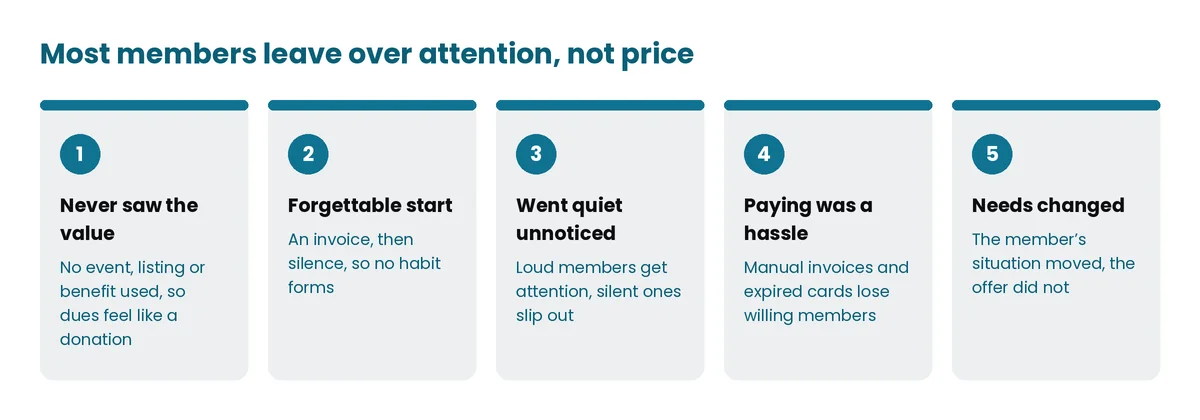
Notice that almost none of these are about price. They are about attention, which you can change.
How do you calculate membership churn?
| Churn rate formula: members lost during a period ÷ members at the start of the period × 100. Example: you began the year with 400 members and 60 did not renew, so your annual churn rate is 60 ÷ 400 × 100 = 15%. |
|---|
Use the same period and the same definition every time, so you can compare year to year. If you are new to the foundations, What is Membership Management? covers the basics. Then split the number in two, because the two kinds of churn call for different responses.
| Type | What happens | Typical cause | Best response |
|---|---|---|---|
| Voluntary churn | The member chooses to leave | Low perceived value, change in needs, lack of connection | Engagement, outreach, exit conversations |
| Involuntary churn | The membership ends by accident | Expired cards, failed payments, missed invoices | Autopay, reminders, payment follow-up |
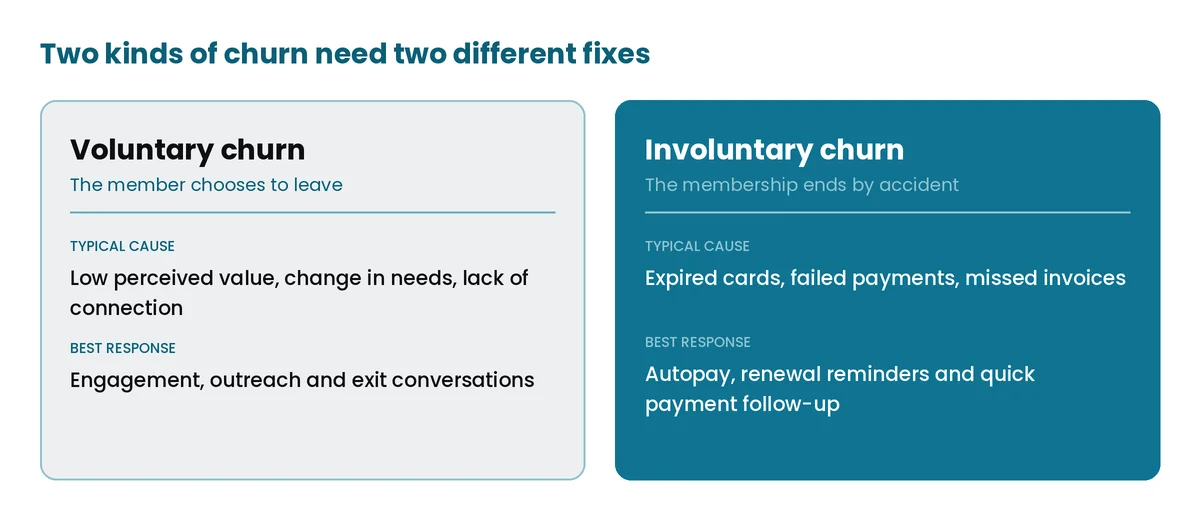
A few other numbers are worth tracking alongside the rate. Together they show where the leak is, not just how big it is. For formulas and the engagement numbers that move before churn does, see our guide to member engagement metrics.
| Metric | What it tells you |
|---|---|
| Churn rate by member type | Which tiers or segments lose the most members |
| Churn by tenure | Whether first-year members leave at a higher rate |
| Renewal rate | The share of members who renew when asked |
| Failed payment recovery | How many missed payments you bring back |
| Members with no activity in 90 days | The list your team should contact this week |
What is a good churn rate for an association?
There is no universal figure, but a median association loses about 18% of its members a year, and about 28% of its first-year members. Marketing General Incorporated’s 2026 Membership Marketing Benchmarking Report puts the median renewal rate at 82% for all members and 72% for first-year members, a 10-point gap. Set your own baseline from the last two or three years and aim to improve it. The trend matters more than any single number.
7 ways to reduce membership churn
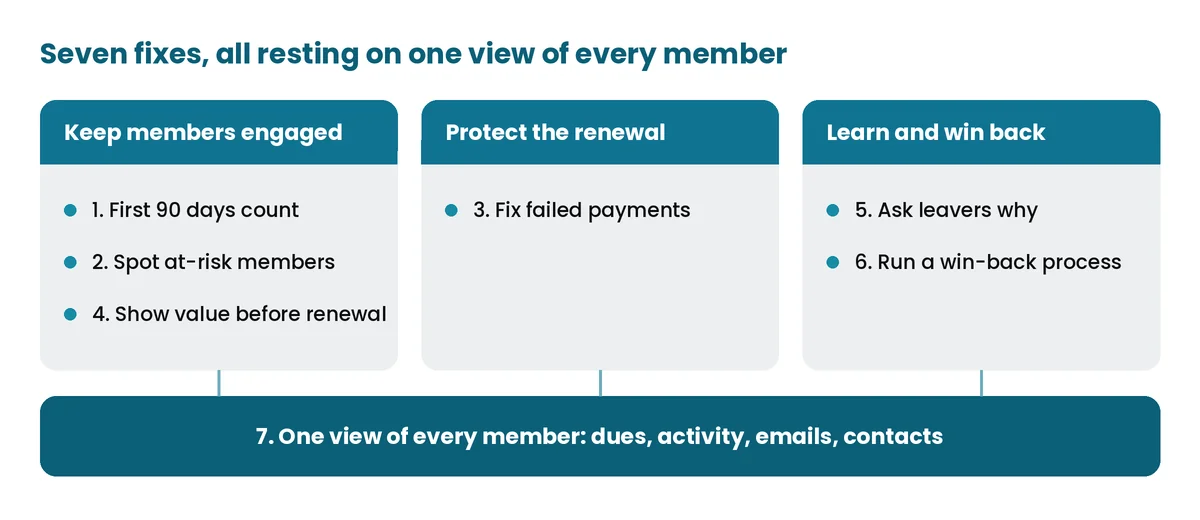
The seven ways to reduce membership churn are: make the first 90 days count, spot at-risk members early, fix failed payments, show value before the renewal invoice, ask leaving members why, run a win-back process, and give your team one view of every member.
1. Make the first 90 days count
The early weeks set the pattern, and the benchmark gap above shows why. A new member who gets one early win, such as a new connection, a referral or a listing that gets noticed, has a reason to stay. We lay out a full onboarding plan for the first 90 days in how to improve membership management.
2. Spot at-risk members early
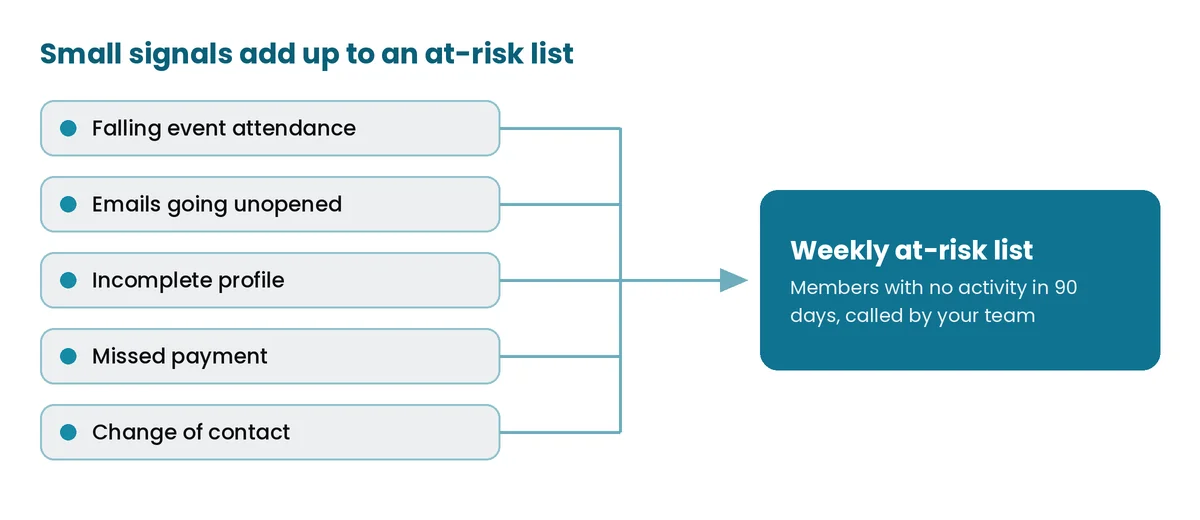
Do not wait for the renewal notice to find out who is unhappy. Members who are drifting leave a trail months ahead: fewer events, unopened emails, a missed payment, a changed contact. Pick a window, such as 90 days without activity, and review that list every week. Our guide on how to identify at-risk members walks through every warning sign and a 30-minute monthly check. When you are ready to rank members by risk, predictive analytics for member retention shows how to build a simple risk score.
Free tool: Member Risk Scoring Sheet. Score members on the warning signs above and get this week’s call list in minutes. Open the Member Risk Scoring Sheet
3. Fix failed payments before they become cancellations
Involuntary churn is the cheapest churn to prevent. Offer autopay, send renewal reminders well before the due date, and follow up quickly when a card fails. A friendly note with a one-click payment link recovers many members who never meant to leave.
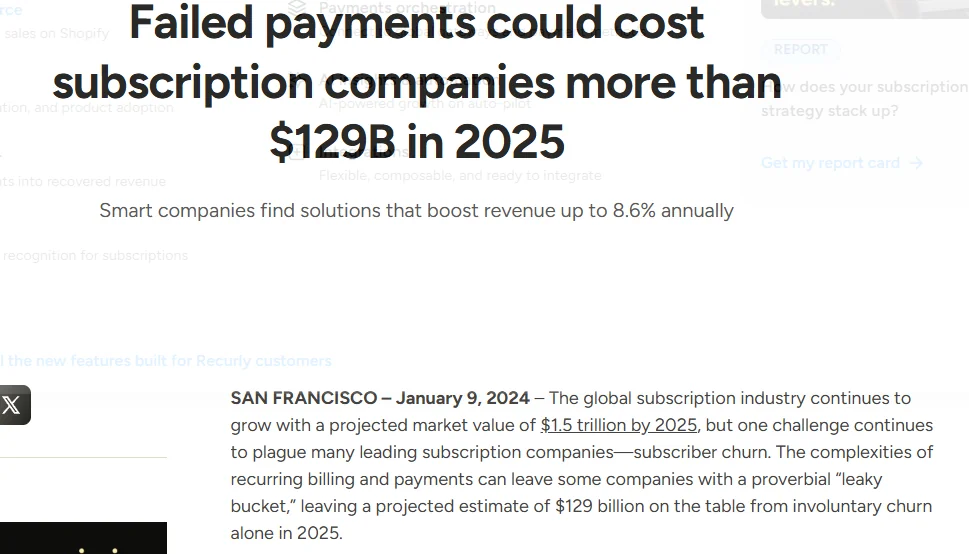
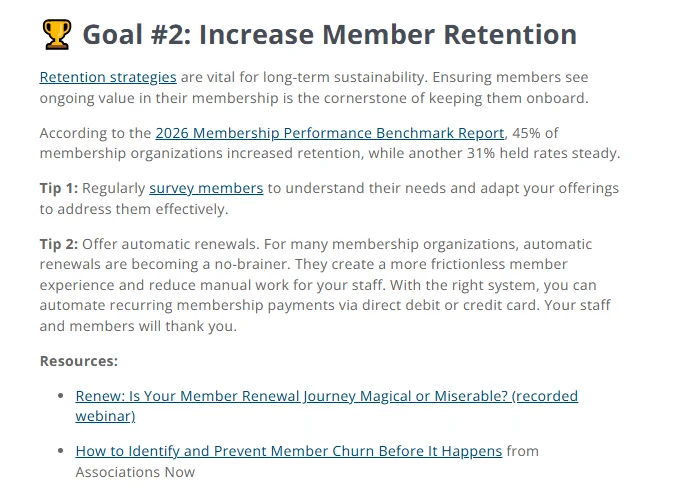
The scale is easy to underestimate. Recurly, a billing platform, projected that failed payments could cost subscription businesses more than $129 billion in 2025. That figure covers subscription companies, not associations, but dues paid by card fail for the same reasons. Membership organizations are moving the same way: the iMIS 2026 benchmark findings recommend automatic renewals to reduce friction and manual work. Our guide to automating membership renewals covers the reminder schedule in detail.
4. Show value before the renewal invoice
A renewal invoice should not be the first time a member thinks about what they get. A few weeks ahead, send a short summary of events attended, continuing education (CE) credits earned, chapter activity, introductions made and benefits used. If there is little to show, that is a signal too, and a reason to call. A member engagement score makes those quiet members easy to find.
5. Ask leaving members why
When someone cancels, ask. A two-question survey or a short phone call is enough. What was the main reason you decided to leave? What could we have done differently? Read the answers each quarter and look for patterns. You will often find one or two fixable causes hiding in plain sight.
6. Run a simple win-back process
A lapsed member is not a lost cause. Reach out 30 to 60 days after they leave, acknowledge the gap and invite them back to something specific, such as an event or a new program. Keep the door open and the message personal. Some will come back, and some will tell you what to change.
7. Give your team one view of every member
All six steps above depend on seeing the whole picture: dues, attendance, emails and contacts in one place. When this data is scattered across spreadsheets and separate tools, the signals appear too late, if at all. A system built for membership, rather than a general sales tool, makes this easier. We explain the difference in membership management vs. CRM, and our guide on how to use member data to improve member retention shows what to collect and how to review it.
Ready to see who needs a call this week? See how your team can spot at-risk members and recover failed payments before renewal. Book a demo
Example: the association that found its leak
Picture an association with 600 members and a small team. Every year, they lose about the same number of members and assume it is just the way things are. When they finally split the numbers, they notice two things. A sizeable part of the loss is involuntary: expired cards and invoices that went to a former contact. And among the voluntary leavers, most had attended nothing in the six months before they left.
They turn on autopay and renewal reminders, and they start a weekly list of members with no activity in 90 days. A staff member calls five of them each week. Nothing dramatic changes overnight, but renewal season stops being a surprise. Same team, same dues, and the leak finally has a name. This is an illustration, not a client case.
How Melora Connect approaches membership churn
Melora Connect is a membership operating system built around one complete record per member, so dues, events, email, chapters, CE credits and activity sit together. Smart segments surface new, at-risk and lapsed members, and a Monday morning briefing tells your team what changed. Automated renewals, invoice runs and MeloraPay autopay help with the involuntary side, with payments landing in your own Stripe account.
You get a team, not a login. Our team helps you set up the at-risk segments and renewal reminders that fit your members, so renewal season becomes a few planned conversations instead of a scramble.
Frequently asked questions about membership churn
What is membership churn?
Membership churn is the loss of members over a period, whether through cancellation, lapse or non-renewal. It is usually shown as a percentage of the members you had at the start of that period, and it splits into voluntary and involuntary churn.
How do you calculate membership churn rate?
Divide the number of members lost during a period by the number of members at the start of the period, then multiply by 100. For example, losing 60 of 400 members in a year is a 15% annual churn rate. Use the same period and definition every time.
What is a good churn rate for an association?
There is no universal figure. As a reference point, MGI’s 2026 Membership Marketing Benchmarking Report puts the median renewal rate at 82% for all members and 72% for first-year members, which means churn of about 18% overall and 28% among new members. Improve on your own baseline.
What is the difference between voluntary and involuntary churn?
Voluntary churn is when a member chooses to leave. Involuntary churn is when a membership ends because of a failed payment, expired card or missed invoice. They need different fixes, so track them separately.
Why do members leave an association?
Most members drift rather than quit: they never saw the value, the first weeks were forgettable, nobody noticed they went quiet, paying was a hassle, or their needs changed. Very few leave over price alone, which means most churn responds to attention.
How can I reduce membership churn quickly?
Start with involuntary churn: offer autopay and send clear renewal reminders. Then build a weekly list of members who have gone quiet for 90 days and contact them personally, starting with first-year members.
The bottom line
Reducing membership churn is not about one big retention campaign. It is about noticing earlier, making it easy to stay and giving members a reason to feel the value long before the invoice arrives. Measure the two kinds of churn separately, fix the accidental losses first and make a habit of reaching out to the quiet ones.
See software built for membership. Smart segments, autopay and renewal reminders on one member record, set up with our team. Book a demo
Sources
-
Marketing General Incorporated, The 2026 Membership Marketing Benchmarking Report, 2026; figures as reported by i4a, How to Calculate Membership Retention Rate (With Benchmarks), 2026.
-
Recurly, Failed payments could cost subscription companies more than $129B in 2025, 2024.
-
iMIS, Top 3 Goals and Challenges for Membership Organizations in 2026, January 15, 2026.