
 People · Events · Communities

Members rarely leave all at once. They drift: one skipped event, a few unread emails, a login that never happens. By the time the renewal invoice goes unpaid, the decision was made long ago.
The good news is that you can identify at-risk members months before they leave, if you know where to look. This guide covers the eight warning signs that matter most, a 30-minute monthly check you can run with the data you already have, and what to do when you spot a member at risk. It is part of our wider guide to reducing membership churn.
Quick answer: The eight warning signs of an at-risk member are: no events in six months, no email clicks in three months, no portal logins, a failed or late payment, a bounced email or departed main contact, a quiet first 90 days, low satisfaction or total silence, and stepping back from a role or downgrading.
What is an at-risk member?
An at-risk member is a current member whose recent behavior suggests they may not renew. They attend less, engage with fewer emails, stop logging in, or run into payment problems. Spot them 60 to 90 days before renewal and there is still time to help. Spot them at renewal and there usually is not.
The stakes are highest with new members. According to Marketing General Incorporated, its 2026 Membership Marketing Benchmarking Report puts the median renewal rate at 82% for all members and 72% for first-year members. The typical association loses close to one in five members every year, and more than one in four new ones. Catching even a few of them early makes a real difference to dues revenue.
What are the warning signs of an at-risk member?
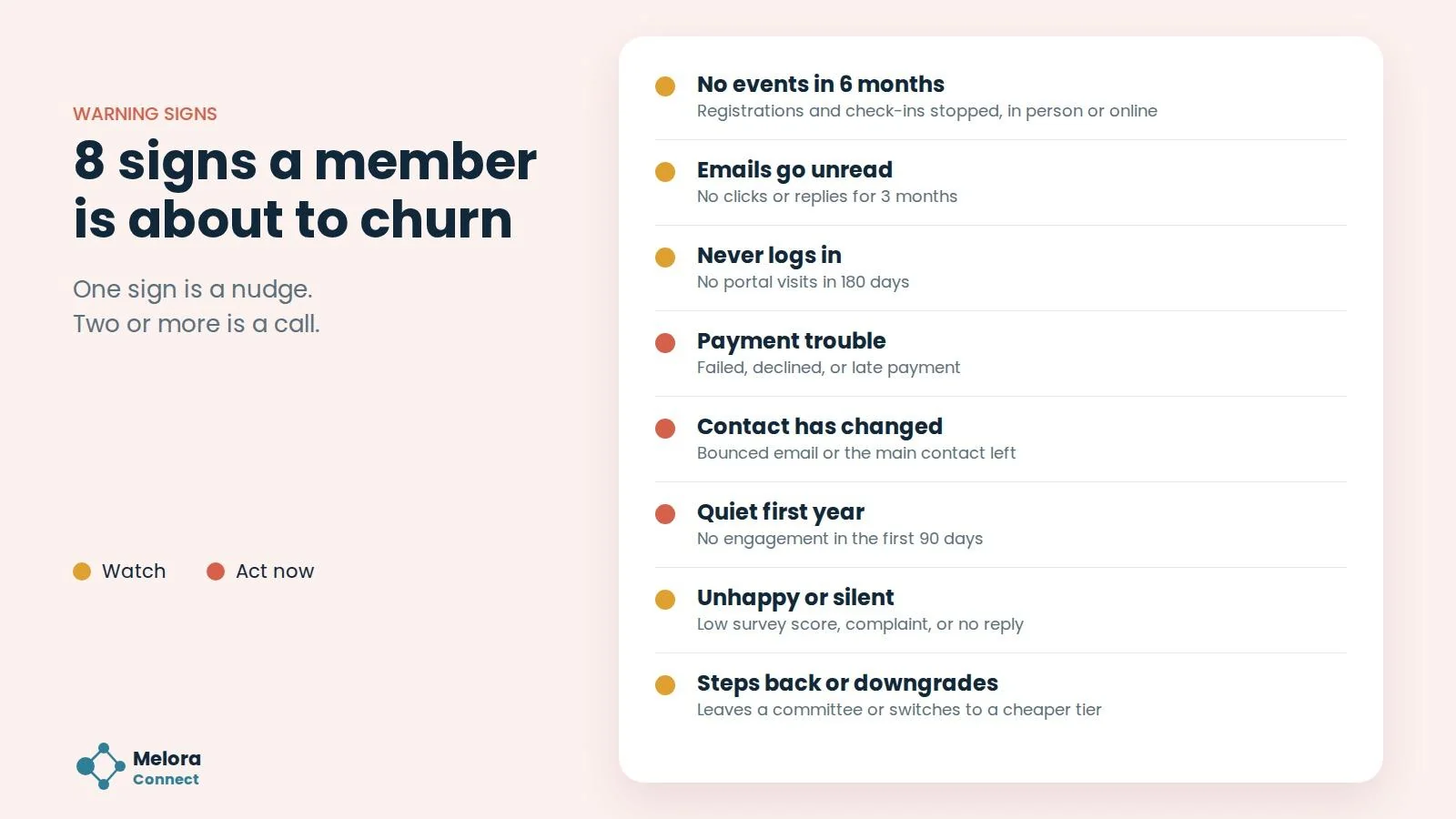
1. They stop coming to events
Event attendance is one of the clearest signs of value. A member who used to show up regularly, in person or online, and has not registered for anything in six months is telling you something.
2. Their emails go unread
Three months without a click or reply usually means your messages have stopped feeling relevant, or they are going to an inbox nobody reads. Do not rely on opens alone: in Litmus’s email client data, Apple Mail Privacy Protection affects roughly 55% to 60% of all opens and can count an email as opened even when nobody read it. Clicks are the more honest signal.
3. They never log in
Members who never visit the member portal never see the resources, directory, or community you offer. To them, membership is just an invoice.
4. Their payment fails or runs late
Not all churn is about value. An expired card or a declined payment can turn a happy member into a lapsed one without anyone deciding to leave. It is a large problem far beyond associations: Recurly projected that failed payments could cost subscription businesses more than $129 billion in 2025.
5. Their contact details change
A bounced email, or the main contact at a member company moving on, cuts the line of communication. Contact data goes stale faster than most teams expect: the ZeroBounce Email List Decay Report for 2026 found that at least 23% of an email list decays within a single year. For business memberships, this is one of the most common hidden causes of churn.
6. They have a quiet first year
New members are the most likely to leave. A first-year member with no event, login, or reply in their first 90 days needs attention now, not at renewal.
7. They are unhappy, or say nothing at all
A low survey score or complaint is an obvious flag. Silence can be just as telling: members who never respond to anything are often the ones who quietly do not renew. Watch members on autopay too, since automatic payment can hide a member who stopped engaging long ago. We explain why in member retention vs. member engagement.
8. They step back from a role or downgrade
A member who leaves a committee, gives up a volunteer role, or switches to a cheaper membership type is often easing toward the exit. Ask what changed before you assume it is about money. The answer is often a new job, a new boss, or a benefit that stopped fitting.
How do you run a 30-minute monthly at-risk member check?
You do not need a data team to spot at-risk members early. Block 30 minutes once a month and work through these four checks. If you would rather not build the scoring yourself, paste an export into our free Member Risk Scoring Sheet and it flags each member and suggests an action. When you are ready to rank members by risk, our guide to predictive analytics for member retention shows how to build a risk score, and a member engagement score can feed into it.
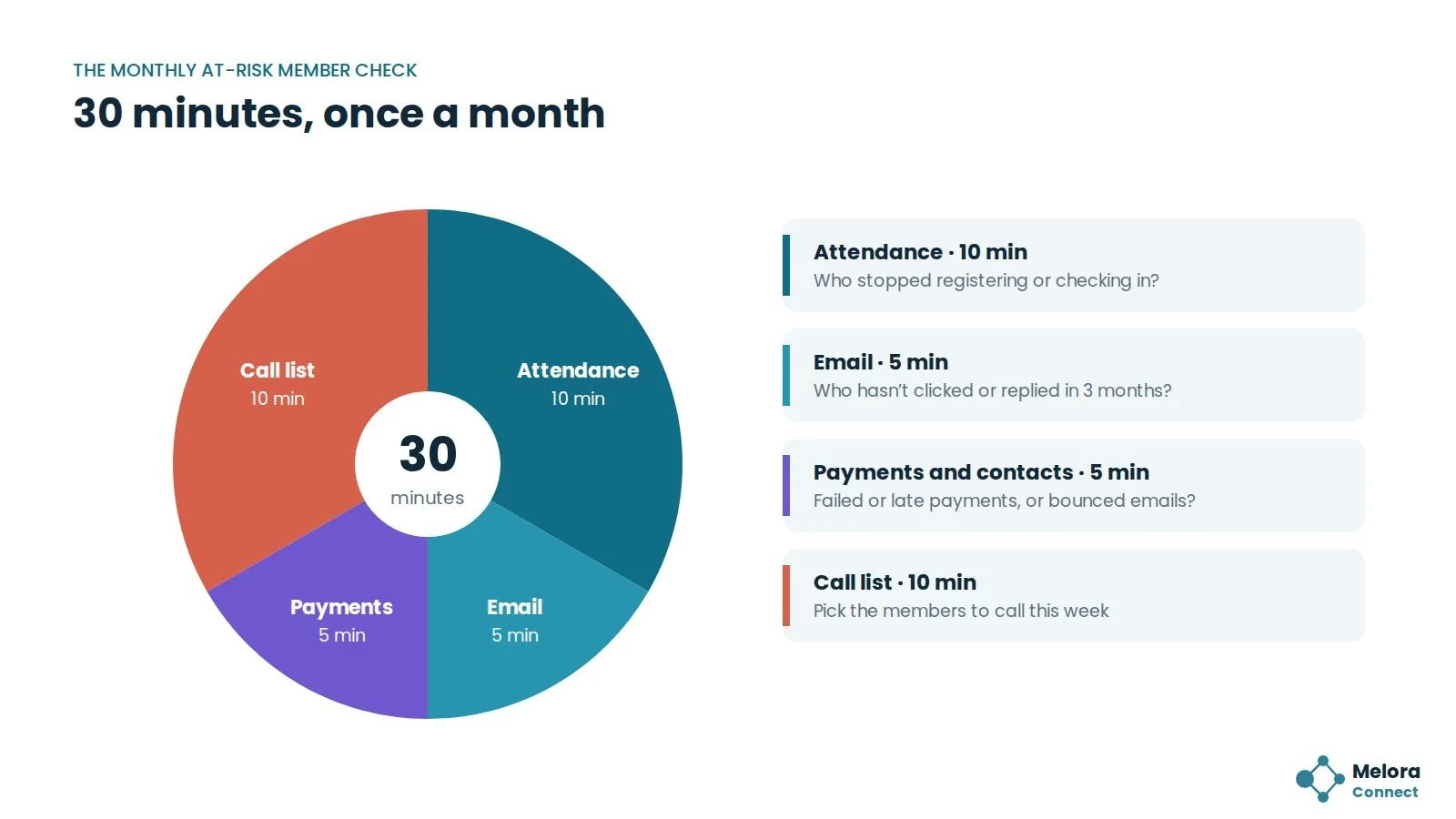
| Check | Where to look | Flag a member if |
|---|---|---|
| Attendance (10 min) | Event registrations and check-ins, in person and online | No events in the last 6 months |
| Email (5 min) | Campaign clicks and replies (opens only as a backup) | No clicks or replies in 3 months |
| Payments and contacts (5 min) | Invoices, payment history, bounced emails | A failed or late payment, or a bounced email |
| Call list (10 min) | Your flagged members, renewal dates first | Two or more flags, or renewal within 90 days |
What should you do when you spot an at-risk member?
One warning sign: send a nudge. A short, personal note pointing to one benefit they have not used yet, such as an upcoming event that fits their interests.
Two or more signs: make a call. Ask how things are going and listen. You will often learn about a job change, a budget cut, or a benefit they did not know existed.
Payment or contact problems: fix them first. Update the contact, resend the invoice, or help them switch to autopay. These are the easiest saves of all, and our guide to automating membership renewals shows how to prevent most of them.
Want to see your at-risk members in one place? Book a demo and see how Melora Connect surfaces them for you. Book a Melora Connect demo
Example: the bounced email that almost cost a member
Illustrative example. Picture a chamber of commerce with 400 members. During her monthly check, the membership manager notices that a long-time member business, a local landscaping company, has had two renewal emails bounce and has not registered for an event since spring.
She calls the main office and learns that the owner’s assistant, who handled the membership, left months ago. She updates the contact to the owner, invites him to the next small-business breakfast, and resends the invoice. He renews the same week, and says he had no idea the membership was about to lapse. Without the check, the renewal would have bounced into an empty inbox.
How Melora Connect helps you spot at-risk members early
Melora Connect keeps one record per member, so attendance, email activity, payments, and contact details all sit in one place instead of four. For online events, Melora creates the Zoom meeting and checks in the people who joined, so virtual attendance counts too. Smart segments surface new, at-risk, and lapsed members, and the Monday morning briefing lists at-risk members with renewals due in the next 90 days.
From there, your team can send a targeted message with merge fields from the live record, or simply pick up the phone. Automatic reminders and saved-card autopay through MeloraPay take care of many payment-related lapses before they happen. And because you get a team, not a login, we help you set up the segments around how your members actually behave.
See your at-risk members in Melora Connect. Book a demo and we will show you what an at-risk list looks like when it is built from member data like yours. Book a Melora Connect demo
Frequently asked questions
How early can you identify at-risk members?
Warning signs often appear months before renewal. Checking monthly, and acting at least 90 days before each renewal date, gives you time for personal outreach. For first-year members, check within the first 90 days.
How many warning signs should trigger outreach?
One sign is worth a light nudge, such as a personal note about an upcoming event. Two or more signs, or any sign within 90 days of renewal, is worth a phone call. Fix payment and contact problems right away, whatever else you see.
What is the most common hidden cause of member churn?
Outdated contact details and failed payments. When the main contact at a member company leaves, or a card expires, the renewal fails without anyone deciding to leave. Email lists lose at least 23% of their addresses a year, so check bounces every month.
Can software identify at-risk members automatically?
Yes, once your data is connected. Smart segments can flag members from attendance, email and payment activity, and a risk score can rank them. A person should still decide who to call and what to say.
The bottom line
Member churn is rarely a surprise in hindsight. The signs are there: fewer events, unread emails, failed payments, changed contacts, a quiet first year. The associations that keep members best are the ones that look for those signs every month and act on them early.
Start with the 30-minute check, call the members with two or more flags, and fix payment and contact problems first. Then let a connected system do the looking for you. To turn these checks into a team routine, see how to improve member retention with the member data you already have.
Sources
-
Marketing General Incorporated blog, The First 30 Days: Turning New Members into Engaged Members, October 22, 2026 (citing the 2026 Membership Marketing Benchmarking Report).
-
Litmus, Email Client Market Share, 2026.
-
Recurly, Failed payments could cost subscription companies more than $129 billion in 2025, October 1, 2024.
-
ZeroBounce, The Email List Decay Report for 2026, 2026.