
 People · Events · Communities

Quick answer: A member engagement score is a single number, usually from 0 to 100, that adds up weighted points for what a member did over the last 12 months, such as events attended, CE credits earned, committee work and email clicks. It shows your team who is thriving, who is drifting, and whom to call before renewal.
Key takeaways
-
A member engagement score turns scattered activity into one number per member, usually from 0 to 100.
-
Use four to six signals you already track reliably, and give effort (events, credits, committees) more weight than email.
-
Count recent activity more, so drifting members surface while there is still time to call them.
-
Check the score after one renewal cycle: higher ranges should renew at clearly higher rates.
Every association has members who are thriving and members who are quietly drifting away. The trouble is telling them apart before renewal season, when a member who has already decided to leave is hard to win back. A member engagement score is the simplest tool for spotting the difference early.
A member engagement score solves that by turning dozens of small signals into one number your team can act on. This guide explains what a member engagement score is, how to build one in five steps, a sample scoring model with a worked example, what to do with each score range, and how to check that your score actually predicts renewals. For the wider set of tactics, see our guide to member engagement strategies.
What is a member engagement score?
A member engagement score is a single number, usually from 0 to 100, that summarizes how actively a member has participated in your organization over a set period. It adds up weighted points for actions such as attending events, earning continuing education (CE) credits, volunteering on a committee, taking part in a chapter, and clicking through your emails.
Think of it like a fitness tracker for membership. One workout does not tell you much. A pattern over months tells you a lot.
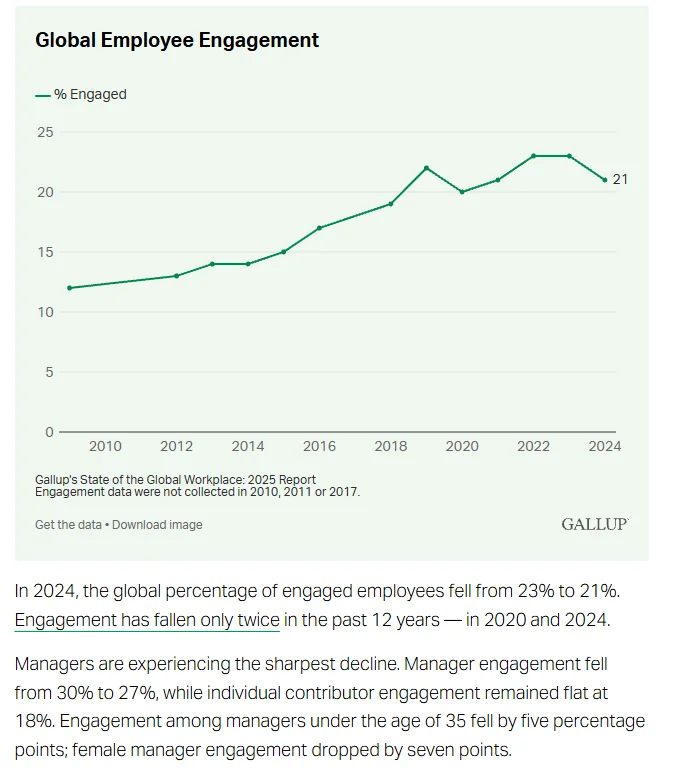
Engagement can be measured when you define it the same way every time. Gallup tracks employee engagement year after year, and its Gallup report on 2024 global engagement found that the global share of engaged employees fell from 23% to 21% in 2024, only the second decline it has recorded since 2009. That is workplace data, not association data, but the lesson carries over: you can only spot a decline if you measure engagement the same way each year.
A member engagement score is not the same as a satisfaction survey or a single number like event attendance. It combines behavior from several places into one view of each member. Our guide to member retention vs. member engagement explains how the two ideas relate.
Why use a member engagement score?
Without a score, engagement lives in different places: attendance in one report, email clicks in another, committee lists in a spreadsheet. A member engagement score brings them together, and it helps in four practical ways:
-
Early warning: it flags members who are slipping long before their renewal date.
-
Focus: a small team can prioritize outreach to the members who need it most.
-
Planning: it shows which programs actually move members from passive to active.
-
Reporting: it gives the board one clear, trackable number for member health, which fits neatly into our Board Report Template.
A falling score is often the first visible sign that a member is drifting, months before an unpaid invoice. Our guide on how to identify members at risk of churning covers the other warning signs to watch alongside it.
How do you build a member engagement score in 5 steps?
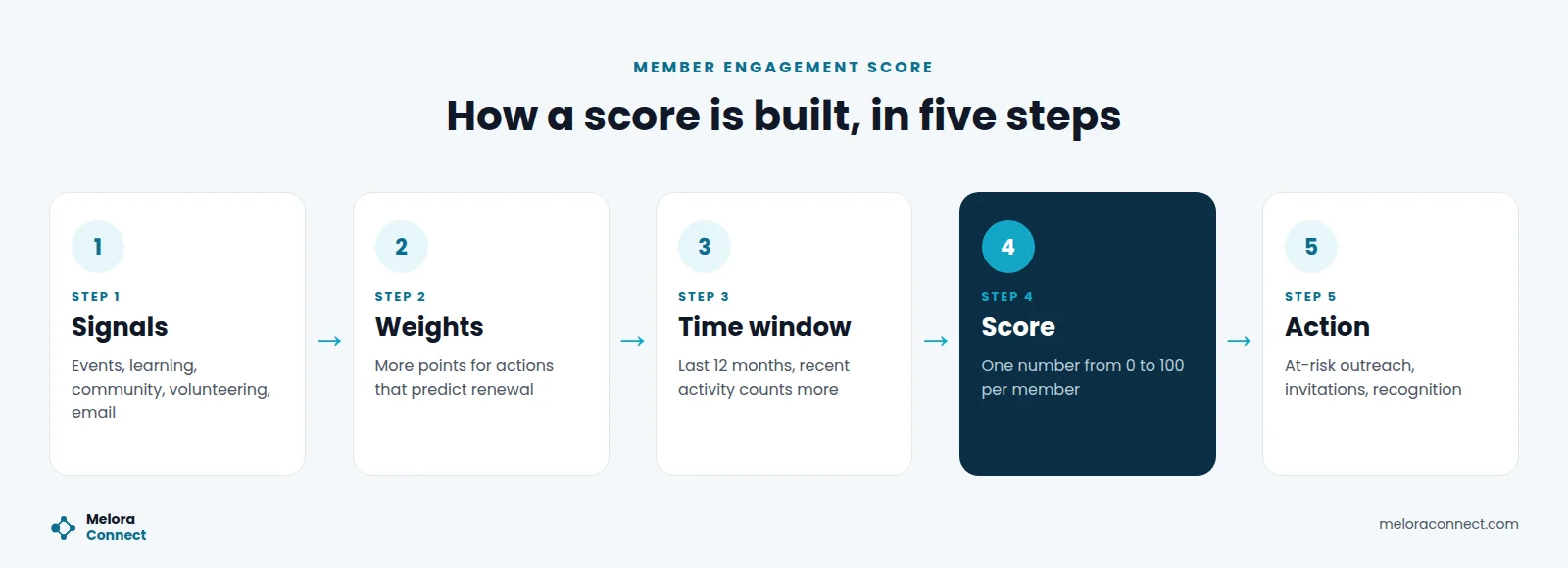
Building a member engagement score takes five steps: choose your signals, assign weights, set a time window, define score ranges, and decide what happens in each range. A first version fits in a spreadsheet.
1. Choose your signals
Pick four to six actions that reflect real value for your members. Common signals include event attendance, learning and CE credits, chapter or community activity, volunteering, and email clicks. Only include signals you already track reliably.
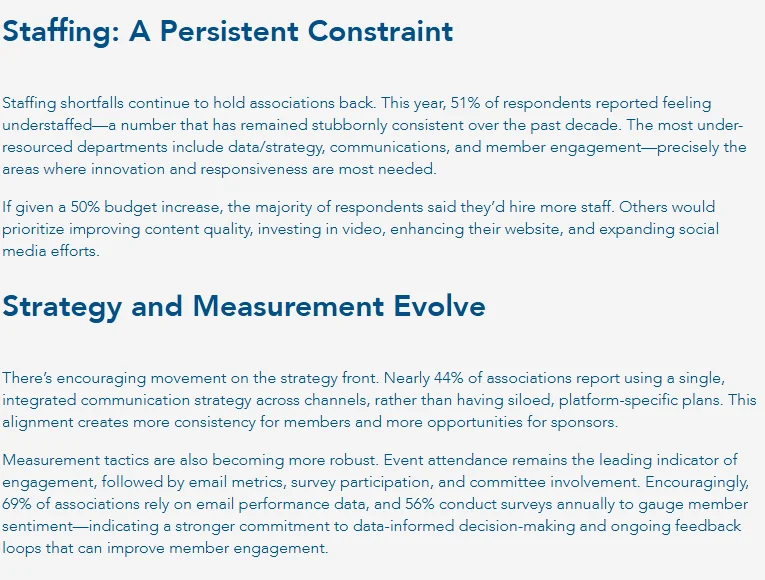
Most associations already have the raw material. In Naylor’s 2025 Association Benchmarking Report, event attendance remains the leading indicator of engagement, 69% of associations rely on email performance data, and 56% run surveys annually to gauge member sentiment. The survey drew responses from over 300 senior association professionals across North America.
2. Assign weights
Not every action is equal. Attending a conference or joining a committee says more than opening an email. Give more points to actions that take effort and that seem connected to renewal.
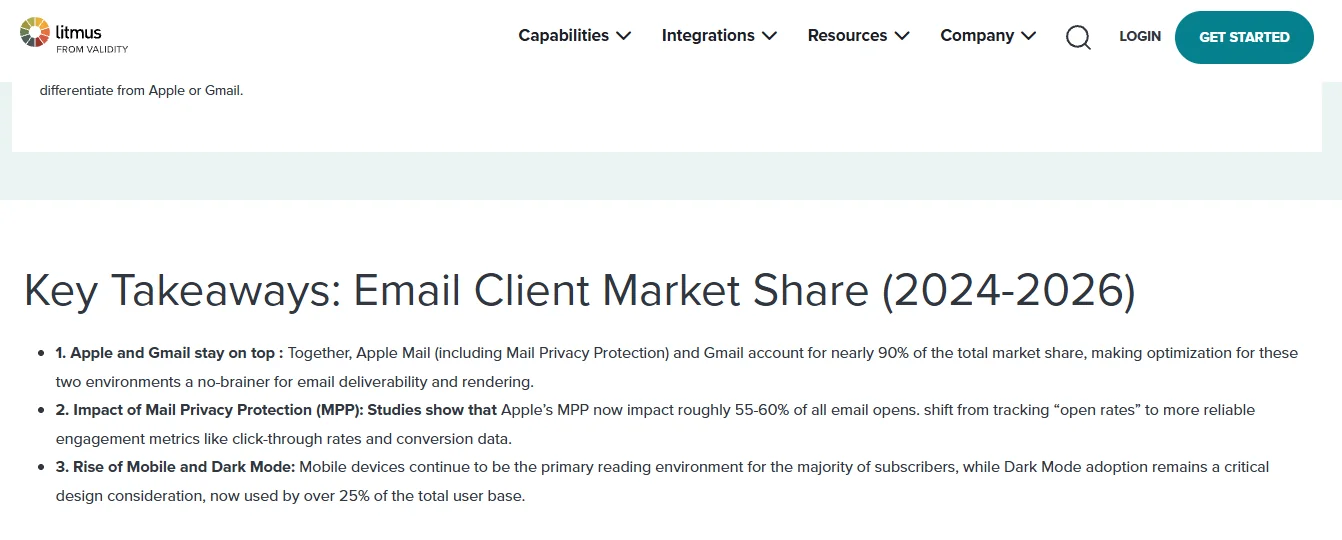
Be careful with email opens in particular. Litmus’s email client market share data, last updated in October 2026, estimates that Apple Mail Privacy Protection affects roughly 55–60% of all email opens, and says opens from users with it enabled are not considered reliable. That is email-industry data, not association data, but the advice is simple: count clicks, not opens.
3. Set a time window
Most associations use the last 12 months, which matches the renewal cycle. To keep the score current, count recent activity more. For example, actions older than six months can count at half value.
4. Define score ranges
Split scores into three simple ranges, such as 0 to 39 at risk, 40 to 69 active, and 70 to 100 highly engaged. Simple ranges are easier for staff to use than precise numbers.
5. Act on the results
A member engagement score is only useful if it changes what your team does. Decide in advance what happens in each range, then review the lists every month.
What does a sample member engagement scoring model look like?
Here is a starting model that adds up to 100 points. The weights are illustrative, not a research benchmark, so adjust the actions and points to fit your association.
| Category | Points | Maximum |
|---|---|---|
| Events | 6 points per event attended | 30 |
| Learning | 5 points per course or CE credit completed | 25 |
| Community and chapters | 2 points per post or reply, 4 for joining a group or chapter | 20 |
| Volunteering | 15 points for an active role (committee, mentor, speaker) | 15 |
| 1 point per email click | 10 | |
| Total | 100 |
Points stop at each category’s maximum, so one very busy area cannot hide silence everywhere else. A member who attends eight events still earns 30 event points, not 48.
Flag at-risk members before renewal. Use our free Member Risk Scoring Sheet to score your members and flag the ones who need a call before renewal. Download the scoring sheet
Worked example: how do you score one member?
Here is the sample model applied to one mid-career member over the last 12 months. The member and the numbers are illustrative. Two of her three events were more than six months ago, so they count at half value, as described in step 3.
| Category | Activity in the last 12 months | Points |
|---|---|---|
| Events | One recent event (6) and two older ones (3 each) | 12 |
| Learning | One course completed last month | 5 |
| Community and chapters | Four replies (2 each) and joined one group (4) | 12 |
| Volunteering | No active role | 0 |
| Seven email clicks | 7 | |
| Total | Score range: at risk | 36 |
Without the half-value rule, the same member would score 42 and sit in the active range. Counting recent activity more is what moves her onto the at-risk list while there is still time to call her.
Example: same dues, very different scores
Picture two members of a professional association who both pay the same dues on autopay. On paper, both look like safe renewals. This example is illustrative.
| Signal | Kenji | Elena |
|---|---|---|
| Events | None this year | Annual conference and three webinars |
| Learning | None | Two courses completed, with CE credits |
| Community and chapters | No activity | Regular replies in her specialty group |
| Volunteering | None | Mentors one early-career member |
| Engagement score | 8 (at risk) | 81 (highly engaged) |
Without a member engagement score, Kenji looks fine because his payment goes through automatically. With one, he shows up on the at-risk list nine months before renewal. The membership director calls him, learns he changed roles and no longer sees how the association fits, and invites him to a new practice group for his specialty. Elena, meanwhile, is a perfect candidate to invite onto a committee.
One number made both conversations possible.
What should you do with each score range?
| Score range | What it usually means | What to do |
|---|---|---|
| 0 to 39: At risk | Little or no participation | Personal call or email, a specific invitation tied to their interests |
| 40 to 69: Active | Some participation, room to grow | Suggest the next step: a course, a chapter, a group, or a small volunteer role |
| 70 to 100: Highly engaged | Regular, meaningful participation | Recognize them, ask for referrals, invite them to lead |
For members in the at-risk range, our guide on how to reduce membership churn lays out outreach that works. Each month, run the same short review:
- Pull the at-risk list and assign every name to a staff member.
- Call or email each at-risk member with one specific invitation, not a generic newsletter.
- Invite two or three highly engaged members to a committee, chapter or speaking role.
- Keep new members in a separate onboarding view until their first 90 days are up.
- Note what you did on the member record, so next month’s review starts from facts.
How do you know your member engagement score works?
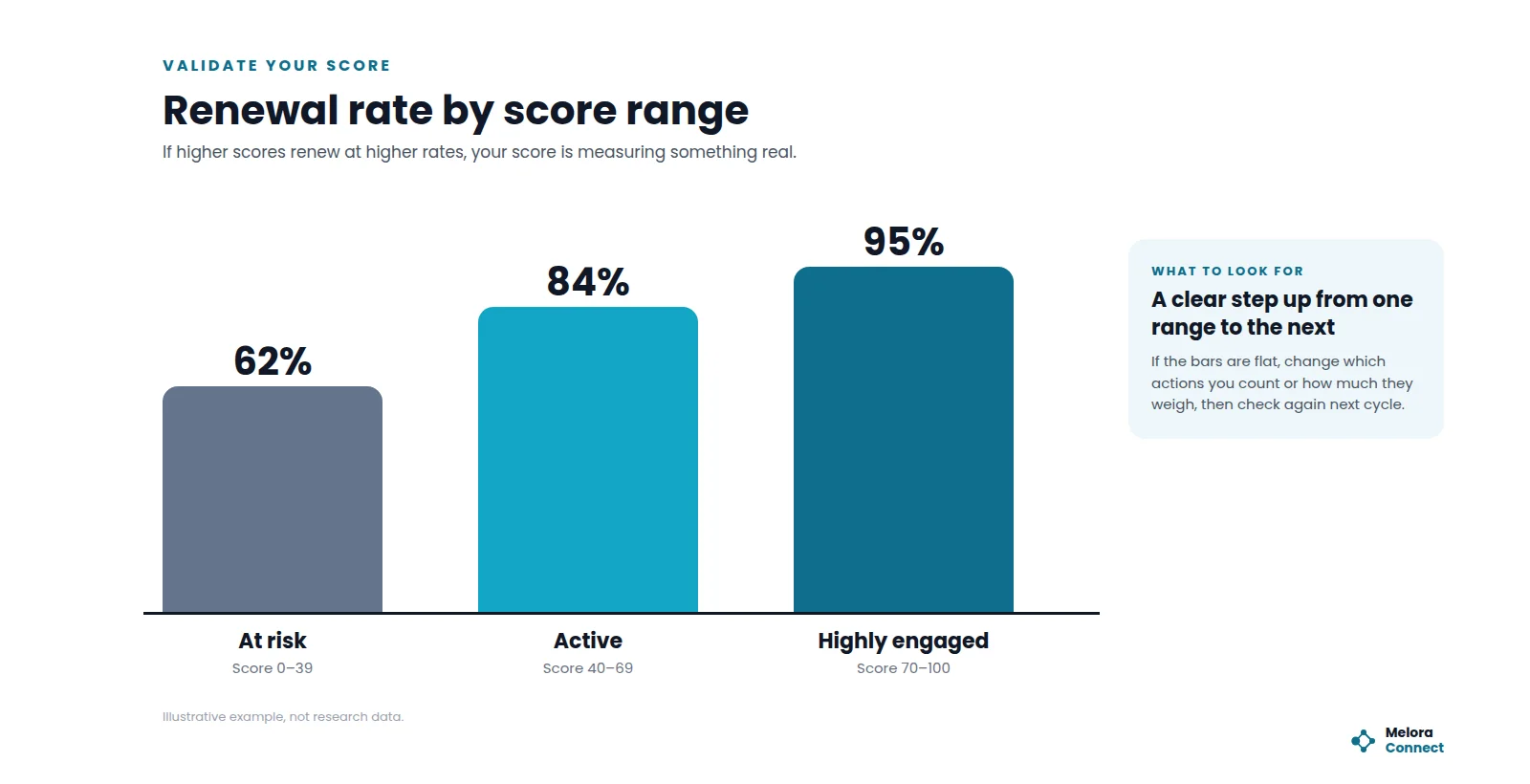
After one renewal cycle, compare renewal rates across your three score ranges. If highly engaged members renew at a clearly higher rate than at-risk members, your member engagement score is measuring something real. The chart above uses illustrative numbers, not research data. If your rates are similar, change which actions you count or how much each one weighs, and check again next cycle. This is the same check as renewal rate by engagement level in our guide to member engagement metrics.
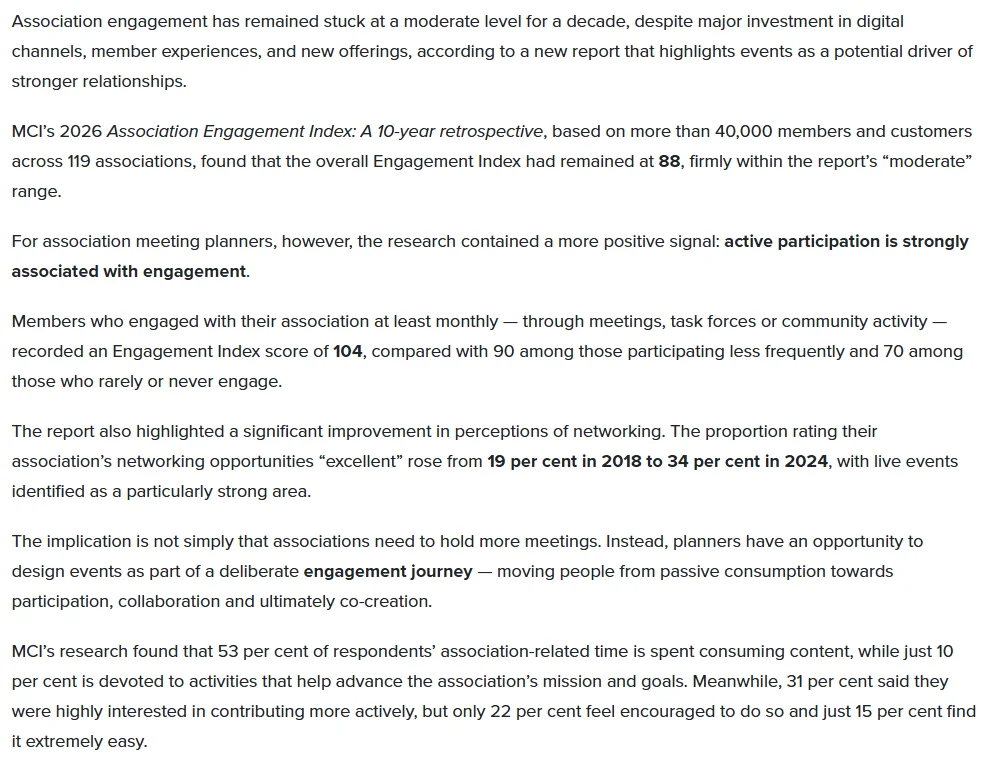
Association research points the same way. MCI’s 2026 Association Engagement Index, as reported by Association Meetings International, draws on more than 40,000 members and customers across 119 associations. Members who engaged at least monthly scored 104 on MCI’s Engagement Index, against 90 for less frequent participants and 70 for those who rarely or never engage. MCI’s index is survey-based, so it measures how members rate the relationship rather than the activity on their record, but it shows that frequent participation and a strong relationship go together.
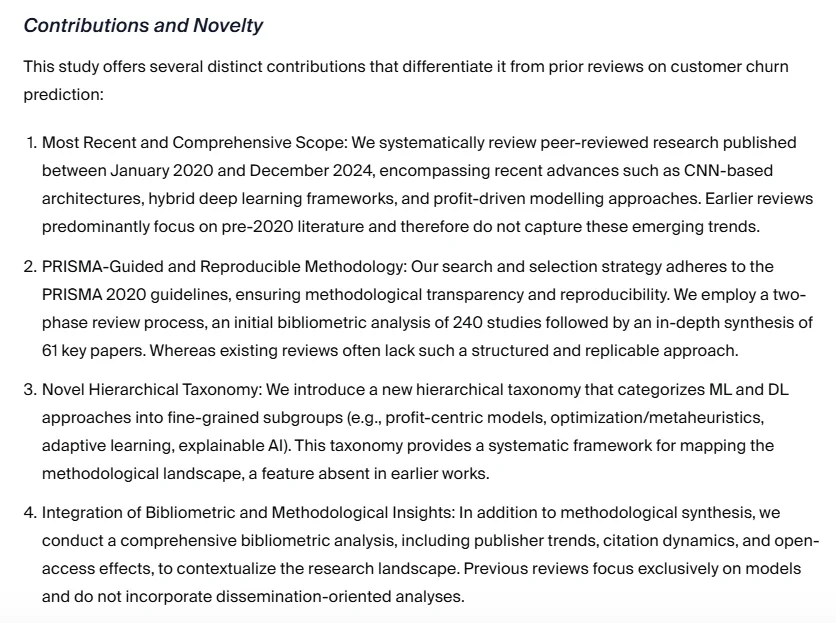
Outside associations, researchers use the same kind of activity data to predict who will leave. A 2025 systematic review in Machine Learning and Knowledge Extraction analyzed 240 churn prediction studies published from 2020 to 2024. One study it covers, from a weight-loss app, predicted dropout from daily login counts and identified 93% of churned users by day 7. That is consumer app data, not membership data, but it shows how much a simple activity signal can reveal.
Want to go further and estimate who is likely to lapse? Our guide to predictive analytics for member retention builds risk tiers and outreach timing on top of a score like this one.
How is a member engagement score different from other engagement measures?
A member engagement score works best alongside other measures, not instead of them. Here is what each one tells you.
| Measure | What it tells you | Limitation |
|---|---|---|
| Member engagement score | How actively each member participated, in one number | Only as good as the signals and weights you choose |
| Single metric (for example, event attendance) | Activity in one program | Misses members who engage in other ways |
| Member survey or satisfaction score | How members feel about the association | Answered by a sample, once or twice a year |
| Net Promoter Score (NPS) | How willing members are to recommend you | Says little about what a member actually does |
| Renewal rate | Whether members stayed | Arrives only after the decision is made |
Use the score for monthly action, and use surveys and renewal rates to check that it points the right way.
What are the most common member engagement score mistakes?
-
Weighting email opens too heavily. Privacy features make opens unreliable, and they say little about value. Count clicks.
-
Tracking too many signals. A score with 20 inputs is hard to explain and hard to trust.
-
Never checking the score against renewals. An unvalidated score is a guess with a number attached.
-
Scoring without acting. A list nobody calls does not keep anyone.
-
Judging new members too early. Give members who joined recently a separate onboarding view.
-
Treating the score as the whole story. Use it to start conversations, not to replace them.
How Melora Connect approaches member engagement scoring
A member engagement score is only as good as the data behind it. Melora Connect keeps one record per member, and event registrations and check-ins, payments, email, committees, surveys, referrals, chapters and CE credits all add to that record. Chapters and CE credits went live on October 27, 2026, so CE credits earned and chapter participation can now count toward a member’s score.
Engagement scoring is built in and works from the activity already on each member record, while smart segments surface new, at-risk and lapsed members. The admin dashboard shows organization health at a glance, you can export your data anytime to test your own weights, and the Monday morning briefing tells your team who needs attention this week. Each online event carries its own join link. Connect your Zoom account and Melora Connect creates the Zoom meeting for a virtual event, moves it when the time changes, and checks in the people who joined after the event. Committee meetings can get a Zoom meeting or a Google Meet link the same way.
Our team helps you decide which actions should count for your members and sets the score up around them during staffed onboarding, because you get a team, not a login.
See engagement scoring on your own members. Bring the actions that matter most to your members, and we will show how they roll up into one score and an at-risk list. Book a demo
Frequently asked questions about member engagement scores
What is a member engagement score?
A member engagement score is a single number, usually from 0 to 100, that summarizes how actively a member has participated in an association over a set period. It adds up weighted points for actions such as attending events, earning CE credits, volunteering and clicking emails, so staff can see who is thriving and who is drifting.
How do you calculate a member engagement score?
To calculate a member engagement score, choose four to six signals, assign points to each with a maximum per category, and add them up over the last 12 months. Count actions older than six months at half value, then group the totals into ranges such as at risk, active and highly engaged.
What is a good member engagement score?
A good member engagement score depends on your model, so there is no universal benchmark. In a 0 to 100 model, 70 or above is often treated as highly engaged. What matters is the comparison: members in your highest range should renew at clearly higher rates than members in your lowest range.
Which activities should count toward a member engagement score?
Count activities that take effort and relate to renewal: event attendance, courses and CE credits, committee or volunteer roles, chapter participation, and email clicks rather than opens. Start with four to six signals you already track reliably, and drop any signal that does not separate members who renew from members who lapse.
How often should you update a member engagement score?
Update a member engagement score at least monthly, using a rolling 12-month window, so it reflects recent activity and not last year’s conference. Review the at-risk list every month, and check the weights against actual renewal rates once a year, after each full renewal cycle, to confirm the score still predicts something real.
Can chambers of commerce use a member engagement score too?
Yes. Chambers of commerce can build a member engagement score the same way, weighting actions like event attendance, directory updates, referrals and committee work instead of courses. Keep it to a few signals, check it against renewals, and see our chamber member engagement guide for chamber-specific ideas.
The bottom line
A member engagement score does not replace knowing your members. It helps a small team know which members to call first. Build it simply, check it against renewals, and use it every month. The score is not the goal. The conversations it starts are.
Find the members who need you most. See engagement scoring, smart segments and the Monday morning briefing on one member record in Melora Connect. Book a demo
Sources
- Gallup, Global Engagement Falls for the Second Time Since 2009, Apr 22, 2025.
- Naylor Association Solutions (Association Adviser), 2025 Association Benchmarking Report: Engagement Gains, Revenue Pains, and the Road Ahead, Aug 4, 2025.
- Litmus, Email Client Market Share: Trends & Statistics 2026, Oct 16, 2026 (last updated).
- Association Meetings International (AMI), Association engagement has stalled. Are meetings the key to changing it? (reporting MCI’s 2026 Association Engagement Index), Sep 11, 2026.
- Imani, Joudaki, Beikmohammadi and Arabnia, Customer Churn Prediction: A Systematic Review of Recent Advances, Trends, and Challenges in Machine Learning and Deep Learning, Machine Learning and Knowledge Extraction 7(3), 105 (MDPI), Sep 21, 2025.