
 People · Events · Communities

Quick answer: Member engagement strategies are planned ways to help members take part more often and more deeply. The ones that work give new members a clear first step, segment messages, offer small roles, connect members to each other, use events to learn about members, close the feedback loop, and act on early warning signs before renewal.
Key takeaways
-
Measure a few engagement signals before trying to improve them.
-
New members are the most open to engagement and the easiest to lose.
-
Small, specific asks build belonging faster than open-ended committee seats.
-
Engagement needs one named owner and a monthly review.
Every association has the same wish: members who show up, take part, and renew because they want to. Yet many engagement efforts amount to more emails, a busier event calendar, and a hope that something sticks.
Effective member engagement strategies are more specific than that. They start from how members actually experience your organization, and they give each person a clear next step. This guide covers what member engagement is, how to measure it, eight strategies that work, and a simple way to turn them into a plan.
What is member engagement?
Member engagement is how actively members use, contribute to, and connect with your organization: attending events, reading and replying to communications, joining committees, using resources, and talking to other members.
Engagement is not the same as satisfaction. A member can be perfectly content and still never show up. What matters is whether members take actions that show they find value, because those actions are what you can influence.
Think of it as a ladder. Members move from attending, to participating, to contributing, and sometimes to leading. Your job is to make each step easy to take.
Why do member engagement strategies matter?
Renewal is a verdict on the whole membership year. Members who experienced value tend to renew, and members who did not tend to drift away quietly, often without telling anyone why.
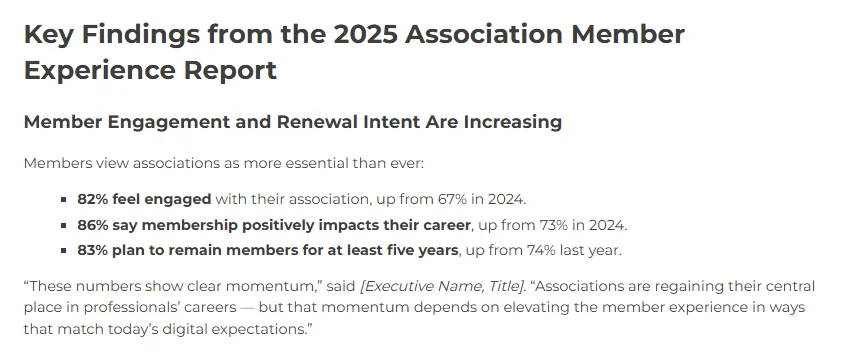
Engagement is how value becomes visible, and members notice it. Higher Logic’s 2025 Association Member Experience Report found that 82% of members feel engaged with their association, up from 67% in 2024, and 83% plan to stay members for at least five years. Those are averages across many associations; your own numbers are what count.
Engagement also gives you early warning: a drop in activity usually appears well before a lapsed renewal. For more on catching that early, see our guide on how to reduce membership churn. Keeping an engaged member is usually easier than replacing one, and our guide to member retention vs. member engagement explains how the two differ.
What is the mid-year engagement gap?
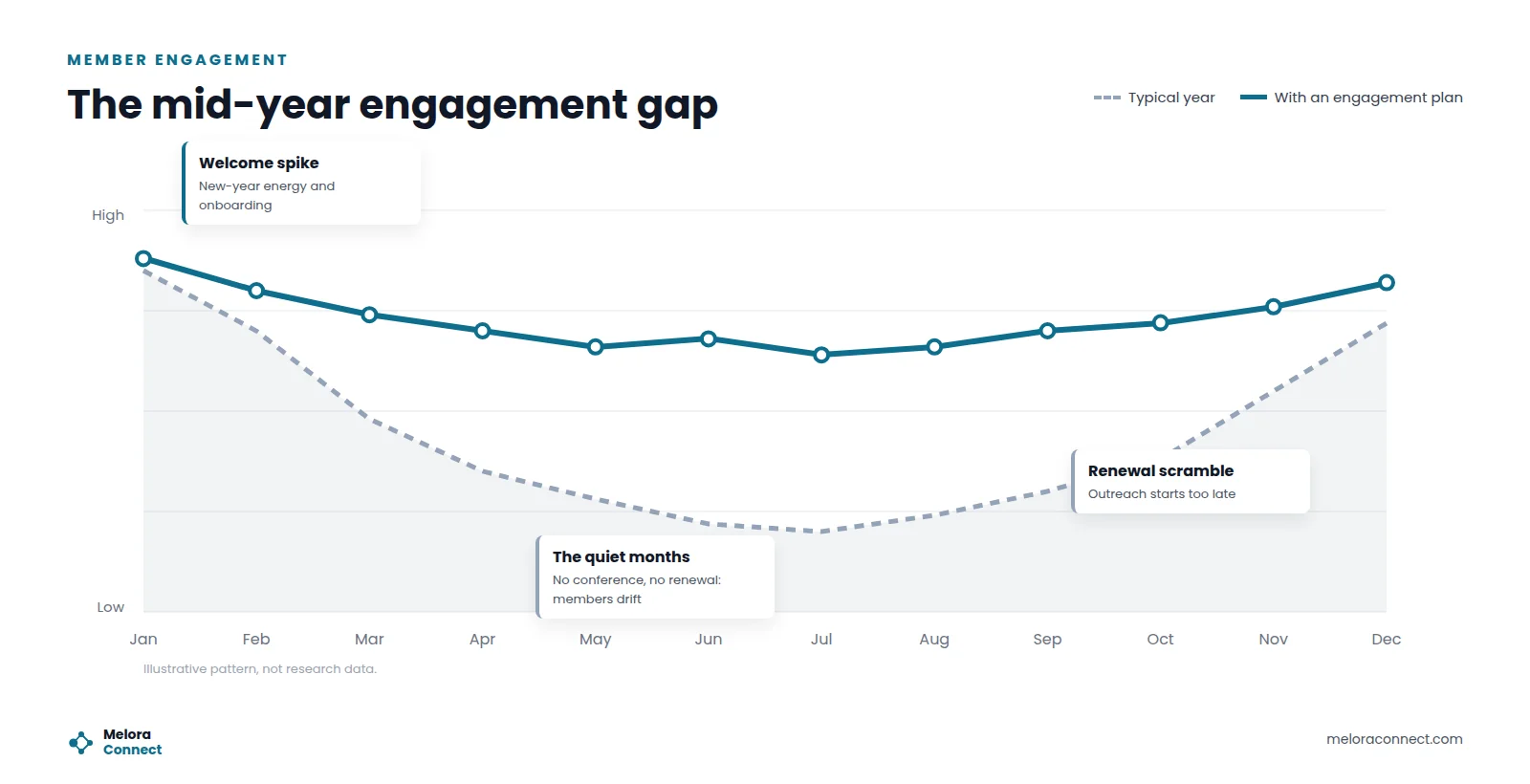
The mid-year engagement gap is the drop in member activity between joining or the annual conference and the renewal notice. Engagement is high when members join and around the big event, then falls during the quiet months, and renewal outreach starts too late to bring members back. The chart above is illustrative. An engagement plan keeps a steady rhythm of small, valuable touchpoints through the whole year, and the strategies below are built to fill those quiet months.
How do you measure member engagement?
You cannot improve what you cannot see. Start by choosing a few signals that show whether members are taking part:
| Signal | What it tells you | Watch for |
|---|---|---|
| Event attendance | Whether members find programs worth their time | Members who stop registering |
| Email activity | Whether messages are relevant | Months of unopened emails |
| Portal or directory use | Whether members use self-service tools | Profiles never completed |
| Committee, chapter and volunteer roles | Depth of commitment | Roles with no new faces |
| Time to first engagement | How quickly new members get started | Long gaps after joining |
| Renewal rate | Overall health of the relationship | A wide gap for first-year members |
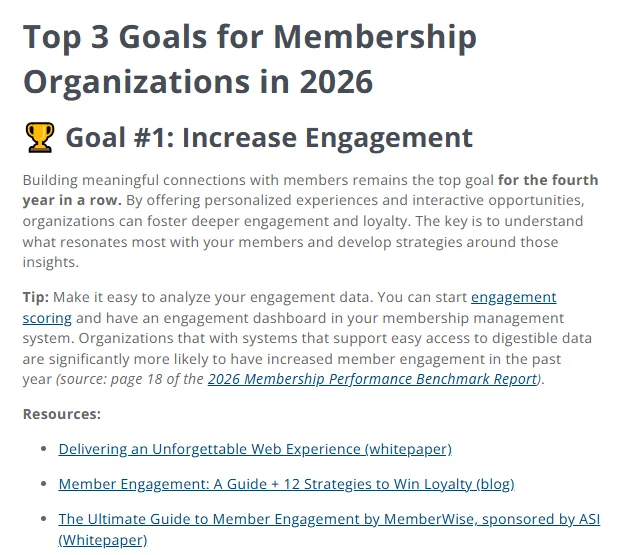
Easy access to these numbers matters as much as the numbers themselves. In the iMIS 2026 Membership Performance Benchmark Report, increasing engagement was the top goal for the fourth year in a row, and organizations whose systems make data easy to access were significantly more likely to have increased engagement.
Compare these with your own history first. Our guide to member engagement metrics gives the formula for each one and the three to start with. To roll these signals into one number per member, use a member engagement score; that guide covers the weights and score ranges.
8 member engagement strategies that actually work
The eight member engagement strategies below are: give new members a clear first step, segment before you send, give members something to do, connect members to each other, connect generations through mentoring, make events do more work, close the feedback loop, and act on early warning signs.
1. Give new members a clear first step
New members are the most open to engagement and the easiest to lose, so give each one a clear first step, such as a recommended event or a personal introduction, in their first month. Our guide on how to improve membership management lays out the full 90-day onboarding plan.
2. Segment before you send
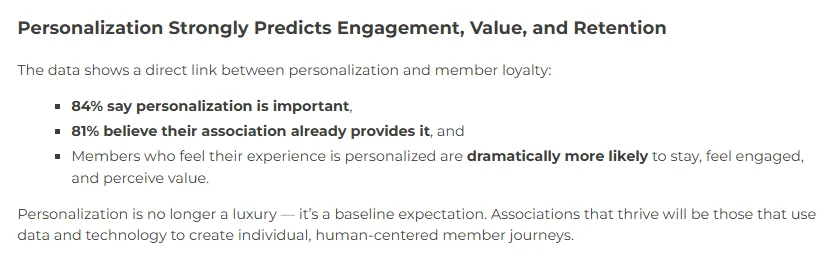
One message to everyone feels like noise to most people. Group members by type, interest, career stage, chapter and activity level, then tailor what you send. A first-year member and a long-time volunteer need different messages, and a simple segment is enough to start. Members expect it: in the same Higher Logic report, 84% of members said personalization is important.
3. Give members something to do
Attending is passive. Contributing builds belonging. Offer small, specific roles: greet newcomers at an event, share a short tip, join a one-off working group. Small asks with clear endpoints are easier to say yes to than open-ended committee seats.
4. Connect members to each other
Members often stay for the people, not the programs. Make introductions deliberately. Match newcomers with established members, build peer groups around shared interests or local chapters, and keep your directory current so members can find each other without asking staff. Even a quarterly coffee hour for new members can do more than another newsletter.
5. Connect generations through mentoring
Mentoring programs engage both sides: newer members get guidance, and experienced members feel valued for what they know. Members rank it highly too; mentoring opportunities were among the benefits members valued most in Higher Logic’s 2025 report. Keep matches simple, agree on how often to meet, and check in after the first meeting.
6. Make events do more work
An event is a chance to learn about members, not just to host them. Before an event, tell people who else will be there. During it, make introductions easy. Afterward, follow up with a relevant next step and record who came, because attendance is some of the best engagement data you have. If your sessions carry continuing education (CE) credits, record those on the member’s record too: credits earned are a strong reason to stay. Our event management software guide explains what to look for if registrations still live in a separate tool.
7. Ask, listen, and close the loop
Short surveys and personal conversations show what members value and what they are missing. The part most organizations skip is closing the loop. When you act on feedback, tell members what you changed. That shows their input mattered and makes them more likely to give it again.
8. Act on early warning signs
Disengagement is gradual: fewer registrations, unopened emails, an overdue invoice. Decide in advance what counts as a warning sign and what your team does about it. A personal message from a real person, sent while there is still time, works better than a generic reminder after the fact. Write the triggers down so nobody has to rely on memory. Our guide on how to identify members at risk of churning lists the most common signs.
Free tool: Member Risk Scoring Sheet. Rank members by warning signs and see who to call first this month. Open the Member Risk Scoring Sheet
Which strategy should you use for which member?
Not every member needs the same approach. Use this table to match strategy to situation:
| Member type | Goal | Strategy to lead with |
|---|---|---|
| New member | Build a first habit | Onboarding sequence and a recommended first event |
| Occasionally engaged | Show unused value | Segmented messages about benefits they have not tried |
| Highly engaged | Deepen commitment | Small leadership roles, mentoring, thank-yous |
| Inactive | Reopen the conversation | Personal outreach well before renewal |
Running a chamber of commerce? Business owners judge membership by what it does for their company, so our guide to chamber of commerce member engagement adapts these ideas for them.
Example: turning an event regular into a contributor
Picture a state society of civil engineers. One member, a senior bridge engineer, has attended almost every monthly technical session for three years. He always stays for questions, but he has never volunteered, and nobody has asked him to.
Because the society tracks engagement, the pattern stands out: high attendance, no contribution. The program chair asks him to help lead one short session on a topic he clearly knows well, a small ask with a clear end. Afterward, staff thank him by name in the newsletter and introduce him to two newer members who asked about the same topic. A year later, he leads the program working group and has brought two colleagues into the society.
This is an illustration, not a client case. The point is that engagement work is not only about rescuing quiet members. A small, specific role, public thanks, and a deliberate introduction moved a loyal attendee up the ladder.
Common member engagement mistakes
-
Measuring only attendance. It is one signal among several, and not every valuable member attends events.
-
Sending more instead of better. Extra messages without relevance train members to ignore you.
-
Treating all members alike. A single campaign rarely suits new, active, and inactive members at once.
-
Waiting for renewal season. By then it is too late to change how the year felt.
-
Launching everything at once. Pick two or three strategies and do them well.
How do you build an engagement plan in one afternoon?
You do not need a long document. Work through four decisions:
-
Pick one segment and one goal. For example, new members attending a first event within 30 days.
-
Choose two strategies. Match them to the segment using the table above.
-
Assign an owner and a date. Every action needs one named person.
-
Choose one metric. Review it monthly and adjust. Our guide on how to build a member journey map can help you see where each segment gets stuck.
Not ready for a full plan? Start this month: send a personal welcome note to every new member, call five members who have not attended an event this year, add a recommended first event to your welcome email, thank three volunteers by name in your next newsletter, and ask one question in your newsletter, then share what you learn.
Who owns member engagement?
Engagement fails when it belongs to everyone and therefore no one. Name a single owner, often the membership director or manager, and give them a standing monthly conversation with events, communications, and finance. Events knows who attends, communications knows who reads, and finance knows who is behind on dues. Engagement is much clearer when those three views sit in the same meeting.
Where technology helps
You can start these strategies with a spreadsheet and a calendar. They get harder as you grow, because the signals that show who is engaged live in different tools: registrations in one, email in another, payments in a third. AI is starting to help with that too, and our guide to AI for member engagement covers what is practical today.
When those signals share one member record, your team can see who is going quiet, which events draw participation, and who is due a personal note. Melora Connect is built that way: one record per member, smart segments for new, at-risk, and lapsed members, and engagement scoring alongside committees, surveys, referrals, and segmented email. Chapters and CE credits are live, and online events connect to Zoom, so local activity, credits earned and virtual attendance all land on the same record. Our team helps you set up and run it, because you get a team, not a login.
See engagement signals in one place. Bring one member segment, and we will show you its engagement signals, segments and scores on one record. Book a demo
Frequently asked questions about member engagement strategies
What are member engagement strategies?
Member engagement strategies are planned ways to help members take part more often and more deeply, such as onboarding, segmentation, small volunteer roles, introductions, mentoring, event follow-up, feedback loops and early outreach. The best ones give each member a clear next step.
What is member engagement?
Member engagement is how actively members use, contribute to, and connect with your organization, from attending events and opening emails to joining committees and talking to other members. It differs from satisfaction: a satisfied member can still be inactive.
How do you measure member engagement?
Pick a few signals: event attendance, email activity, portal or directory use, committee and volunteer roles, time to first engagement, and renewal rate. Compare them with your own history, then combine them into a member engagement score once the signals sit on one record.
What is the fastest way to improve engagement?
Start with new members. A personal welcome and one recommended first event tend to show results within a few months, because new members are the most open to taking part and the easiest to lose.
Who should own member engagement?
One named person, usually the membership director or manager, with a standing monthly conversation with events, communications and finance. Each of those teams sees a different part of engagement, and the owner brings the views together.
Do small associations need engagement software?
Not to start. A spreadsheet and a calendar are enough for the first strategies. Software starts to pay off when engagement signals are spread across several tools and nobody can see them together.
The bottom line
Member engagement grows from small, specific steps, repeated all year. Pick one segment, give those members a clear next step, and watch whether they take it. The strategies that work are the ones your team can keep doing in the quiet months, not only at renewal time.
Make the quiet months count. See how Melora Connect brings events, email, chapters and CE credits onto one member record. Book a demo
Sources
-
Higher Logic, Higher Logic Releases 2025 Association Member Experience Report: Understand the New Standard for Members, December 4, 2025.
-
iMIS, Top 3 Goals and Challenges for Membership Organizations in 2026, January 15, 2026.