
 People · Events · Communities

Most associations do not need a reinvention. They need fewer things falling through the cracks: the new member nobody welcomed, the renewal reminder that went out late, the loyal member who quietly stopped coming and lapsed before anyone noticed.
This guide covers ten practical strategies to improve membership management, ordered roughly the way a member experiences your organization: joining, onboarding, engaging, renewing. Each one includes a first step you can take this month, and at the end you will find a self-assessment, a 90-day plan, six policies worth writing down, and a 12-month calendar.
Before you start: find where your hours go
Spend one week logging how your team’s membership time is actually spent. Use five buckets: data entry and updates, payments and invoices, renewals and reminders, member questions, and reporting. Most teams are surprised by the result. The work that feels like “managing members” is often mostly moving data between tools.
Keep that log. It tells you which of the strategies below will free up the most time first.
10 strategies to improve membership management
1. Put every member in one record
When member details live in one spreadsheet, payments in another tool, and event attendance in a third, nobody can see the full relationship. Every other strategy on this list depends on fixing that.
First step: pick one system as the source of truth for member records. Merge duplicates, archive records nobody has touched in years, and agree that every update happens there, not in a side file. If that system is still a spreadsheet, here is how to replace membership spreadsheets.
Moving records into a new system? Our free membership data migration workbook helps you map every field before you import.
2. Make joining take less than three minutes
Every extra form field, unclear membership tier, or manual approval step costs you members you will never know you lost.
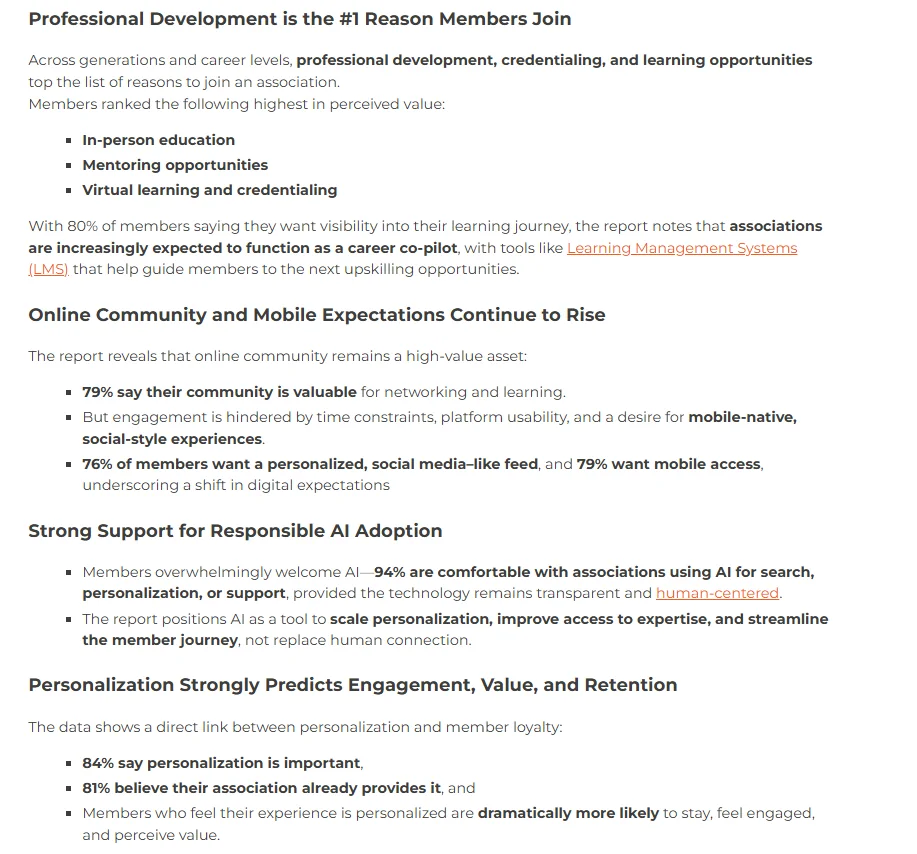
Most of those joiners are on a phone. In Higher Logic’s 2025 Association Member Experience Report, a survey of 552 association members and nonmembers, 79% said they want mobile access.
First step: join your own association on your phone, as a stranger would. Time it. Remove every field you do not use, combine tiers that confuse people, and make sure payment happens in the same flow. Our association website best practices cover the join and renewal pages in more detail.
3. Build a 90-day onboarding plan
New members are the most likely to leave. In the MGI 2026 Membership Marketing Benchmarking Report, the median renewal rate for first-year members was 72%, compared with 82% overall. The first 90 days are where you close that gap.
| When | What happens |
|---|---|
| Day 1 | Welcome email from a real person, with one clear next step |
| Week 1 | Prompt to complete their profile and join the member directory |
| Week 2 | Invitation to one specific upcoming event that fits their interests |
| Month 1 | Personal introduction to one or two members in their field or area |
| Month 2 | Highlight one benefit they have not used yet |
| Day 90 | Quick check-in: “Is membership giving you what you hoped?” |
First step: write the six messages above once, then automate the timing.
Short on time to write them? Our free AI prompt library for associations can help you draft them faster, in your own voice.
4. Define what engagement means for you
“Engagement” means different things to different organizations. For a chamber, it might be event attendance and directory use. For a professional society, it might be education credits and committee work.
First step: pick three to five actions that genuinely signal value for your members, such as attending an event, opening the newsletter, using a benefit, or volunteering. Track those, and only those. A simple count (for example, “three or more actions this year”) is enough to start. When you are ready for more, a member engagement score weights each action by how much it predicts renewal.
5. Stop sending every message to everyone
When every member receives every email, members learn to ignore all of them. Segmentation is the fastest way to make communication feel personal without writing more of it.
Members expect it: in the same Higher Logic report, 84% said personalization is important.
First step: create four segments: new members (first year), highly engaged, occasionally engaged, and inactive. Then ask before every send: which of these four actually needs this?
6. Treat events as membership, not a side program
Events are often the most visible member benefit, yet attendance data frequently lives in a separate ticketing tool. When event participation sits on the member record, it becomes your clearest engagement signal. Our guide to event management software covers how to connect the two.
First step: after your next event, record attendance on each member’s profile and send a personal follow-up to every first-time attendee.
7. Make member value visible
Members get value; they do not always see it. In Higher Logic’s 2025 Association Member Experience Report, 86% of members said membership has a positive effect on their career, yet 28% of nonmembers said they do not see enough return on investment. And over a year, members forget what they have received.
First step: send each member a short personal recap before their renewal, such as “Your year with us”: events attended, resources used, connections made, discounts saved. Even a simple version reminds members why they joined.
Example: “Your year with us.” Hi Priya, here is your year as a member: 4 events attended, 2 new client introductions, $180 saved on event registrations, and 6 resources downloaded. Thanks for being part of the community. Your renewal is coming up on March 1.
8. Start renewals 90 days out, and segment them
A single reminder the week dues expire treats renewal as a bill. Treat it as the end of a year-long relationship instead:
| Days before renewal | Highly engaged | Occasionally engaged | Inactive |
|---|---|---|---|
| 90 | Value recap | Value recap plus one unused benefit | Personal call or email from staff |
| 60 | Early renewal invitation | Event invitation | Invitation to a small, relevant event |
| 30 | One-click renewal reminder | Renewal reminder with benefits | Renewal reminder plus personal note |
| 0 to 30 after | Grace reminder | Grace reminder | Win-back sequence (strategy 9) |
First step: move your first renewal touchpoint to 90 days out, and make the inactive segment a personal outreach list, not an automated one. For the full workflow and copy-ready emails, see how to automate membership renewals.
9. Win back lapsed members
A lapsed member is not necessarily a lost one. They may have changed jobs, gotten busy, or simply missed the reminder.
First step: in the 30 to 60 days after a membership lapses, send a short, honest message asking what happened, with an easy way to rejoin. Log every answer you get. The reasons are some of the most useful feedback you will ever collect. Our guide on how to reduce membership churn covers the rest of the retention picture.
10. Automate the busywork and review monthly
Invoices, receipts, payment retries, renewal reminders, and welcome emails should run on their own. Most membership management software handles this; the hours you get back go into strategies 3, 7, and 9, which need a human touch.
First step: set a 30-minute monthly review of three numbers: new members, renewal rate, and first-year renewal rate. Ask one question each time: what will we do differently next month? Our guide to member engagement metrics has the formulas.
To share those numbers with your board, use our free board report template.
Where to start: impact vs. effort
You do not need to do all ten at once. Here is how they typically compare:
| Strategy | Impact | Effort | Start when |
|---|---|---|---|
| 1. One member record | High | Medium | First, if data is scattered |
| 2. Three-minute joining | Medium | Low | This month |
| 3. 90-day onboarding | High | Low | This month |
| 4. Define engagement | High | Low | This month |
| 5. Segment messages | Medium | Low | After strategy 4 |
| 6. Events as membership | High | Medium | Before your next event |
| 7. Member value recap | High | Medium | Before your next renewal cycle |
| 8. 90-day renewals | High | Medium | Next renewal cycle |
| 9. Win-back | Medium | Low | Anytime |
| 10. Automate and review | High | Medium | Alongside strategy 1 |
Quick wins: strategies 2, 3, 4, and 9 are low effort and can start this month with the tools you already have.
Self-assessment: score your membership management
Score each statement: 0 = not yet, 1 = partly, 2 = yes.
- All member information lives in one system everyone uses.
- A new member can join and pay on a phone in under three minutes.
- Every new member gets a planned onboarding sequence.
- We have defined what engagement means for us and we track it.
- Our emails go to segments, not the whole list.
- Event attendance appears on each member’s record.
- Members get a reminder of the value they received before renewing.
- Renewal outreach starts at least 90 days out and differs by engagement.
- We contact lapsed members and record why they left.
- We review renewal and first-year renewal rates every month.
0 to 7: focus on strategies 1 and 3 first; they unlock everything else. 8 to 14: you have the foundations; work on renewals, value recaps, and segmentation. 15 to 20: you are ahead of most associations; keep refining and measuring.
Want to know which members to call first? Use our free member risk scoring sheet to flag members at risk before renewal, then rerun this self-assessment every quarter. Open the member risk scoring sheet
Your 90-day action plan
| Timeframe | Focus | Done when |
|---|---|---|
| Days 1 to 30 | Log your team’s hours; consolidate member records; shorten the join form | One source of truth, and a join flow under three minutes |
| Days 31 to 60 | Write and launch the 90-day onboarding sequence; define engagement; create four segments | Every new member is in onboarding; engagement is tracked |
| Days 61 to 90 | Build the 90-day renewal sequence and win-back message; start the monthly review | Next renewal cycle is planned; first monthly review held |
Write it down: 6 membership policies every association needs
Many membership problems are really policy problems: staff decide case by case, members get different answers, and nobody remembers what was agreed. Writing these six down alongside your 90-day plan, and having your board approve them, saves hours of debate later.
| Policy | What it should answer |
|---|---|
| Membership categories and eligibility | Who can join each tier, what it costs, what is included, and whether eligibility is checked |
| Renewal and grace period | Anniversary or calendar-year renewals, when reminders start, how long the grace period lasts, when access ends |
| Refunds and transfers | Whether dues are refundable, prorated, or transferable to a colleague |
| Payment and late fees | Accepted payment methods, invoice terms, and whether late fees apply |
| Data privacy and communications | What data you collect, who can see it, how members opt out, and how you handle requests to view or delete data |
| Member conduct and removal | Expected conduct at events and online, and the process if membership must be suspended |
Publish the member-facing parts on your website and link them from your join form. It builds trust and cuts down on emails to staff.
This is general guidance, not legal advice. Have policies that touch on privacy or contracts reviewed by someone qualified in your jurisdiction.
A 12-month membership management calendar
The 90-day plan gets the strategies started. This calendar keeps them running, because recurring tasks are easier to keep up with when they have a fixed place in the year. Adapt it to your fiscal year and renewal model.
| Month | Membership tasks |
|---|---|
| January | Set this year’s membership goals; review last year’s renewal and churn numbers |
| February | Clean member data (quarterly); audit tiers and pricing |
| March | Review onboarding sequence; check first-year renewal results |
| April | Member survey: what is valuable, what is missing |
| May | Clean member data (quarterly); review staff and volunteer access |
| June | Mid-year board report; adjust events calendar based on attendance |
| July | Refresh join page and benefits list; test joining on a phone |
| August | Clean member data (quarterly); plan value recaps for upcoming renewals |
| September | Review renewal emails and win-back sequence; update templates |
| October | Recruitment push; review lapsed-member survey answers |
| November | Clean member data (quarterly); review policies with the board |
| December | Thank-you message to all members; year-in-review report |
Every month: the 30-minute review from strategy 10. If you use calendar-year renewals, move the renewal tasks to the 90 days before your renewal date.
How Melora Connect helps
Most of these strategies get much easier when member records, payments, events, and communications live in one place. That is what Melora Connect is built for.
Every member has one record, and smart segments sort new, at-risk, and lapsed members on their own, which covers much of strategies 1, 5, and 9. Renewals, reminders, and invoice runs are automated, with saved card autopay and MeloraPay card and ACH payments into your own Stripe account. Event registrations and check-ins land on the member’s profile, engagement scoring shows who is drifting, and the Monday morning briefing puts it in front of your team each week.
And because you get a team, not a login, we help you set up the pieces that take the most thought, like membership tiers, onboarding emails, and renewal timing, around how your organization actually works.
Want a second pair of eyes? Bring your scorecard to a call and we will suggest where to start, whether or not you use Melora Connect. Book a demo
Frequently asked questions
How can associations improve membership management?
Start by centralizing member data, simplifying joining, and building a structured onboarding plan for new members. Then define and track engagement, segment communications, start renewals earlier, and automate routine admin work.
What is the most important membership management strategy?
For most associations, onboarding new members well. First-year members renew at noticeably lower rates than long-standing members, so the first 90 days have an outsized effect on retention.
What membership policies should an association have?
At minimum: membership categories and eligibility, renewal and grace period, refunds and transfers, payments and late fees, data privacy and communications, and member conduct. Have your board approve them and publish the member-facing parts.
Do you need software to improve membership management?
Not to start. Several strategies, like onboarding emails and defining engagement, work with any tools. But keeping everything connected and automated is much easier with membership management software as you grow.
The bottom line
Better membership management is not one big project. It is a set of small habits: one member record, a fast way to join, a warm first 90 days, a clear picture of who is engaged, and renewal conversations that start long before the invoice.
Pick two quick wins this month, write down your policies, put the calendar on the wall, run the self-assessment again in 90 days, and keep going. Your members will feel the difference before your renewal numbers show it.