

Membership management sounds simple: keep a list, collect dues, send renewal reminders.
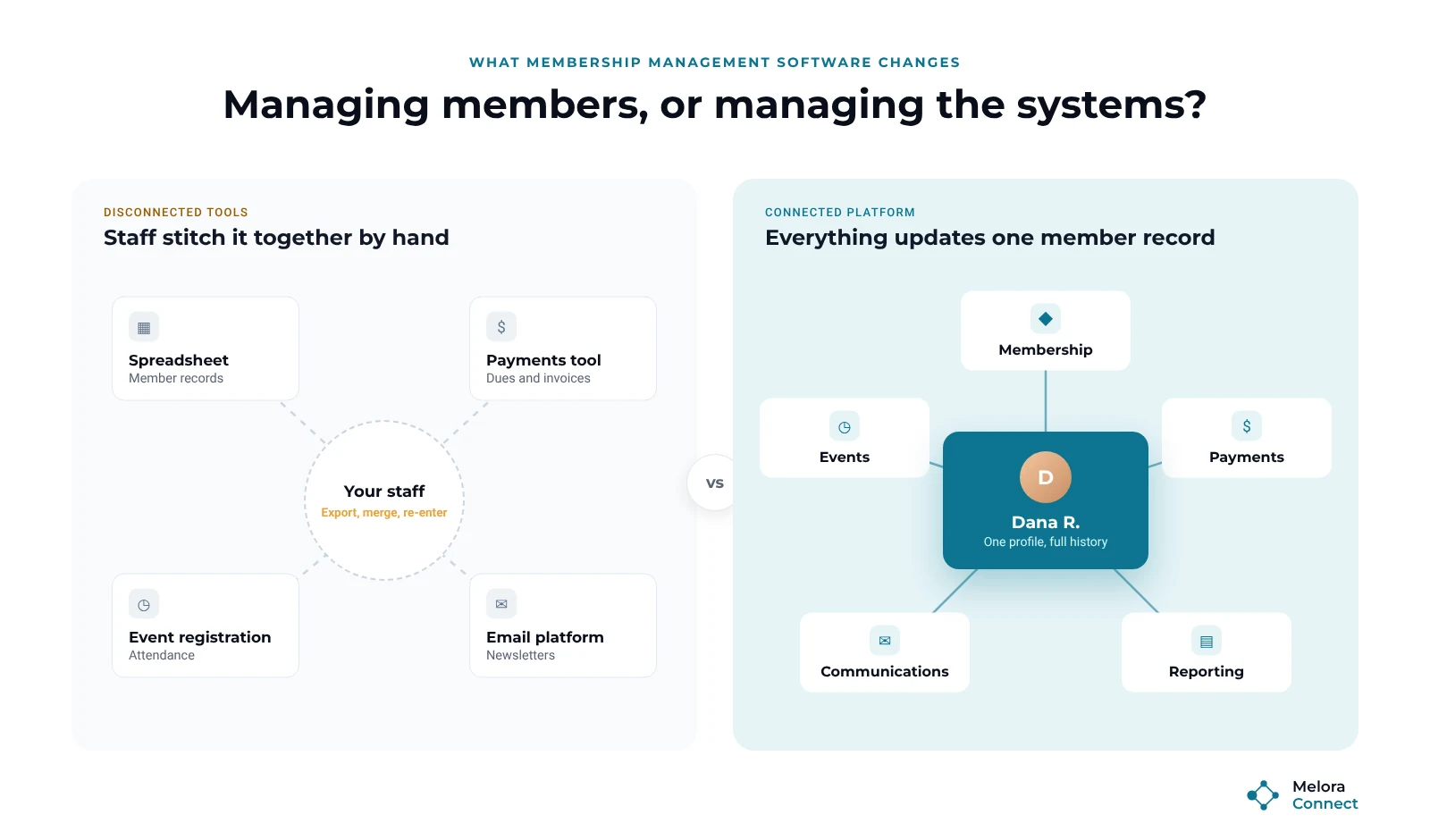
Then the association grows. Member records live in a spreadsheet, payments in another tool, event registrations in a third, and email in a fourth. Before long, your staff is not managing members anymore. They are managing the systems that manage the members.
This guide explains what membership management actually covers, how the member lifecycle works, which software features matter, and the three metrics worth tracking first. It is written for associations, chambers of commerce, professional societies, and any organization that runs on membership.
What is membership management?
Membership management is the process of attracting, onboarding, engaging, renewing, and retaining members throughout their relationship with an organization. For associations, it typically covers member records, applications, dues and payments, communications, events, renewals, and reporting.
The key word is relationship. A member list tells you who belongs. Membership management tells you how each person is experiencing their membership, and what your team should do about it.
Why membership management matters
Most associations do not have a value problem. In the MGI 2023 Membership Marketing Benchmarking Report, the median renewal rate was 85%, and respondents said their bigger challenge was communicating the value they deliver, not creating it.
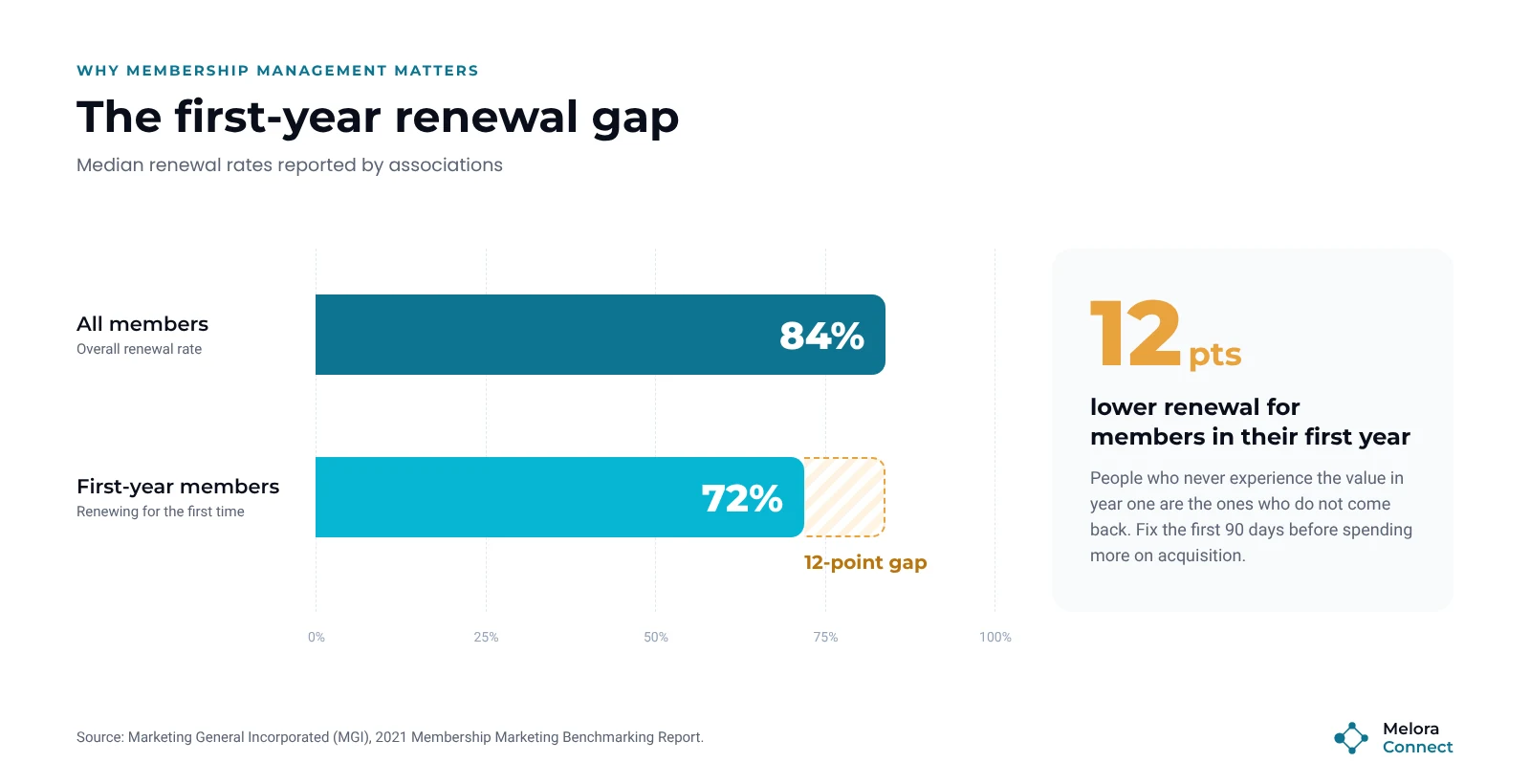
The gap is widest with new members. In MGI’s 2021 report, the median renewal rate for first-year members was 72%, compared with 84% overall. People who never experience the value in year one are the ones who do not come back.
Good membership management closes that gap by making value visible at every stage, not just on the renewal invoice.
The 7 stages of the membership lifecycle
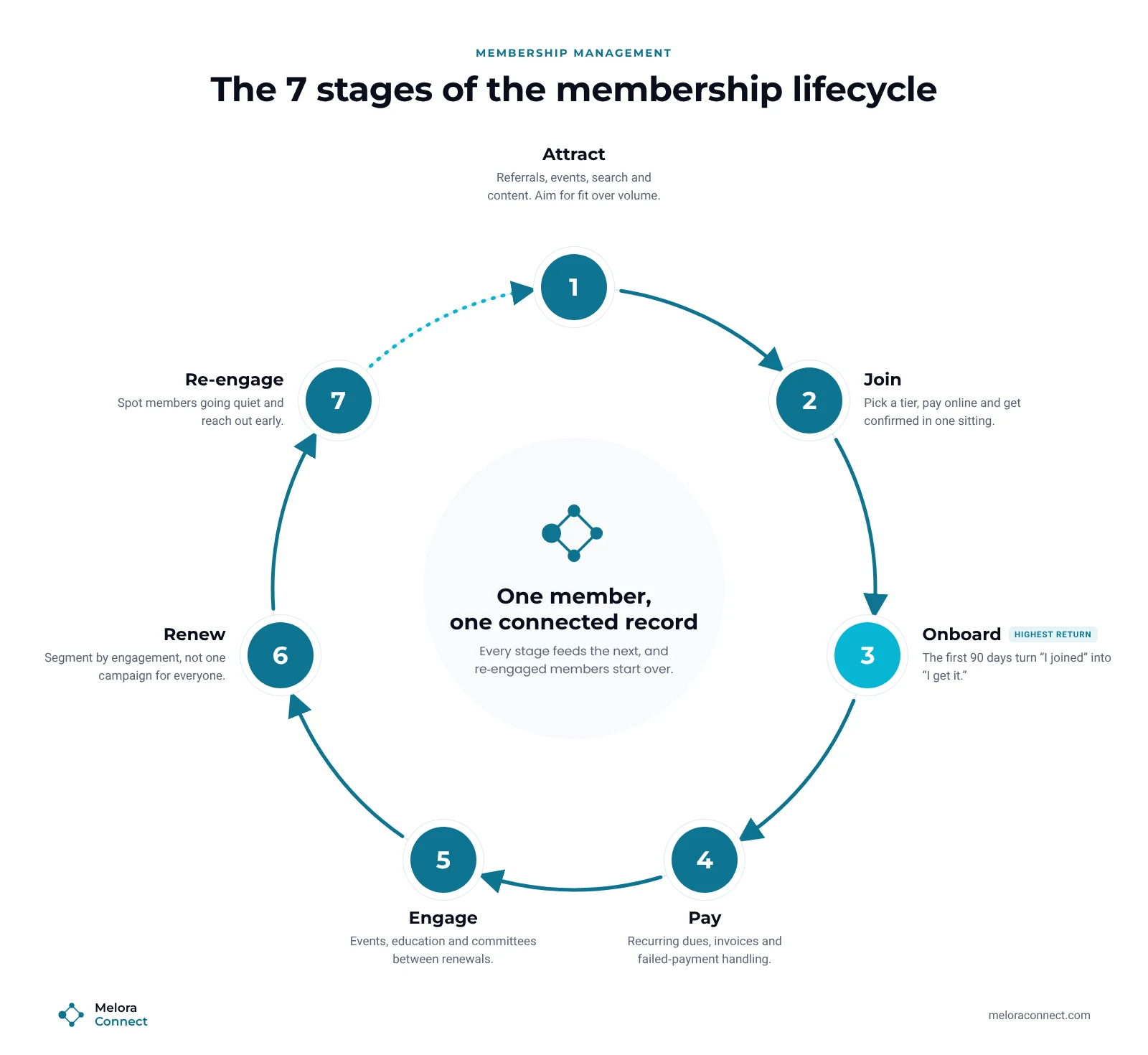
Attract → Join → Onboard → Pay → Engage → Renew → Re-engage
1. Attract
Membership management starts before anyone joins. Referrals, events, search, social media, partnerships, and educational content all bring in prospects. Aim for fit over volume: the people who find real value are the people who renew.
2. Join
Every extra form field, confusing tier, or manual approval step is a chance for a prospect to give up. A strong joining flow lets someone choose a membership type, pay online, and get confirmation in one sitting, while staff handle approvals from a single queue instead of an inbox.
3. Onboard: the first 90 days
Joining is the start of the relationship, not the end of the sale. The first 90 days decide whether a new member moves from “I joined” to “I get why this is worth it.”
Practical onboarding includes a short welcome sequence, a nudge to complete their profile, one recommended event, and a personal introduction to one or two other members. Given the first-year renewal gap above, this is the stage with the highest return on effort.
4. Pay: dues and payments
Invoices, recurring billing, tiered pricing, failed payments, and receipts all live here. The test is simple: when someone asks “who still has not paid?”, your team should be able to answer in seconds, not after an afternoon of reconciliation.
5. Engage: between renewals
Members need reasons to show up between renewal dates: events, education, committees, advocacy, mentoring, directories, and exclusive resources.
An association that only contacts members when dues are due is reminding them about a bill. One that delivers value all year is reminding them why they joined.
6. Renew
Renewal is a verdict on the whole membership year, which is why one renewal campaign for everyone rarely works. Segment by engagement instead:
| Engagement level | Renewal approach |
|---|---|
| Highly engaged | Make renewal one click, and say thank you. |
| Occasionally engaged | Highlight the specific benefits they have not used yet. |
| Inactive | Start personal re-engagement outreach 60 to 90 days before renewal. |
7. Re-engage
An inactive member is not necessarily a lost member. They may have changed jobs, gotten busy, or never found the benefit that fits them. Watch for early signals such as fewer event registrations, unopened emails, or an overdue invoice, and reach out while there is still time. That is the difference between proactive and reactive retention.
Example: the member who went quiet
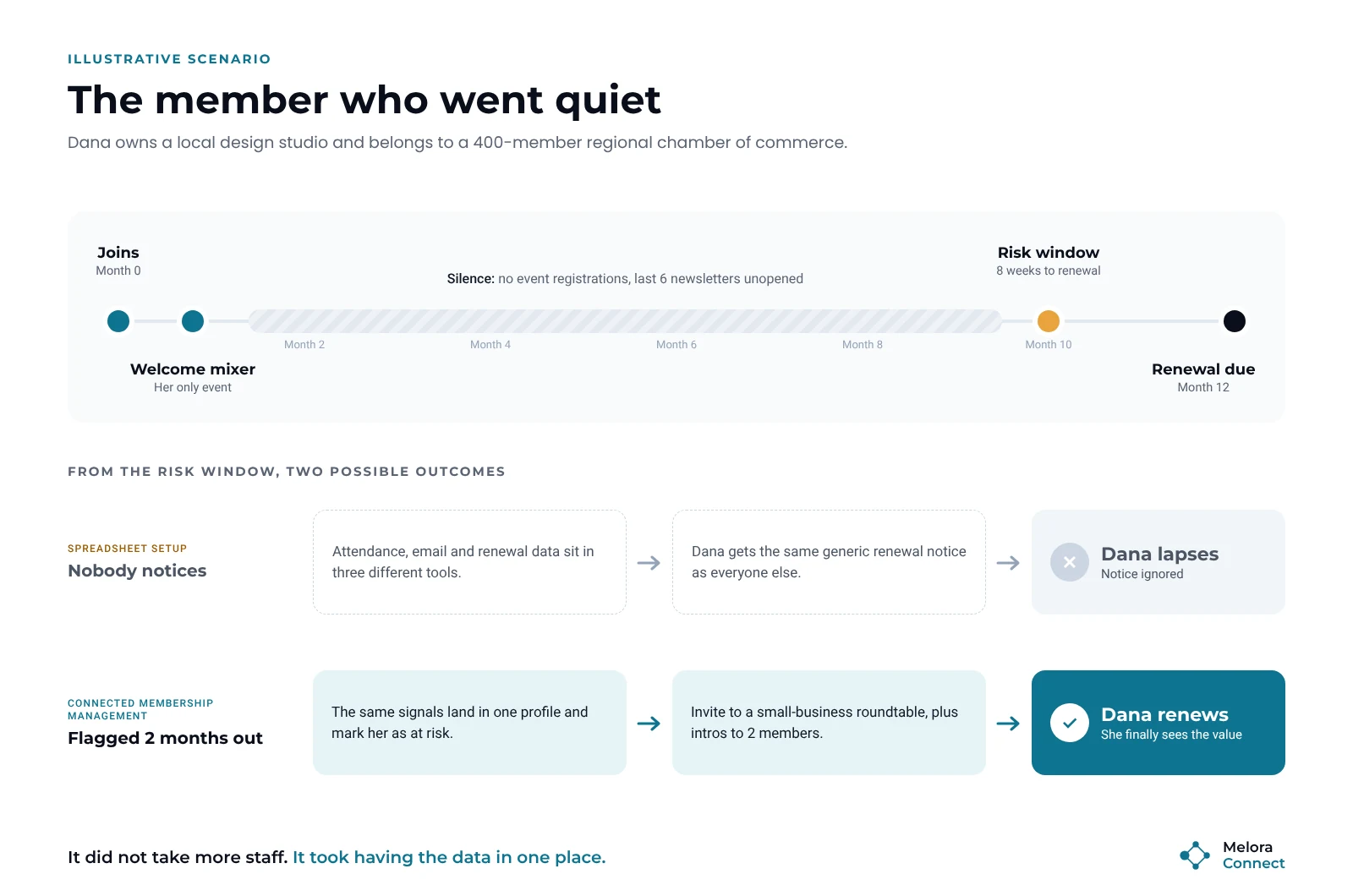
This is an illustrative scenario.
Picture a regional chamber of commerce with 400 members. Dana, who owns a local design studio, joined ten months ago. She came to the welcome mixer, then nothing. She has not registered for an event since, has not opened the last six newsletters, and her renewal is due in eight weeks.
In a spreadsheet setup, nobody notices. Attendance lives in the registration tool, email data in the newsletter platform, and the renewal date in a column nobody checks until the invoice goes out. Dana gets a standard renewal notice, ignores it, and lapses.
With connected membership management, the same signals land in one profile. Dana is flagged as at risk two months out. The membership director invites her to a small-business roundtable in her industry and introduces her to two members who could become clients. She renews, not because of a reminder, but because she finally sees the value.
That outcome did not take more staff. It took having the data in one place.
What is membership management software?
Membership management software is a platform that centralizes member records, applications, payments, communications, events, renewals, and reporting in one system. At its simplest, it replaces spreadsheets. At its best, it connects every lifecycle stage, so one action (a payment, an event check-in, an email click) updates everything else automatically.
A member database answers “who are our members?” Membership management software should also tell you who renews next month, who is going quiet, which events drive participation, and how much revenue each membership tier brings in.
Membership management software vs. AMS
Association management software (AMS) usually covers a broader scope: membership plus events, committees, chapters, education, certifications, advocacy, and finance. In practice the terms overlap, and the label matters less than the question behind it: does the system support how your organization actually works?
A platform with fewer features that share data will usually beat one with a hundred disconnected modules.
Membership management software features: what to look for
Start with your workflows, not a feature checklist. Then use this table to pressure-test any platform you evaluate.
| Feature | What to look for | Red flag |
|---|---|---|
| Member database | One profile with status, history, payments, events, and communications | Event or payment data sits in a separate tool |
| Online applications | Custom forms, tiers, approval workflows, payment at signup | Staff re-enter applications by hand |
| Dues and payments | Recurring billing, invoices, failed-payment handling, receipts | Reconciliation happens in a spreadsheet |
| Renewals | Automated reminders tied to engagement, not just dates | One generic reminder for every member |
| Member portal | Self-service profile updates, payments, registrations, resources | Members email staff to change an address |
| Events | Registrations and check-ins flow into the member record | Attendance exported to CSV after each event |
| Email and segmentation | Lists built from type, interests, activity, and renewal status | Every message goes to everyone |
| Reporting | Live dashboards for growth, renewals, revenue, and engagement | Board reports take a day to assemble |
| Automation | Welcome sequences, renewal campaigns, at-risk alerts | Every follow-up depends on someone remembering |
| Integrations | Accounting, payments, calendar, and video tools | Data still needs manual cleanup after syncing |
Has your association outgrown spreadsheets? A 6-point self-check
Spreadsheets work fine for a small group. The trouble starts when they become the infrastructure holding your membership operation together. Count how many of these apply to you:
- Member data lives in more than one file, and nobody is sure which is current.
- Someone has to remember who needs a renewal reminder this week.
- Members email staff to update basic contact details.
- You know who attended an event, but not how it connects to their membership.
- Board reports take hours of exporting, cleaning, and merging.
- Your team spends more time managing tools than talking to members.
0 to 1: your current setup is probably fine for now. 2 to 3: you are feeling the strain, so start by centralizing member data. 4 or more: your tools are costing you staff time and, most likely, members.
Scored 4 or more? Book a walkthrough built around your workflow and see how it would look in Melora Connect. Book a demo
3 membership metrics to track first
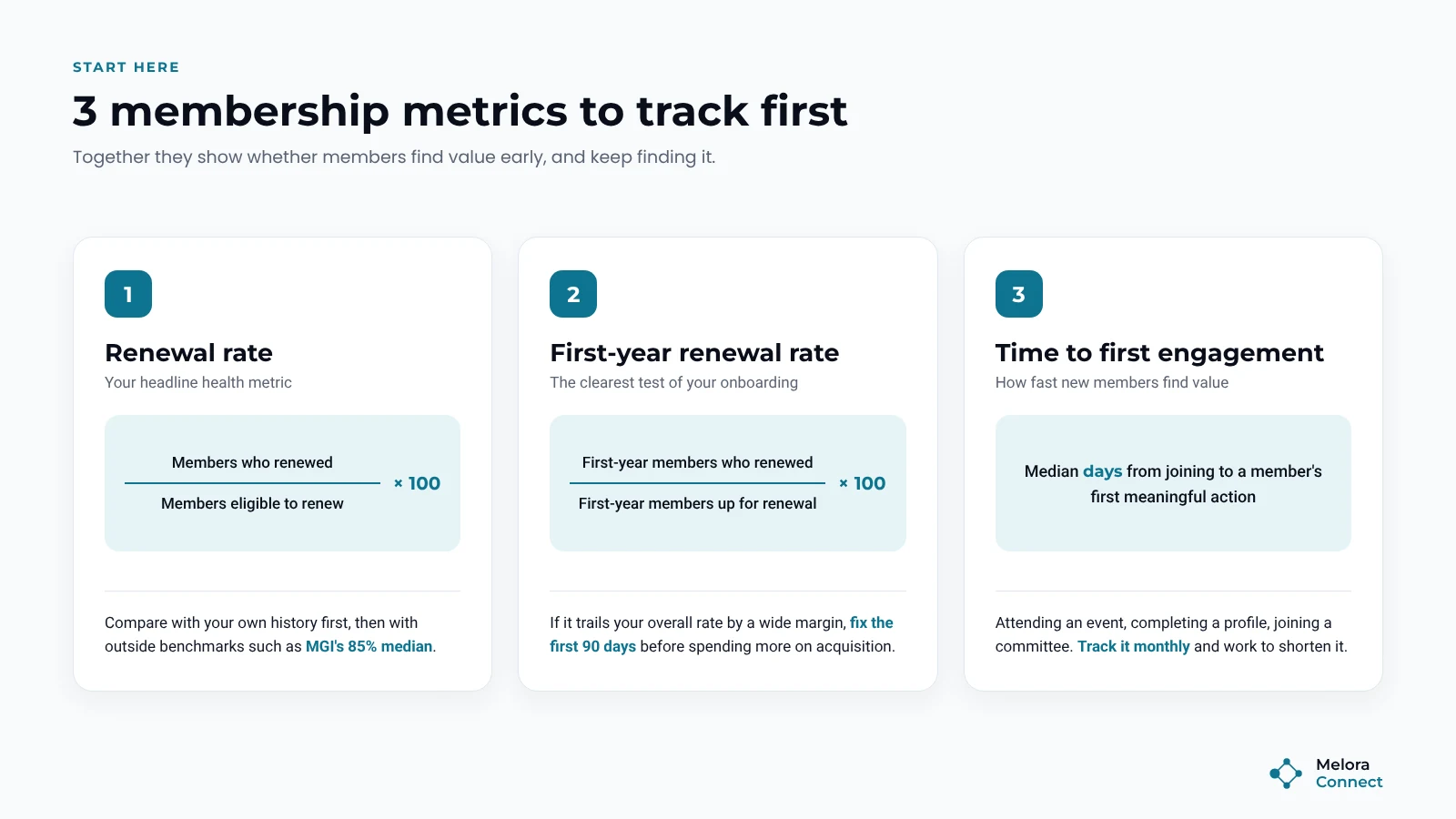
You can track dozens of numbers. Start with these three, because together they show whether members find value early and keep finding it.
Renewal rate
Renewal rate = members who renewed ÷ members eligible to renew × 100
Your headline health metric. Compare it with your own history first, then with outside benchmarks such as MGI’s 85% median.
First-year renewal rate
First-year renewal rate = first-year members who renewed ÷ first-year members up for renewal × 100
Usually lower than overall renewal, and the clearest test of your onboarding. If it trails your overall rate by a wide margin, fix the first 90 days before spending more on acquisition.
Time to first engagement
The median number of days between joining and a member’s first meaningful action, such as attending an event, completing a profile, or joining a committee. Define “meaningful” for your organization, track it monthly, and work to shorten it.
How Melora Connect approaches membership management
Most organizations we talk to do not have too little software. They have too much software that does not talk to itself: one system for dues, another for events, another for email, another for reports, with staff stitching them together by hand.
Melora Connect is built around the opposite idea: one connected platform where membership, events, payments, communications, and reporting share the same member record. When Dana checks in at an event, her profile updates. When her engagement drops, your team sees it before her renewal date. And because our team comes from event production, events are treated as core engagement data, not an add-on.
We are not trying to automate relationships. We are removing the busywork that keeps your team from having them.
See it with your own workflow. Book a demo of Melora Connect built around your current membership process. Book a demo
Frequently asked questions about membership management
What is membership management?
Membership management is the process of attracting, onboarding, engaging, renewing, and retaining members. It covers member records, applications, dues, communications, events, renewals, and reporting.
What does membership management software do?
It centralizes member data and automates routine work such as applications, payments, renewal reminders, and reporting, so staff can see each member’s full relationship in one place.
What is the difference between membership management and an AMS?
Membership management focuses on the member lifecycle. An AMS (association management software) usually adds broader operations such as committees, chapters, education, and finance. Many platforms do both.
When should an association move off spreadsheets?
When member data is split across files, renewals depend on someone’s memory, or reporting takes hours. If two or more of those apply, a connected system will likely pay for itself in staff time.
How does membership management improve retention?
By connecting engagement data to renewal dates, it shows which members are going quiet early enough to act, and it lets you tailor outreach to each member’s actual experience.
The bottom line
Membership management is not keeping a list. It is the system you use to build and keep relationships with the people who fund your mission.
The associations that retain members best are not the ones with the most data. They are the ones that act on the data they already have, early and personally. Start small: centralize your member records, fix the first 90 days, and track first-year renewals. Then let the right platform handle the mechanics, so your team can spend its time on the community that makes membership worth having.