
 People · Events · Communities

Quick answer: Member retention vs. member engagement comes down to result versus cause. Member retention is whether members renew from one period to the next, measured at renewal as a lagging indicator. Member engagement is how actively members participate and get value during the year, measured continuously as a leading indicator that changes months before renewal.
Key takeaways
-
Retention is the outcome (did they stay?). Engagement is the driver (are they getting value right now?).
-
Retention is measured once a year at renewal. Engagement can be measured, and changed, every month.
-
In MGI’s 2025 benchmarking update, lack of engagement or not using benefits was the top reason members did not renew, at 52%.
-
Silent renewers, members who renew on autopay but never participate, are the risk a renewal rate cannot show.
-
The single most useful view is renewal rate by engagement level.
Member retention vs. member engagement is one of the most common mix-ups in association management. The two words show up in the same sentence, sometimes as if they meant the same thing. They do not, and mixing them up can lead associations to focus on the wrong work at the wrong time.
Member retention is the result you want. Member engagement is how you get there. This guide explains how each one is measured, what the latest benchmarks say about why members leave, how the two work together, and what to do when they do not line up. It is part of our wider guide to reducing membership churn.
What is member retention vs. member engagement?
Member retention is an organization’s ability to keep members from one membership period to the next; member engagement is how actively members participate in and get value from the organization during that period. Retention is the outcome you report to the board. Engagement is the work that produces it.
What is member retention?
Member retention is usually measured as a renewal rate:
Member retention rate = members who renewed ÷ members eligible to renew × 100
Member retention answers a simple question: did they stay? It is measured at a point in time, usually around the renewal date, which makes it a lagging indicator. By the time you see it, the decision has already been made. Track first-year renewal separately, because new members leave at a higher rate than long-standing ones.
What is member engagement?
Member engagement is participation that delivers value: attending events, earning CE credits, joining a committee or chapter, answering a survey, volunteering, and opening and clicking your emails. It is measured continuously, throughout the year.
Member engagement answers a different question: are they getting value right now? That makes it a leading indicator. It changes before renewal does. For ways to raise it, see our member engagement strategies, and for business members, our guide to chamber of commerce member engagement.
What are the key differences between member retention and member engagement?
| Aspect | Member retention | Member engagement |
|---|---|---|
| What it is | Keeping members from year to year | Participating and getting value during the year |
| Question it answers | Did they stay? | Are they getting value now? |
| Type of indicator | Lagging | Leading |
| When it is measured | At renewal | Continuously, at least monthly |
| Example metrics | Renewal rate, first-year renewal rate, lapsed rate | Participation rate, event attendance, CE credits earned, email clicks, engagement score |
| Who moves it | Mostly the membership and renewals team | Everyone: events, education, communications, chapters, committees |
| What you can still change | Very little, once the decision is made | A lot, months before renewal |
Why do members stop renewing?
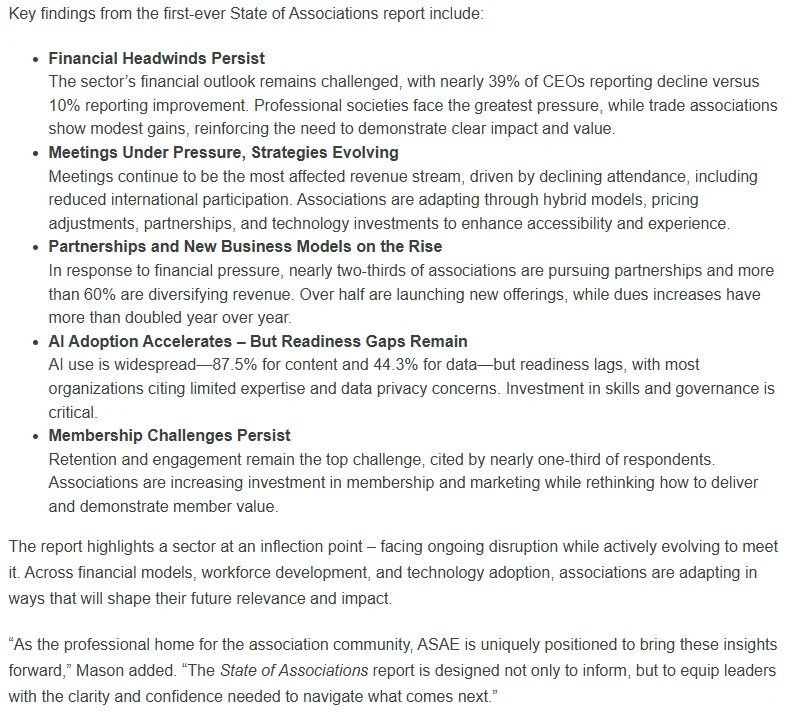
Retention and engagement are not a niche worry. When ASAE released its first State of Associations report in March 2026, it noted that “retention and engagement remain the top challenge, cited by nearly one-third of respondents.”
The benchmarks show where the gap opens. In Marketing General Inc.’s 2025 Membership Marketing Benchmarking Report update, presented by Tony Rossell in September 2025, the median overall renewal rate was 84% and the median first-year renewal rate was 75%. The top reason associations gave for members not renewing was lack of engagement with the organization or not using benefits (52%), well ahead of employer does not pay dues (27%), lack of value (24%), forgot to renew (24%) and too expensive (23%).
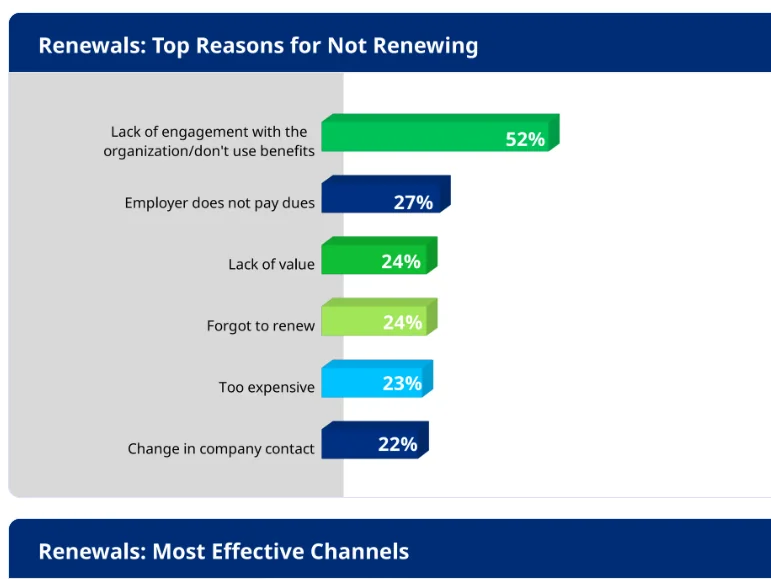
Two things stand out. First, the nine-point gap between overall and first-year renewal means the first year is where engagement matters most. Second, most of the top reasons are engagement problems that show up in your data months before the renewal notice goes out. Read them this way:
| Reason for not renewing | What kind of problem | Earliest signal | First move |
|---|---|---|---|
| Lack of engagement or not using benefits | Engagement | No events, courses or email clicks for 6 months or more | Personal outreach with one benefit picked for that member |
| Lack of value | Engagement | Low survey scores, no repeat participation | Ask what they joined for, then show where to get it |
| Forgot to renew | Process | Unopened renewal emails, expired card on file | Automated reminders and saved-card autopay |
| Employer does not pay dues | Budget | Job change, new company contact | A value summary the member can share with their employer |
| Too expensive | Price and value | Price questions, downgrade requests | Show what they used this year next to the dues amount |
How do engagement and retention work together?
Members renew when they can name the value of belonging. Engagement is how they experience that value: the course that helped their career, the introduction that became a client, the committee that gave them a voice. Engagement is the cause. Member retention is the effect.
That is why focusing only on the renewal campaign rarely works. A great renewal email cannot make up for a year with no value. A great year makes the renewal email almost unnecessary. The link is not perfect, though. Some engaged members leave for reasons outside your control, and some members who never participate renew anyway, at least for a while. Those exceptions are where the matrix below earns its keep.
What is the engagement–retention matrix?
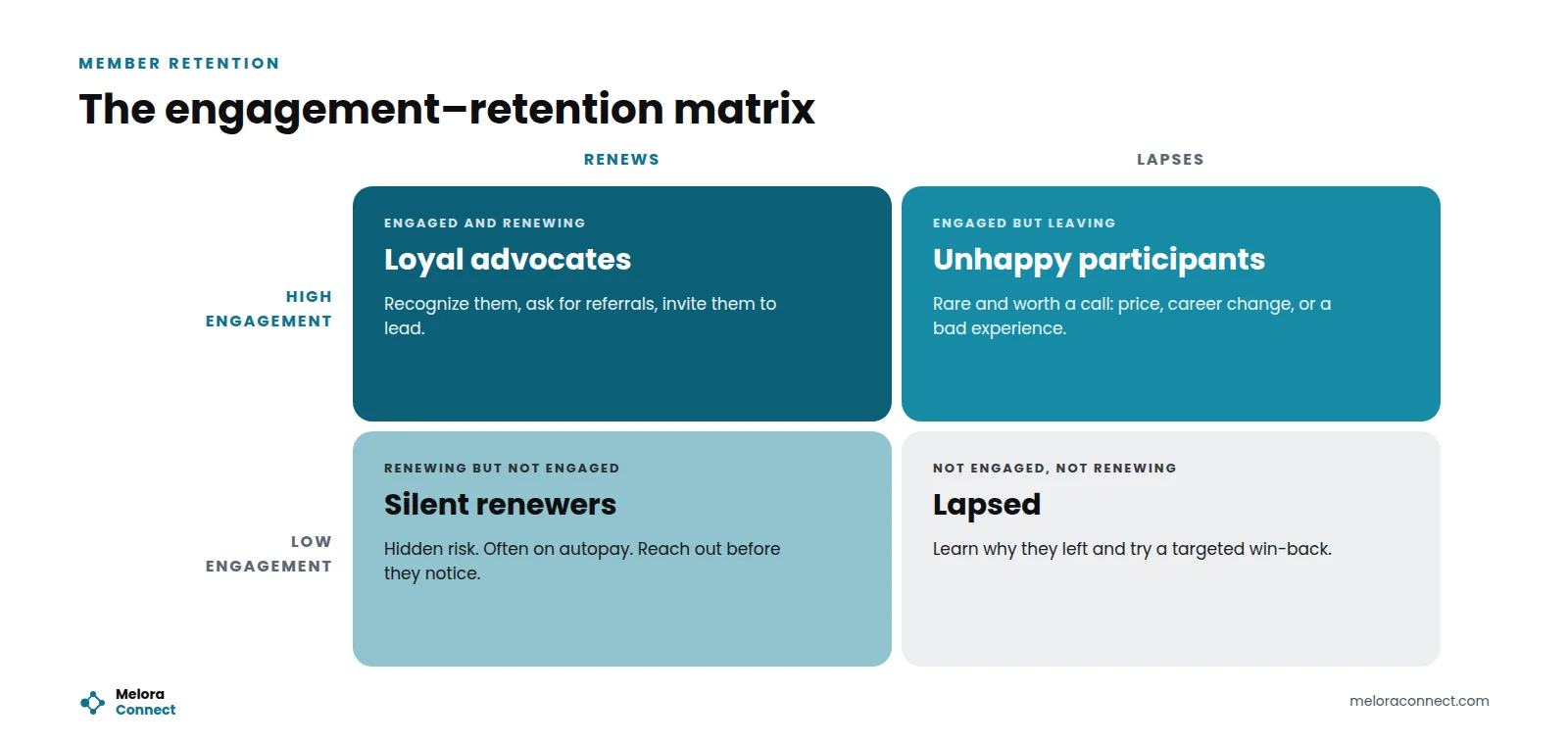
Most of the time, engagement and retention move together. When they do not, it is worth paying attention. Plotting members on these two dimensions creates four groups:
-
Loyal advocates are engaged and renewing. Recognize them, ask for referrals, and invite them to lead.
-
Unhappy participants are engaged but leaving. This is rare, and usually points to price, a career change, or a bad experience. A personal call is worth it.
-
Silent renewers renew but do not participate, often because dues are on autopay. They are your hidden member retention risk.
-
Lapsed members are neither engaged nor renewing. Learn why they left and try a targeted win-back.
Why does member retention compound over time?
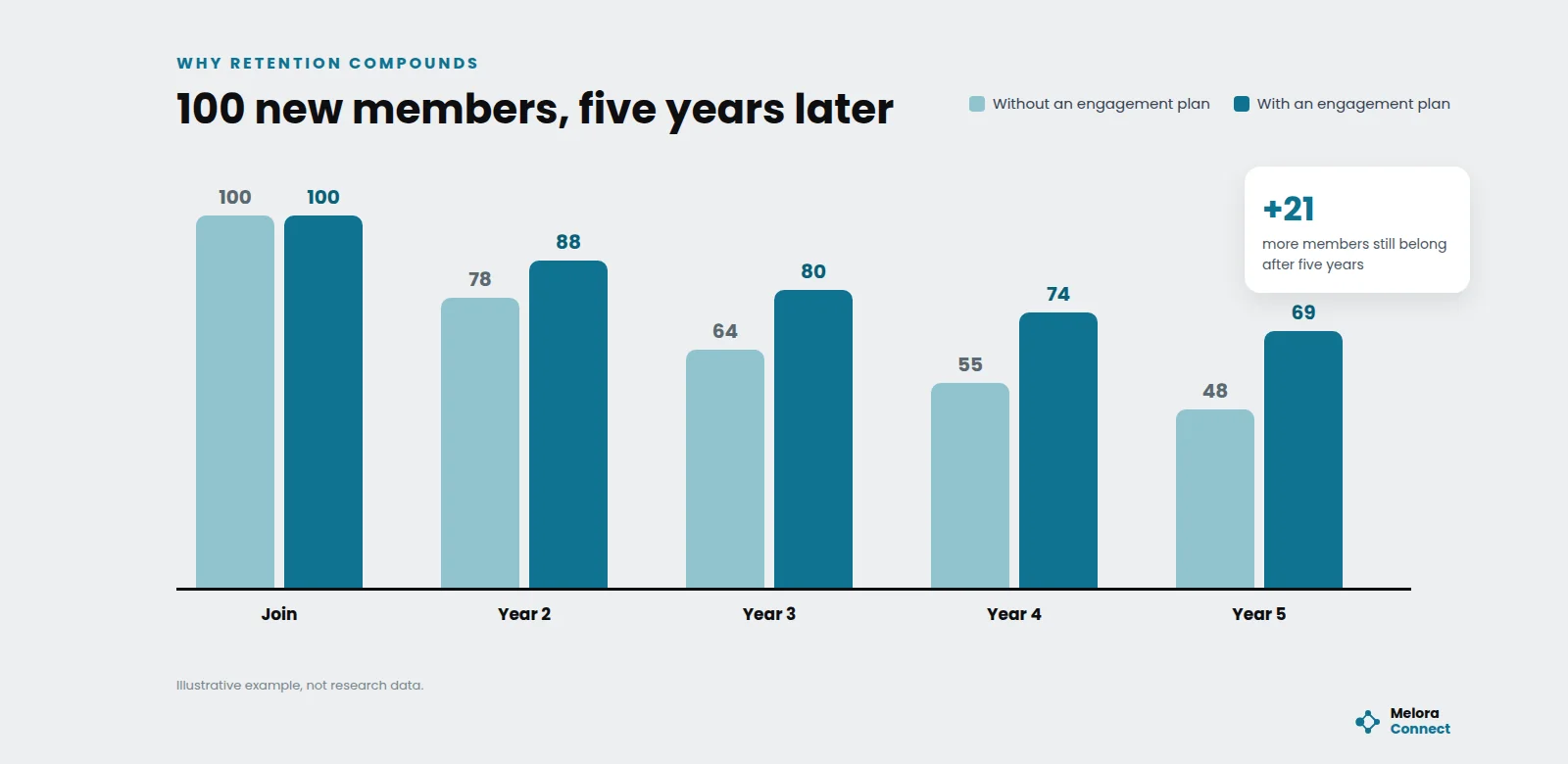
Small differences in member retention add up. The chart above is illustrative, not research data. Picture 100 new members. Without an engagement plan, 48 are still members after five years. With one, and a renewal rate a few points higher each year, 69 are, which is 21 more people paying dues, attending events and referring others. Improving member retention is often the most reliable way to grow, because every member you keep is one you do not have to replace.
Example: the silent renewer
This example is illustrative. Picture an association with 2,500 members and a strong 86% renewal rate. James has renewed automatically for four years. On paper, he is a perfect member.
But his engagement data tells another story: no events in 18 months, no course completions, and no email clicks in a year. When his company changes its expense policy, he cancels without a second thought, because he cannot remember the last time the membership helped him.
With engagement tracked alongside renewal, James would have appeared on the at-risk list long before. A call from the membership team, an invitation to a specialty group, or a relevant webinar could have reminded him why he joined. That is the difference between reacting to member retention and managing it.
How can you use engagement to protect member retention?
Two retention basics apply here as they do everywhere: a strong start for new members, covered in our guide to improving membership management, and an effortless renewal, covered in how to automate membership renewals. The four moves below are about the gap between engagement and retention.
1. Watch engagement, not just renewal dates
Track engagement monthly, and treat a drop in participation as an early warning. A member engagement score turns many small signals into one number you can sort by. Once you have a year or two of scores next to renewal outcomes, predictive analytics for member retention can show which drops matter most for your members.
2. Look closely at silent renewers
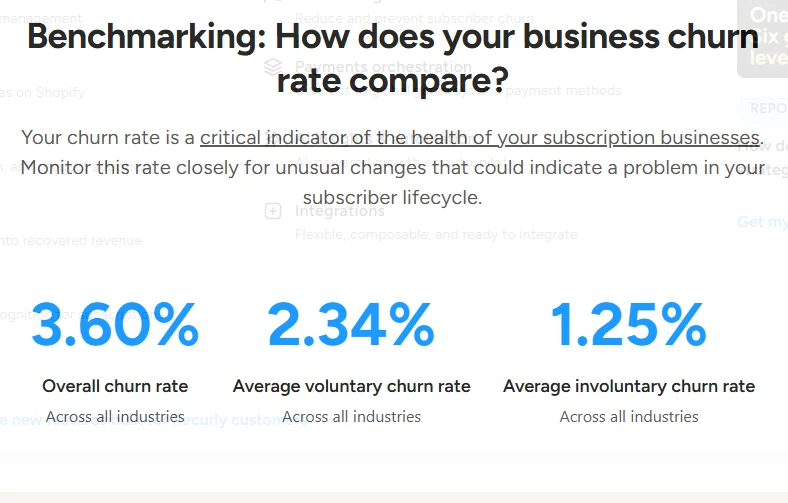
Autopay is great for convenience, but it can hide disengagement. Subscription businesses track this split explicitly. Recurly’s churn rate benchmarks, updated with July 2026 network data, separate voluntary churn (customers who choose to leave) from involuntary churn (failed payments) and report average rates of 2.34% voluntary and 1.25% involuntary across all industries, noting that “voluntary churn accounts for the majority of total churn.” That is subscription data, not association data, but the lesson carries over: autopay fixes the payment problem, not the value problem.
Review members who renew automatically but show no activity, and reach out personally before their next renewal. Our guide on how to identify at-risk members covers the other warning signs to watch.
3. Segment renewal outreach by engagement
Highly engaged members need a thank-you and a one-click renewal. Members who participate occasionally need a reminder of benefits they have not used. Inactive members need a personal conversation 60 to 90 days before renewal.
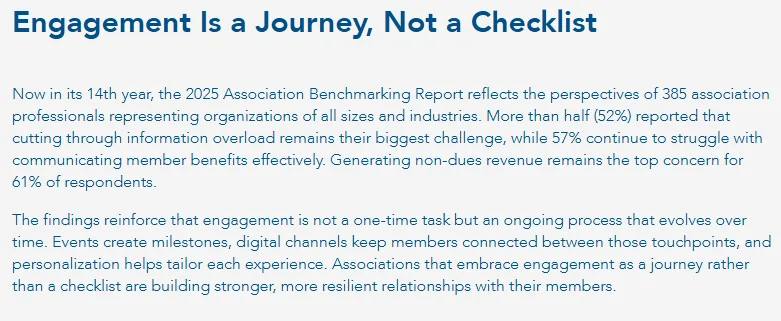
That middle step is harder than it sounds. In Naylor’s 2025 Association Benchmarking Report, summarized on Association Adviser, “57% continue to struggle with communicating member benefits effectively.” Engagement data helps here, because it tells you which benefit each member has not used yet.
4. Learn from every member who leaves
Ask lapsed members why they did not renew, using the same reasons as the table above so you can compare year over year. The answers will show you where engagement broke down and what to fix next. Our guide on how to improve member retention with member data shows how to fold those answers into a quarterly review.
Score your members’ renewal risk. Rate every member on engagement and renewal signals and get a ranked list of who to call first, in our free Member Risk Scoring Sheet. Download the scoring sheet
How do you measure retention and engagement side by side?
Track retention with your renewal rate and engagement with participation, then put the two side by side. Start with these six numbers:
| Metric | Side | Formula | How often |
|---|---|---|---|
| Renewal rate | Retention | Members who renewed ÷ members eligible to renew × 100 | Monthly and at year end |
| First-year renewal rate | Retention | First-year members who renewed ÷ first-year members eligible × 100 | Monthly and at year end |
| Lapsed rate | Retention | Members who lapsed ÷ members eligible to renew × 100 | Monthly |
| Participation rate | Engagement | Members with at least one activity in the last 12 months ÷ all members × 100 | Monthly |
| Engagement score trend | Engagement | Change in average engagement score since last quarter | Quarterly |
| Renewal rate by engagement level | Both | Renewal rate calculated separately for active and inactive members | Quarterly and at year end |
The single most useful view is renewal rate by engagement level. If highly engaged members renew at a clearly higher rate, your engagement work is paying off. If the two rates are close, either your engagement measure is counting the wrong activities or something other than value is driving renewals. Our guide to member engagement metrics has more formulas for both sides.
Put both numbers in front of your board. Report renewal rate, first-year renewal and engagement on one page with our free Board Report Template. Download the template
Where do your members sit on the matrix?
Try this with last year’s renewal list. It takes an afternoon and shows you which of the four groups needs attention first.
- Sort by renewal: mark every member who was up for renewal as renewed or lapsed.
- Add one engagement measure: event attendance, email clicks or an engagement score for the same 12 months, and split members into active and inactive.
- Count the four groups: loyal advocates, unhappy participants, silent renewers and lapsed members.
- Calculate renewal rate for active and inactive members separately.
- Act on the biggest risk first, and repeat the exercise each quarter.
Here is what that looks like with illustrative numbers. A professional society had 1,200 members up for renewal and 1,020 renewed, an 85% renewal rate. Of the 1,200, 720 were active. Counting the four groups gives 690 loyal advocates, 30 unhappy participants, 330 silent renewers and 150 lapsed members. Active members renewed at 96% (690 ÷ 720); inactive members renewed at 69% (330 ÷ 480).
The headline 85% looks healthy, but 330 silent renewers mean next year’s losses are already on the member list. If inactive members keep renewing at 69%, about 100 of them will leave next year unless someone gives them a reason to stay.
How Melora Connect connects engagement and member retention
Most associations we talk to have the data for both sides. It just lives in different places: renewals in one system, event attendance in another, email clicks in a third. Nobody can see a silent renewer until they lapse.
Melora Connect keeps both sides on one member record. On the retention side, renewals and invoice runs are automated, reminders go out by email, and members pay by card or ACH through MeloraPay, including saved-card autopay, with every payment landing in your own Stripe account. On the engagement side, event registrations and check-ins, email activity, committees, surveys, CE credits and chapters (live since October 27, 2026) all sit on the same profile, and engagement scoring turns that activity into one number. Smart segments surface new, at-risk and lapsed members, and the Monday morning briefing tells staff who needs attention this week, so silent renewers do not stay silent.
You get a team, not a login. Our team configures Melora Connect with you, migrates your data, and helps you decide which activities count as engagement for your members, so both sides of the record tell one story.
See your silent renewers before they lapse. Bring last year’s renewal list, and we will show you renewal rate by engagement level in Melora Connect. Book a demo
Frequently asked questions about member retention vs. member engagement
What is the difference between member retention and member engagement?
Member retention measures whether members stay from one membership period to the next, usually as a renewal rate. Member engagement measures how actively members participate and get value during the year, through events, learning, committees and communication. Engagement is the cause and a leading indicator; retention is the effect and a lagging one.
Is member engagement a leading or lagging indicator?
Member engagement is a leading indicator. It changes months before a renewal decision, so a drop in event attendance, course activity or email clicks warns you while there is still time to act. Member retention is a lagging indicator, because the renewal rate only shows the decision after members have made it.
Does higher engagement always mean higher retention?
Usually, but not always. Some engaged members leave because of price, a job change or an employer that stops paying dues. Some disengaged members keep renewing on autopay until something prompts them to cancel. Tracking renewal rate by engagement level helps you spot both exceptions and act on them early.
What is a good membership renewal rate?
In Marketing General Inc.’s 2025 benchmarking update, the median overall renewal rate for associations was 84% and the median first-year renewal rate was 75%. Trade associations reported higher medians than individual membership organizations. Compare your rate with your own history first, and track first-year renewal separately, because new members leave more often.
Which should we track first, retention or engagement?
Start with retention, because you already have renewal data and can calculate the rate today. Then add one engagement measure, such as event attendance or email clicks over 12 months, and compare renewal rates for active and inactive members. That one comparison shows whether engagement is driving retention for you.
What is a silent renewer?
A silent renewer is a member who keeps renewing, often automatically through autopay, but shows little or no engagement: no events, no courses and no email clicks. Silent renewers look safe in the renewal rate, but they are at high risk of leaving when budgets tighten, so reach out before their next renewal.
The bottom line
Member retention tells you whether members stayed. Member engagement tells you why, and gives you time to act. The benchmarks agree: lack of engagement is the most common reason members do not renew. Associations that manage engagement every month do not have to fight for retention once a year. Their members already know why they belong.
Keep more members, year after year. See engagement scoring, smart segments and automated renewals on one member record in Melora Connect. Book a demo
Sources
- ASAE, ASAE Releases First-Ever ‘State of Associations’ Report Offering Data-Driven View of Industry’s Present and Future, Mar 23, 2026.
- Marketing General Inc. (Tony Rossell), The Pulse of Association Membership: The 2025 Membership Marketing Benchmarking Report Update, Sep 18, 2025.
- Recurly, Churn rate benchmarks: SaaS, media, retail & more industries, Updated with July 2026 data (no day given).
- Naylor Association Solutions (Association Adviser), Membership Momentum: Engaging Today, Growing Tomorrow, Oct 23, 2025.