
 People · Events · Communities

Quick answer: To improve member retention with member data, connect every member’s payments, events, email, learning and feedback into one record, watch for early signals like fading attendance or a failed payment, and act on them weekly. Personal outreach months before renewal, plus fixing payment friction, keeps more members than any reminder sent at renewal time.
Key takeaways
-
Members rarely announce they are leaving. They drift, and the drift shows up in your data months before renewal.
-
One record per member matters more than more data. Scattered data cannot be acted on in time.
-
Some lapses are not decisions at all: failed payments quietly cost members who meant to stay.
-
A short weekly list and a few personal calls beat a big annual analysis nobody acts on.
Every association already has the information it needs to improve member retention. It sits in event check-ins, email clicks, payment records, committee lists, CE credits and survey replies. The problem is that it is scattered, so nobody sees the full picture until a member does not renew.
Member data will not keep members on its own, but it tells you who needs attention, when, and why. This guide covers what data to collect, the five steps from data to action, the signals to watch, why failed payments deserve their own plan, and a routine your team will keep. It is part of our wider guide to reducing membership churn, and for the difference between the two concepts, see member retention vs. member engagement.
How does member data improve member retention?
Member retention data is the record of what each member does with your association (paying, attending, learning, reading, volunteering and giving feedback) used to spot who is getting value and who is drifting before renewal. It improves member retention because it moves the moment you notice a problem from the renewal date to months earlier.
Members rarely announce that they are leaving. They drift: fewer events, unread emails, a profile that never gets updated, a card that expired. Those small changes show up in your data long before they show up in your renewal rate.
Associations that use member data well do not wait for the renewal date to find out who is leaving. They spot the drift while a personal call, a relevant invitation, or an updated card can still change the outcome.
What member data should you collect?
You do not need everything. You need the data that tells you whether members are getting value, and whether paying you is easy:
| Data type | Examples | What it tells you about retention |
|---|---|---|
| Profile | Join date, membership type, chapter, industry, role | Who is new, who is at a career change, which segments renew best |
| Payments | Renewal history, autopay status, failed payments, overdue invoices | Who renews easily and who hits friction |
| Events | Registrations, check-ins, no-shows | Whether members show up and come back |
| Learning | Courses completed, CE credits earned | Whether members are growing through you |
| Communication | Email opens and clicks, bounces, portal logins | Whether members are paying attention, and whether your emails arrive |
| Community and volunteering | Committees, chapter roles, mentoring, referrals | Whether members feel ownership |
| Feedback | Survey scores and comments, reasons for leaving | Why members stay or go |
What are the 5 steps from member data to action?
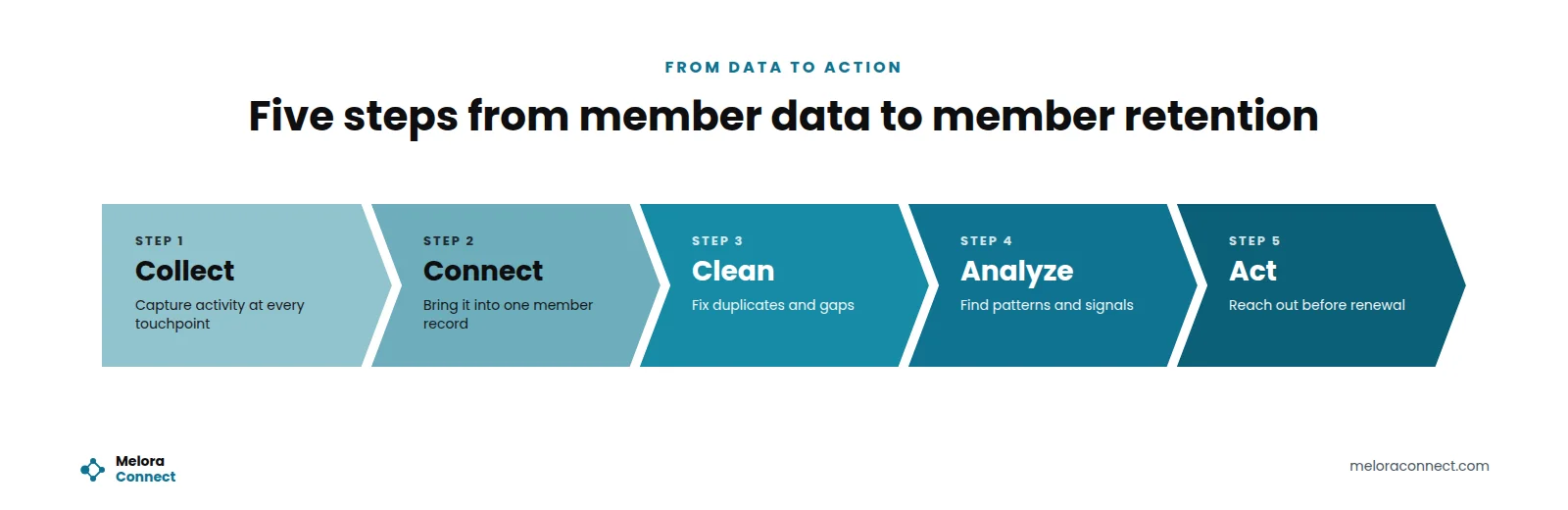
Turning member data into retention takes five steps: collect, connect, clean, analyze and act. Most associations get stuck at step 2, because data lives in separate tools.
1. Collect
Capture activity at every touchpoint: registrations, check-ins, course completions and credits, email clicks, payments and survey answers. If a meaningful action is not recorded, it cannot inform member retention.
2. Connect
Bring everything into one record per member. Data split across an event tool, an email platform and a spreadsheet is almost impossible to act on in time. If spreadsheets are still your system of record, start with our guide to replacing membership spreadsheets.
3. Clean
Merge duplicates, fill in missing fields and fix outdated contact details. A member with two records looks half as engaged as they really are.
4. Analyze
Look for patterns: which members are fading, which segments renew best, and which actions are linked to renewal. A member engagement score can turn many signals into one number, and predictive analytics for member retention shows how to rank members by risk.
5. Act
Turn insights into outreach. Assign at-risk members to a staff person, invite fading members to something relevant, fix payment problems, and thank highly engaged members. Then measure what worked.
Which retention signals are hiding in your member data?
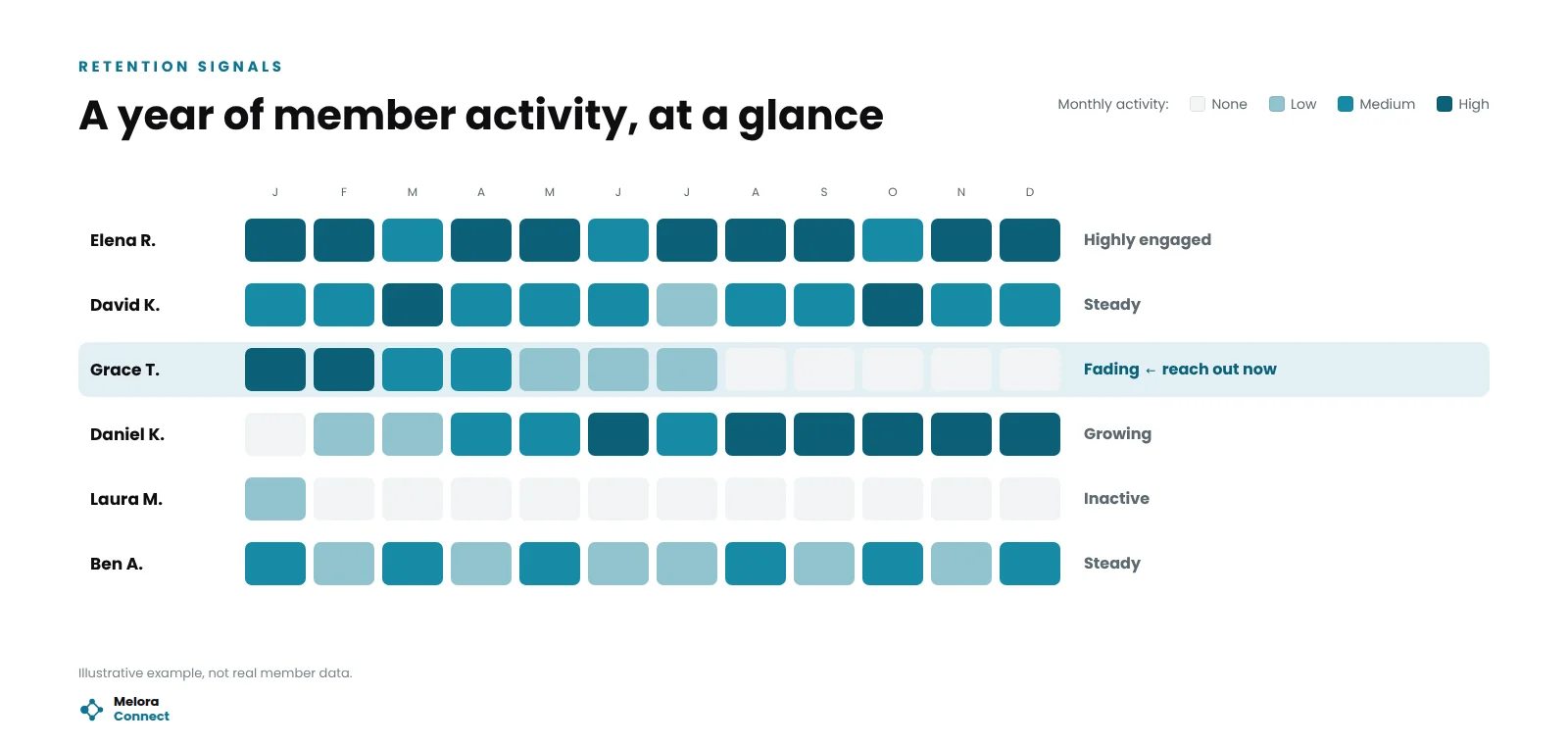
A simple activity view like the one above (illustrative, not real member data) makes fading members easy to spot: a row that goes quiet after a busy spring, a payment that failed, a profile that was never filled in. Our guide on how to identify at-risk members lists all eight warning signs and a 30-minute monthly check. The point here is that every one of them is already sitting in data you collect.
| Signal in your data | What it may mean | First action |
|---|---|---|
| Event attendance stops after a busy year | Programs no longer fit, or life changed | Personal call; invite to one relevant event |
| Emails bounce or go unopened for months | Wrong address, or your emails land in spam | Ask the member to update their profile; check deliverability |
| A card payment fails or autopay is off | Expired card, not a decision to leave | Reminder with a direct link to update the card |
| Downgrade to a cheaper membership type | Value is unclear at the current price | Ask what changed; point to the benefits they use |
| No CE credits logged this cycle | Certification needs are met elsewhere | Share upcoming courses that count toward their credits |
| First-year member with no activity after 90 days | Onboarding did not land | Welcome call and one clear next step |
Score your members by risk. Rate each member on the signals above and get a ranked list of who to call first, in our free Member Risk Scoring Sheet. Download the scoring sheet
Why are failed payments a retention problem?
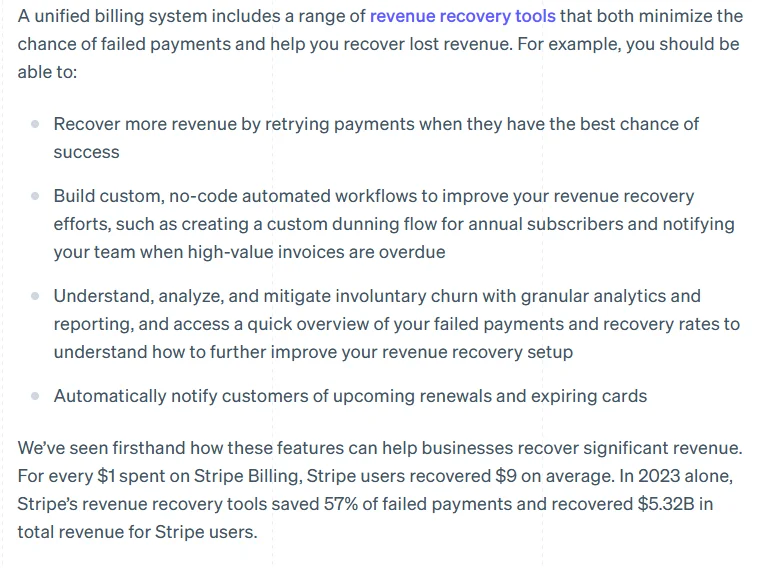
Not every lapse is a decision. Some members mean to renew, but an expired card or a declined charge ends their membership anyway. Subscription businesses call this involuntary churn, and it is the easiest kind of churn to prevent, because the member never chose to leave.
Failed payments are also the easiest to win back. In Stripe’s 2024 subscription churn survey and billing data, Stripe reports its recovery tools saved 57% of failed payments in 2023, and that a recovered monthly subscription typically lasts another seven months on average. Those are software, media and ecommerce subscriptions, not associations, but the lesson carries: most dues are annual, so a recovered renewal can be worth a full year.
Treat payments as retention data. Before each renewal cycle, check:
- Which members have autopay off, or a saved card that expires before their renewal date.
- Which renewals failed last month, and whether each member got a reminder with a direct link to pay.
- Whether members can pay by card or ACH, so a declined card is not the only route.
- Who on staff calls members whose payment failed twice.
For the reminder sequence itself, see our guide to automate membership renewals.
Which analyses improve member retention?
Four analyses explain most of what your renewal numbers cannot:
| Analysis | What it shows | Points to |
|---|---|---|
| Renewal rate by segment | Which membership types, chapters, industries or regions are most at risk | A segment problem |
| Join-year cohorts | How many members from each year’s class are still members, and when they tend to leave | An onboarding problem |
| Renewal rate by engagement level | Whether engaged members really renew more, and which activities matter most | A program problem |
| Reasons for leaving | The most common causes of lapses, from exit surveys and calls, including failed payments | A value or payment problem |
Run these once a quarter and pick one fix to work on. For the formulas behind each one, see our guide to member engagement metrics.
Take the numbers to your board. Present renewal rate, cohorts and at-risk members on one page with our free Board Report Template. Download the template
How do you turn member data into outreach members notice?
Data tells you who to contact. What you say decides whether it works. The most useful message reminds a member of value they have already received, in their own terms: the sessions they attended, the credits they earned, the committee they sit on.
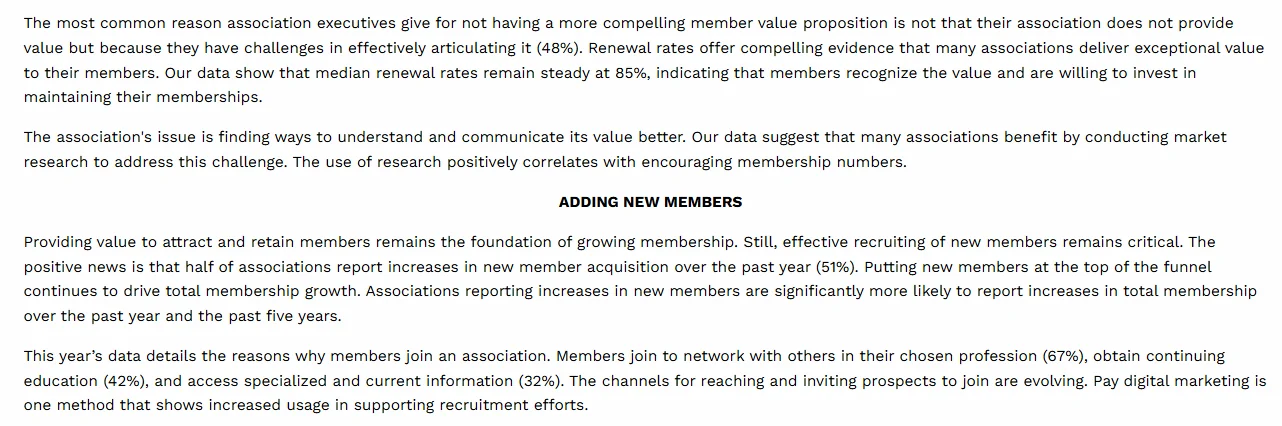
That is where many associations struggle. In Marketing General Incorporated’s 2024 Membership Marketing Benchmarking Report summary, the most common reason executives gave for not having a more compelling member value proposition was not a lack of value but trouble articulating it, cited by 48%. Member data is how you articulate it, one member at a time.
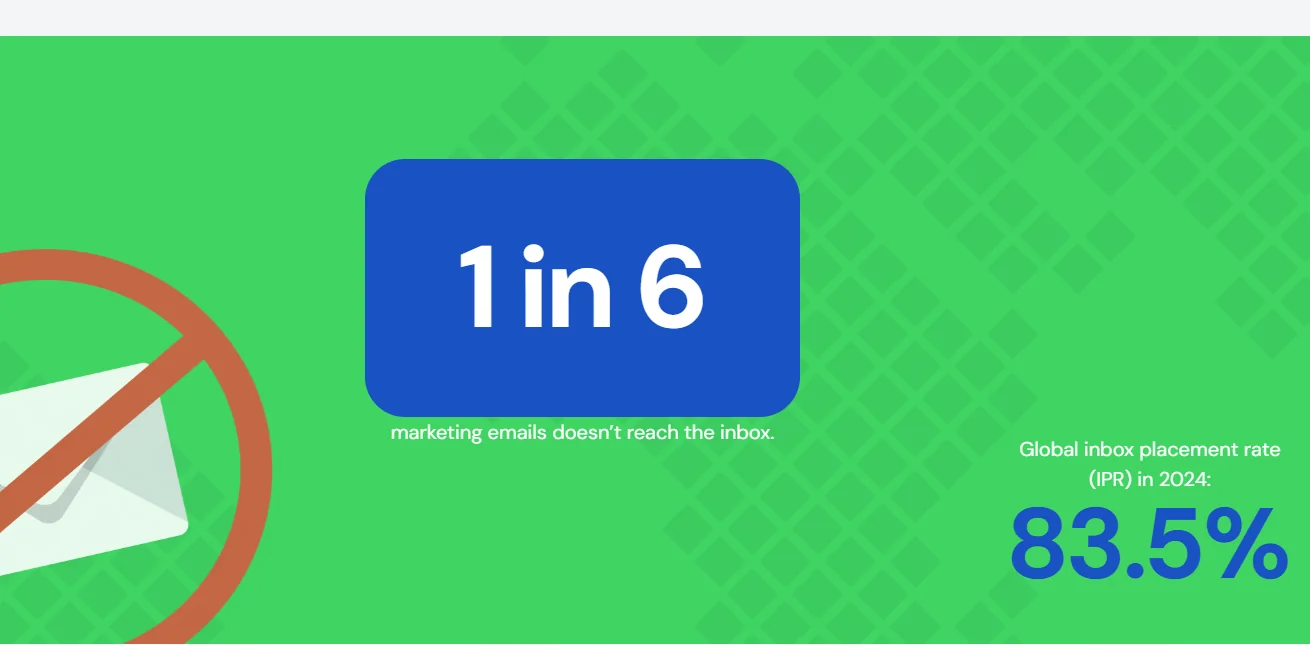
Your email also has to arrive. Validity’s 2025 Email Deliverability Benchmark Report found that 1 in 6 marketing emails does not reach the inbox, with a global inbox placement rate of 83.5% in 2024. That is commercial email, not association email, but it explains why “unopened” does not always mean “uninterested.” Remove bounced addresses, ask members to update their profiles, and for at-risk members, pick up the phone.
A few rules make outreach personal without making it creepy: mention activity the member would expect you to know, offer one next step, and send it from a person, not “the membership team.” Our guide to member engagement strategies has ideas for that next step.
Example: Omar’s Monday morning briefing
This example is illustrative. Picture Omar, the membership director of a state society of 1,800 physical therapists. For years, his Monday started with exports: payments from one system, event registrations from another, a renewal spreadsheet he updated by hand. By the time the picture was clear, it was Wednesday.
Now the Monday morning briefing is waiting when he logs in. It shows who joined last week and got a welcome email, which renewals are overdue with invoices ready to resend, and which members are at risk with renewals due in the next 90 days. This week, 11 members are on the at-risk list. Three of the overdue renewals belong to members whose saved card expired.
One of them is Beth, a nine-year member who used to attend every regional workshop. She has not registered for anything since spring, and last month she moved to a cheaper membership type. Omar calls her before lunch. She has opened her own clinic and assumed the society was mainly for employed therapists. He introduces her to the practice owners’ group and sends the date of its next meeting. Beth renews in June and moves back up a tier.
The expired cards take less time: each of the three members gets a reminder with a link to update their card, and two update it that week.
The data was in Omar’s systems all along. The briefing simply put it in front of him while there was still time to call. Each Monday he works through the list the same way, a few calls at a time, and renewal season is no longer the first time anyone looks.
How do you keep member data clean and trusted?
Member retention depends on data quality, and members trust you with their information. Bad data does not just waste time; it points your outreach at the wrong people. Outside the association world, the Twilio Segment State of Personalization Report 2024 found that 61% of companies worry that inaccurate data is muddying their AI-driven personalization efforts. The same risk applies to a renewal call based on a duplicate record.

Keep both quality and trust in good shape:
- Members can update their own profiles, so details stay current without staff effort.
- Duplicates are merged regularly, especially after events and imports.
- Key fields are defined once, such as what counts as an active member, and used consistently.
- You collect only what you use, and explain why you collect it.
- Access is limited to the people who need it, and permissions are reviewed regularly.
What retention data routine should your team follow?
Data only improves member retention if someone looks at it on a schedule. This rhythm works for most membership teams:
| When | What to do | Time it takes |
|---|---|---|
| Weekly | Read your briefing or at-risk list and make a few calls | 30–60 minutes |
| Monthly | Run the 30-minute at-risk check; fix bounced contacts and failed payments | About an hour |
| Quarterly | Run the four analyses above and pick one fix to work on | Half a day |
| Yearly | Compare the members you flagged with the members who actually lapsed, and adjust your signals | Half a day |
How Melora Connect turns member data into retention
Most associations we talk to have plenty of member data. What they lack is one place where it adds up, and a habit of looking at it before renewal.
Melora Connect gives every member one complete record, and everything else pulls from it: dues and payments through MeloraPay by card or ACH into your own Stripe account, event registrations and check-ins, CE credits and chapters, segmented email with merge fields from the live record, surveys and committees. Online events carry their own join link. Connect your Zoom account and Melora Connect creates the Zoom meeting for a virtual event, moves it when the time changes, and checks in the people who joined after the event. Committee meetings can get a Zoom meeting or a Google Meet link the same way. Members update their own profiles in the member portal, and you can export your data to CSV anytime.
Smart segments surface new, at-risk and lapsed members, engagement scoring turns activity into one number, and the admin dashboard shows organization health at a glance. Automated renewals and reminders, invoice runs and saved-card autopay reduce payment friction, and the Monday morning briefing turns those signals into a short list of conversations each week, before renewal. See the rest of our engagement tools.
You get a team, not a login. Our onboarding team brings your existing data across, usually in about 30 days from signed agreement to live, and helps you decide which signals to watch first.
See your at-risk list before renewal season. Bring a sample of your member data, and we will show you how it looks on one record, with your Monday briefing. Book a demo
Frequently asked questions about how to improve member retention
How can member data improve member retention?
Member data shows early signs that a member is drifting, such as fewer events, unopened email, a downgrade or a failed payment. When that data sits on one record and someone reviews it weekly, your team can reach out months before renewal, while a call or a relevant invitation can still change the outcome.
What member data matters most for retention?
The most useful member data for retention is event attendance, payment and autopay history, email engagement, learning activity such as CE credits, volunteering and committee roles, and feedback. Together they show whether members are getting value and whether paying you is easy. Collect only what you will actually use.
What are early warning signs that a member will not renew?
Common warning signs are attendance that stops after a busy year, emails that go unopened or bounce, a downgrade to a cheaper membership type, a failed card payment, no CE credits logged, and a new member with no activity after 90 days. Each one calls for a different, specific first action.
What is involuntary churn in a membership?
Involuntary churn is when a membership lapses because a payment fails, for example an expired or declined card, rather than because the member chose to leave. It is the easiest churn to prevent: track failed payments, send reminders with a direct payment link, offer card and ACH, and call repeat failures.
How often should we review member data for retention?
Review a short at-risk list weekly and make a few calls. Run a 30-minute at-risk check and fix failed payments monthly. Every quarter, run deeper analyses such as join-year cohorts and renewal rate by segment, and once a year compare the members you flagged with those who actually lapsed.
Do we need a data team to improve member retention?
No. Most associations can improve member retention with connected data, a few clear signals and a weekly review by the membership team. A spreadsheet-based risk score is enough to start. Predictive models help larger associations, but personal outreach to the right members matters more than the sophistication of the analysis.
The bottom line
Member retention is not decided at renewal time. It is decided over the year, in small moments your member data already records: a missed event, an unopened email, a card that expired. When you connect that data and look at it every week, you stop discovering lapses and start preventing them.
See every member’s story in one place. See payments, events, CE credits and engagement on one member record in Melora Connect. Book a demo
Sources
- Stripe, Subscription business leaders are looking for a better way to combat churn, Nov 13, 2024.
- Marketing General Incorporated, Five Association Membership Growth Drivers (2024 Membership Marketing Benchmarking Report), Jul 23, 2024.
- Validity, 6 Email Marketing Trends You Should Know to Thrive in 2025 (2025 Email Deliverability Benchmark Report), Aug 6, 2025 (last updated).
- Twilio Segment, The State of Personalization Report 2024, Jun 18, 2024.