
 People · Events · Communities
Quick answer: AI in association management means using machine learning and language tools to analyze member data, take routine work off staff, and recommend next steps for engagement and retention. It works best on one connected member record, with staff reviewing what AI suggests and making every decision a member will see.
Key takeaways
-
Automation follows rules you write; AI finds patterns you did not write down.
-
The biggest shift is moving from reacting to lapses to spotting renewal risk early.
-
Most associations are interested but not ready: staff skills lag behind interest.
-
AI is only as good as the member record it learns from, so connect your data first.
-
Keep people in charge of relationships, and tell members how AI uses their data.
Associations run on relationships, but the work behind them, from tracking renewals to answering the same member questions every week, grows faster than most teams do. AI in association management is changing that equation.
It does not replace the people who make an association feel like a community. It takes on the sorting, flagging, and summarizing that eats up their week. The real shift is this: your member database stops being a record of what happened and starts telling you what to do next.
This guide covers what AI in association management means, how it differs from automation, what 2025–2026 research says about adoption, the five areas it is changing, and what it should never replace. For a hands-on list of where to start, see our hub of AI for associations use cases.
What is AI in association management?
AI in association management is the use of machine learning and language tools to analyze member data, automate routine work, and recommend actions that improve engagement and retention. In practice, that means software that can spot patterns across thousands of member records, read and summarize text, and answer common questions in plain language.
A traditional system answers “what happened?” AI adds two more questions: “what is likely to happen?” and “what should we do about it?”
What is the difference between AI and automation?
The two terms are often mixed up. Automation follows rules you write. AI looks for patterns you did not write down. Most associations already use the first and are only beginning to use the second, and that gap is where the field is changing fastest.
| Approach | How it works | Membership example |
|---|---|---|
| Automation | Fixed rules: if this happens, do that | Send a renewal reminder 30 days before the due date |
| AI-assisted insight | Finds patterns and estimates what is likely | Flag members whose activity resembles past lapses |
| Generative AI | Drafts text, summaries, or answers on request | Draft a check-in note for staff to edit |
| Human judgment | Decides what to do and owns the relationship | Call a long-time member who has gone quiet |
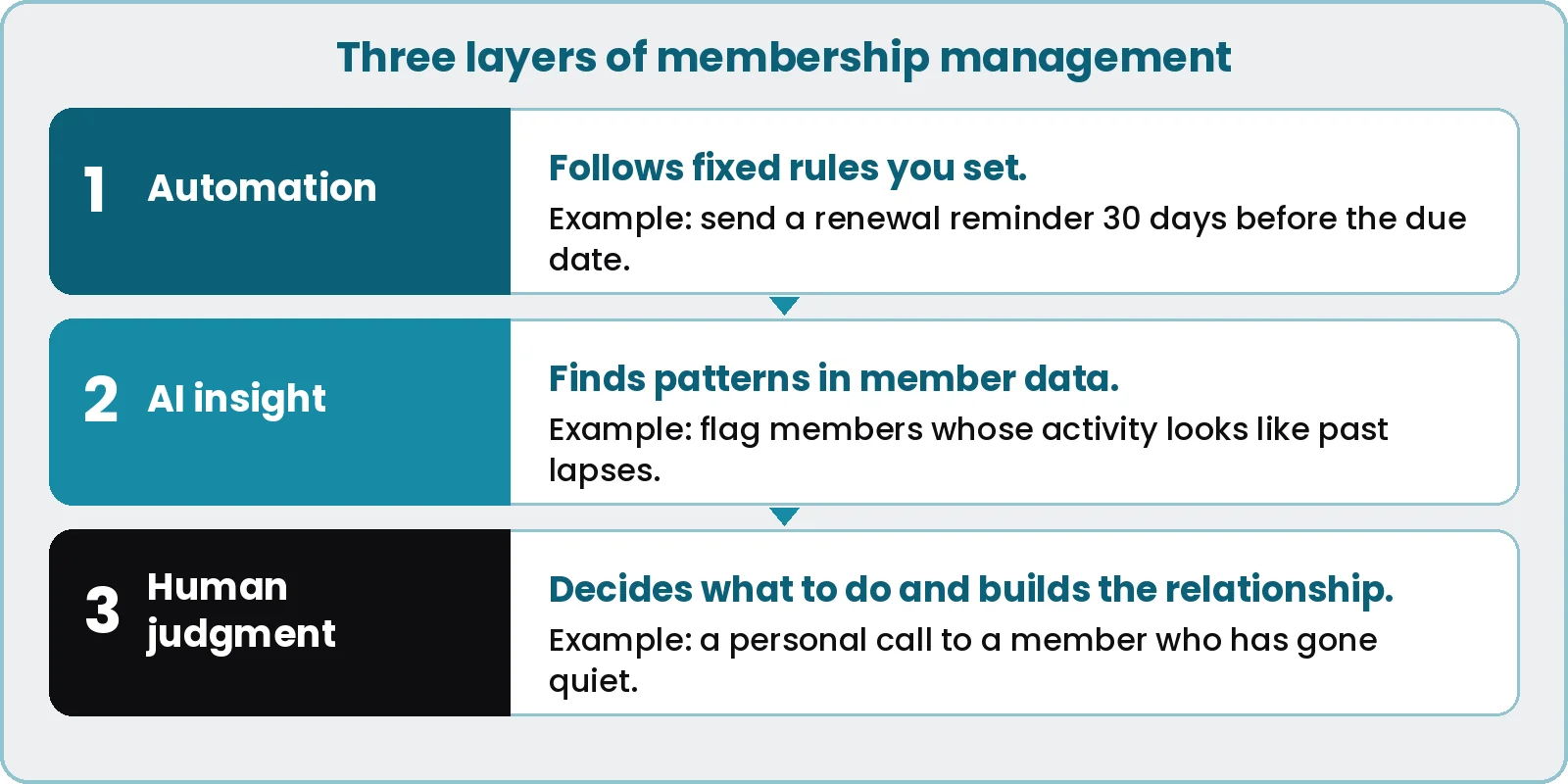
A useful rule of thumb: if a feature only does what you told it to, it is automation. If it surfaces something you did not ask for, it is AI. Neither label guarantees quality, so judge a feature by what it does for your team, and remember that the layer that matters most is still the person who decides what to do next.
Why does AI in association management matter now?
Members are used to apps that remember their preferences, so one newsletter for everyone feels generic. Meanwhile, the same three or four staff often handle membership, events, communications, and the board report. AI matters because it gives a lean team the reach of a much larger one, without asking members to accept a less personal experience.
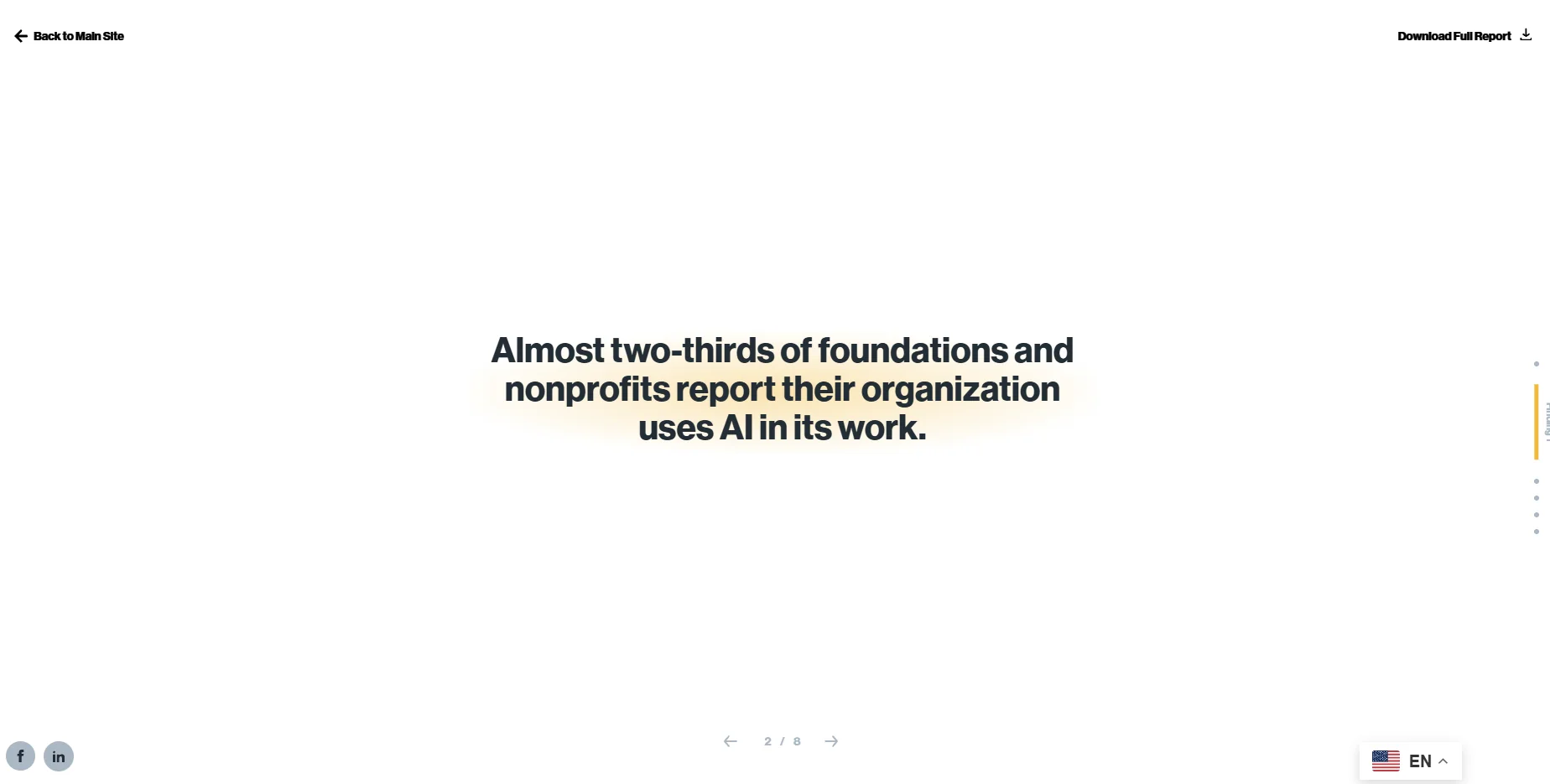
The research shows interest running ahead of readiness. In ASAE’s 2026 article “AI as Strategic Enabler”, 85 percent of association executives felt either somewhat or not very prepared to navigate the impacts of AI (from an ASAE Insight Update), and nearly 65 percent of association leaders named a lack of internal expertise as their top barrier to adoption.
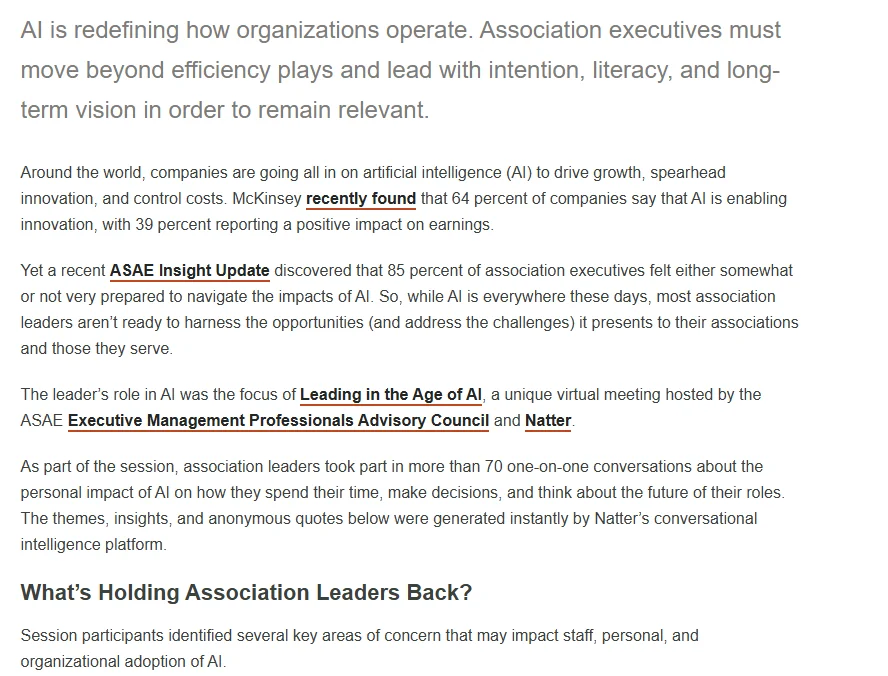
The wider nonprofit sector looks the same. The Center for Effective Philanthropy’s 2025 “AI With Purpose” report, based on a nationally representative survey of US nonprofit and foundation leaders, found that almost two-thirds of foundations and nonprofits use AI in their work. Almost two-thirds also say none or just a few of their staff have a solid understanding of AI.
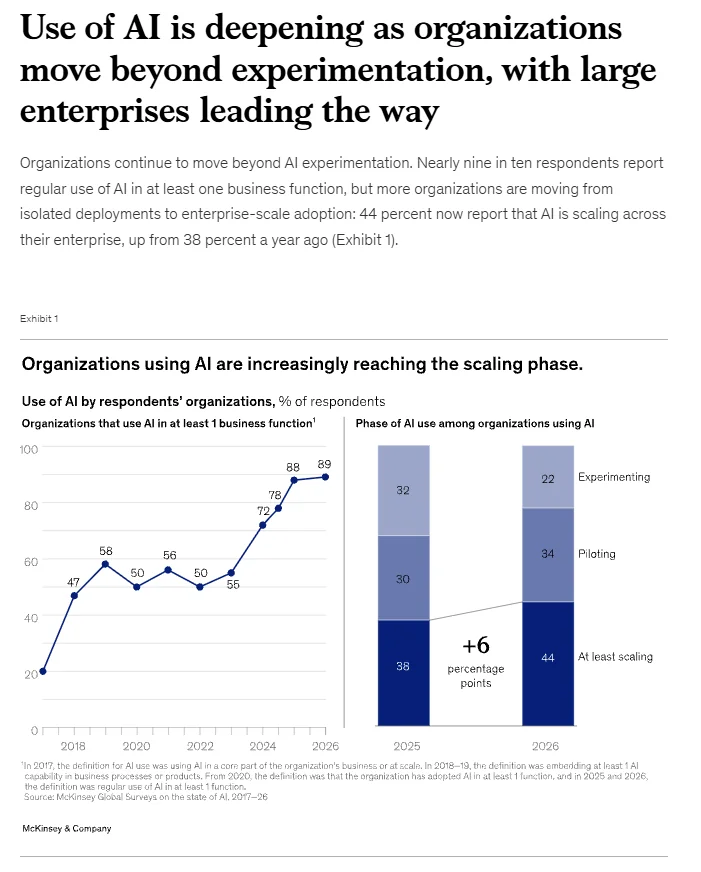
Across all industries, the gap is closing fast. McKinsey’s State of AI 2026 survey reports that nearly nine in ten respondents’ organizations use AI regularly in at least one business function, and 44 percent say AI is now scaling across their enterprise, up from 38 percent a year earlier. Those are mostly companies, not associations, but members bring those expectations with them.
What are 5 ways AI is changing association management?
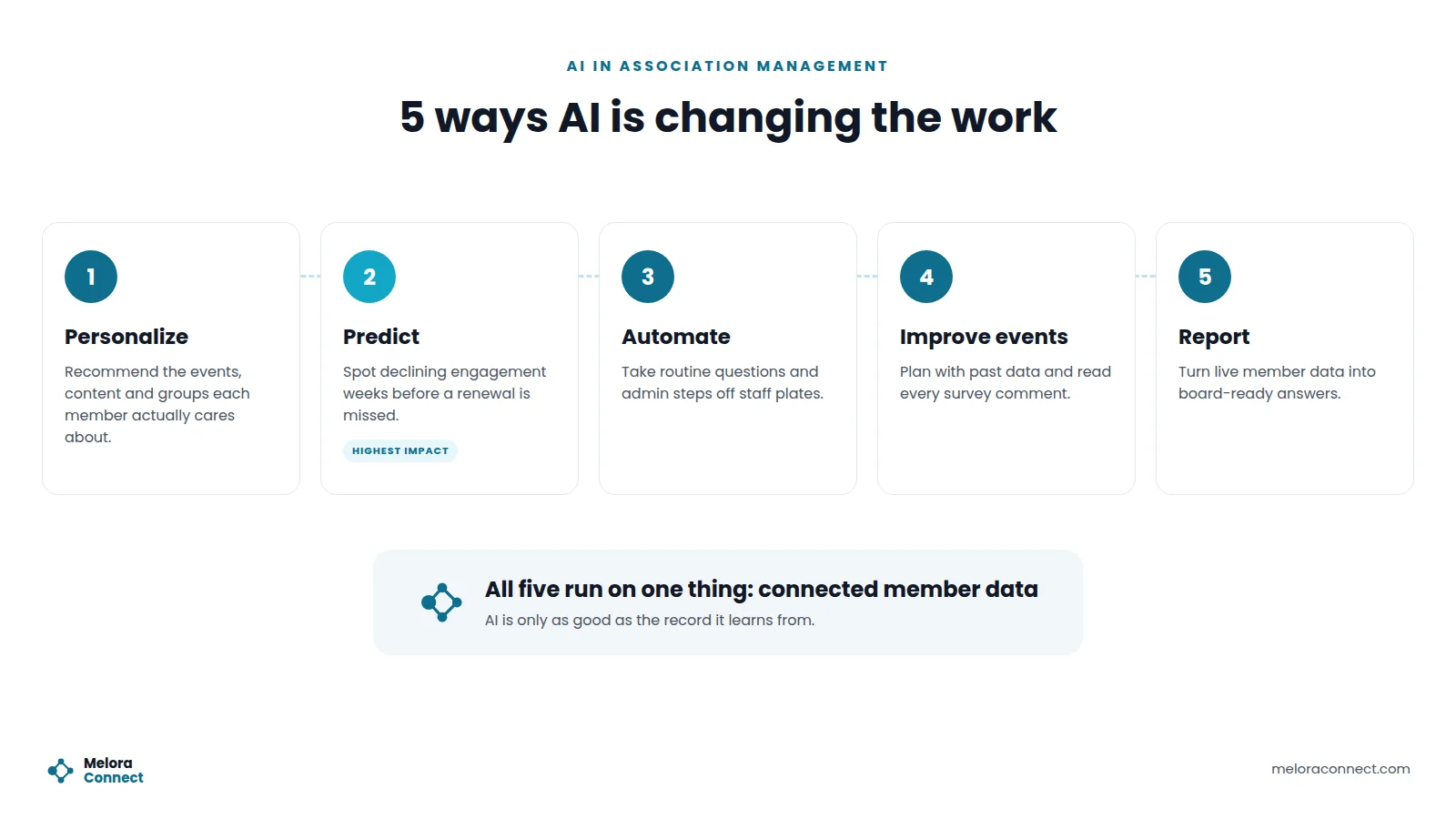
AI is changing association management in five areas: personalized member experiences, renewal risk prediction, less staff busywork, smarter events, and faster answers for leadership. All five run on the same thing: connected member data.
1. Personalized member experiences
Instead of one message for everyone, AI looks at each member’s event history, interests, committee involvement, and email activity to suggest what is most relevant to them. A new member in the healthcare sector sees healthcare sessions first. A member who just earned a certification is pointed toward the next one.
The result is communication that feels personal at scale, which is hard to do by hand. Our guide to AI for member engagement shows how to put it into practice.
2. Predicting renewal risk
A member rarely lapses out of nowhere. The signals show up months earlier: fewer event registrations, unopened emails, no logins to the member portal. AI connects those signals and flags members whose engagement is dropping, so your team can reach out while there is still time.
This is the highest-impact use of AI for most associations, because it turns retention from a reaction into a plan. For how a simple risk score is built, see our guide to predictive analytics for member retention, and for the warning signs themselves, our guide on how to identify members at risk of churning.
Score renewal risk before you buy any AI. List your members, score the warning signs, and see who needs a call this month in our free spreadsheet. Download the scoring sheet
3. Less busywork for staff
Much admin work follows familiar patterns: routine member questions, standard applications and credit checks, first drafts of newsletters and renewal emails. The change is who takes the first pass. AI prepares the work and staff review it, instead of staff doing every step by hand. Our guide to AI for association staff breaks down seven admin tasks and what should stay human.
4. Smarter events, before and after
Events are where many members first feel the value of belonging. Before an event, AI can review past attendance and registration patterns to suggest topics, time slots, and pricing. After it, AI can read every open-ended survey comment and group them into clear themes, so nothing gets lost because nobody had time to read it.
5. Faster answers for leadership
Board reports often take a full day of spreadsheet work. With connected data, AI can summarize growth, renewals, revenue, and engagement in plain language, and staff can ask follow-up questions instead of building a new report. See how AI can automate association reporting for a step-by-step approach, and our member engagement metrics guide for the numbers worth reporting.
Example: 640 survey comments, one afternoon
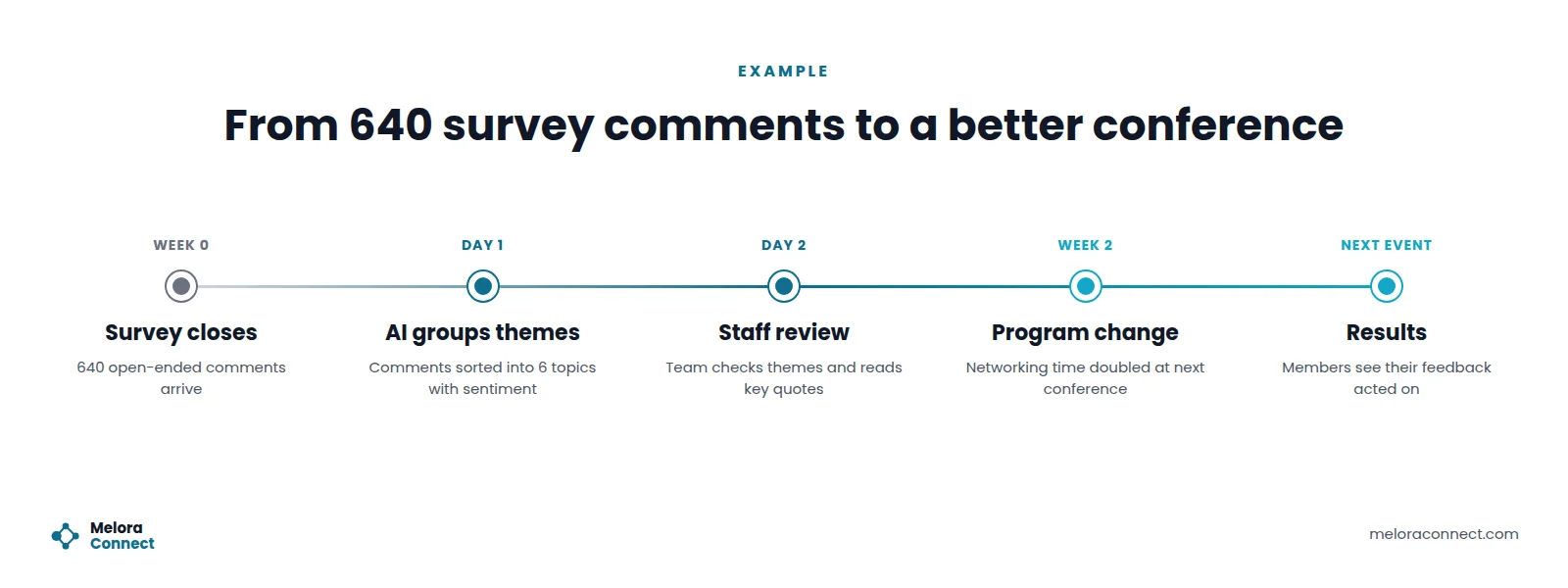
This example is illustrative, and it uses a general AI text-analysis tool. Picture a professional society with 1,100 members that just finished its annual conference. The post-event survey brings in 640 open-ended comments. In the old setup, those comments sit in a spreadsheet, because nobody has two free days to read them all. The team skims a few, writes a short summary, and moves on.
With AI, the same comments are grouped into six themes by the next morning, each with a sentiment label and representative quotes. The team spends an afternoon reviewing the results and reading the key comments themselves, because a theme summary can miss sarcasm or merge two different complaints. One theme stands out: members want more time to network. The society doubles the networking blocks at the next conference and tells members it did so because of their feedback.
No one was hired. Every comment finally got read, and a person still decided what to change.
Traditional vs. AI-assisted association management: what changes?
| Area | Traditional approach | AI-assisted approach |
|---|---|---|
| Member communication | One newsletter for every member | Content matched to each member’s interests |
| Retention | Lapses noticed after the renewal date passes | At-risk members flagged weeks in advance |
| Member questions | Staff answer the same emails every week | Routine questions answered instantly, complex ones escalated to staff |
| Event feedback | A sample of comments read by hand | Every comment grouped into themes, key quotes checked by staff |
| Reporting | A day of spreadsheet work before each board meeting | Plain-language summaries from live data |
| Staff time | Mostly spent on admin | More time for members, partners, and strategy |
What are the common myths about AI in association management?
Four myths keep coming up:
-
“AI will run my association.” In practice it assists. Staff stay accountable for decisions and relationships.
-
“More AI features means a better platform.” Features that do not connect to your workflows add noise, not value.
-
“AI needs huge amounts of data.” Some uses, like predicting renewal risk, need a couple of renewal cycles of history, but drafting and summarizing work from day one.
-
“AI is only for large associations.” Size matters less than data quality and a clear problem to solve.
What should AI not replace?
AI is good at patterns. It is not good at trust. A welcome call from a board member, an introduction between two members who should meet, a conversation with someone thinking of leaving: these are the moments that make people stay.
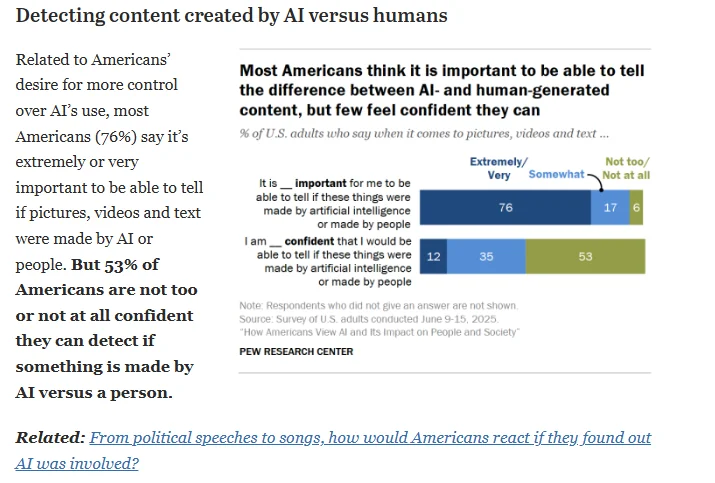
Members also want to know when AI is involved. In Pew Research Center’s 2025 survey on how Americans view AI, 76% of US adults said it is extremely or very important to be able to tell whether pictures, videos and text were made by AI or people. About six in ten said they would like more control over how AI is used in their own lives, and 50% were more concerned than excited about AI in daily life. That is the general public, not association members specifically, but your members are part of it.
Let AI decide who needs attention and why. Let people decide how to show up. The associations that get this balance right will feel more personal to members, not less.
How do you start using AI responsibly?
You do not need a big project to get started. Our AI for associations hub includes a 6-point readiness check and a 30-day pilot plan. The principles behind both are simple: start with one problem, connect your data, keep a person in the loop, and be open with members. If drafting is your first problem, our free AI Prompt Library for Associations is an easy place to begin.
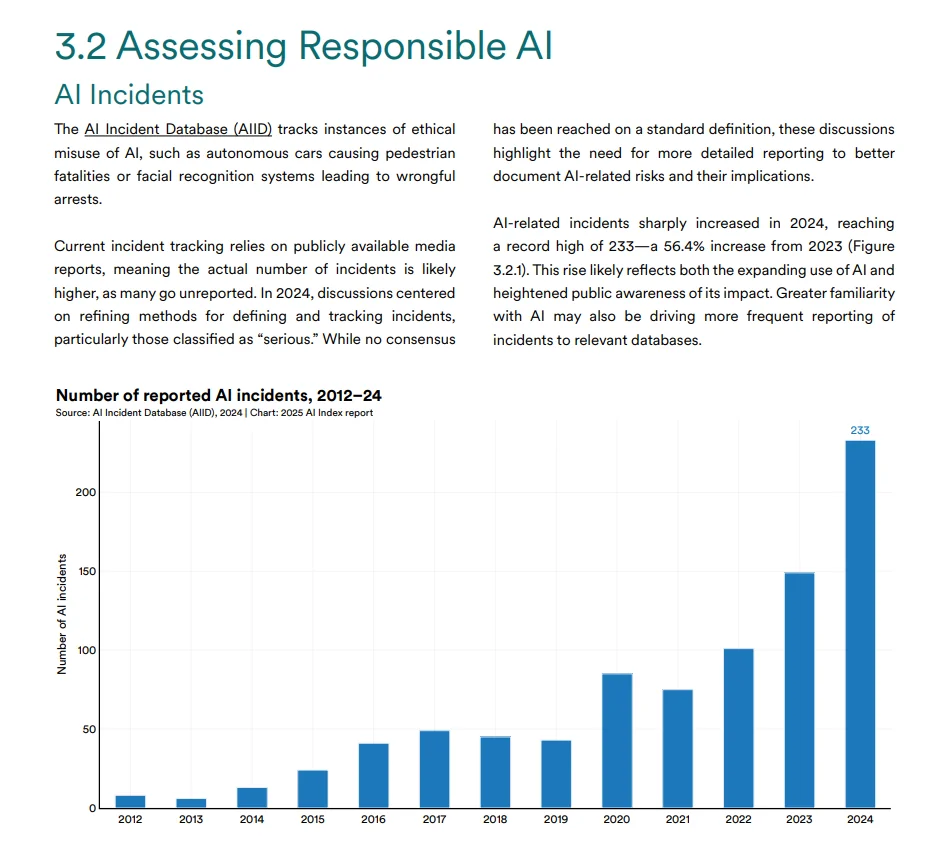
Keeping a person in the loop is not a formality. Stanford HAI’s AI Index Report 2025 found that reported AI-related incidents rose to 233 in 2024, a record high and a 56.4% increase over 2023. Those incidents span every sector worldwide, not associations, but they are a reminder that AI output needs a reviewer before it reaches a member.
Before you pilot any AI tool, check these five things:
- You can name the one problem you want AI to help with, and the number that will show it worked.
- Each member has one record, with events, payments and emails attached to it.
- A named staff member reviews AI output before any member sees it.
- A short written note says which tools staff may use and what member data may go into them.
- Members can find a plain-language explanation of how their data is used.
Start with prompts your team can use this week. Copy tested prompts for renewal emails, board summaries, event follow-ups and more, with a review step built in. Get the prompt library
How Melora Connect approaches AI and association management
Every useful AI feature depends on complete, connected member data, so that is where Melora Connect starts. It gives every member one connected record, and everything else pulls from it: dues and payments, event registrations and check-ins, email campaigns, surveys, committees, advocacy campaigns, and chapters and CE credits (live since October 27, 2026). Every check-in becomes engagement data instead of a spreadsheet export.
What we offer today sits on the automation side of the line drawn above. Smart segments surface new, at-risk, and lapsed members. Engagement scoring shows who is active (see how a member engagement score works). Automated renewals and reminders go out on schedule, and a Monday morning briefing tells your staff what changed in the past week. They run on rules you can see, which makes them easy to check and easy to trust. Each organization’s data is isolated, with daily encrypted backups and audit logs.
Today you can connect the AI assistant your team already uses, such as Claude or ChatGPT, to Melora Connect with an API key, so it can look up members, events and dues invoices and make the changes the key allows. Coming soon: a staff AI assistant built into Melora Connect, a website assistant for member questions, and help writing advocacy letters. If you are comparing platforms in the meantime, our guide to AI association management software lists the questions to ask every vendor, including us.
You get a team, not a login. Our team configures Melora Connect with you, migrates your member data, and stays on as a managed service, so your record is clean before any AI touches it.
See which members need a call this week. Bring a recent member export, and we will show you segments, engagement scores and a Monday briefing built from it. Book a demo
Frequently asked questions about AI in association management
What is AI in association management?
AI in association management is the use of machine learning and language tools to analyze member data, automate routine work, and recommend actions that improve engagement and retention. Typical uses include flagging members at risk of lapsing, personalizing communication, summarizing survey comments, and drafting reports, with staff reviewing the output and making final decisions.
How is AI used in association management?
Associations use AI to personalize member communication, flag members at risk of not renewing, answer routine questions, take first passes at admin work, group event survey comments into themes, and summarize membership data for the board. The most valuable uses rely on one connected member record, and staff review anything a member will see.
What is the difference between AI and automation?
Automation follows rules you set, such as sending a renewal reminder 30 days before the due date. AI finds patterns you did not specify, such as members whose activity looks like past lapses, and suggests what to do. Most associations already automate; AI adds insight, and people still decide what happens next.
Are associations already using AI?
Many are experimenting, but readiness lags. ASAE reported in 2026 that 85 percent of association executives felt somewhat or not very prepared for AI’s impacts. In the wider nonprofit sector, the Center for Effective Philanthropy found almost two-thirds of nonprofits and foundations use AI, while most have few staff who understand it well.
Will AI replace association staff?
No. AI takes over sorting, flagging, drafting and summarizing, which frees staff time, but it does not build trust or own relationships. Welcome calls, introductions between members, and conversations with members thinking of leaving stay human. The best results come when staff review AI suggestions and decide how to act on them.
What should an association do before adopting AI?
Pick one clear problem and a number that shows success, connect member data into one complete record, and name a staff member who reviews AI output. Write a short note on which tools and data staff may use, and tell members plainly how their data is used before anything goes live.
The bottom line
AI in association management is turning member data into early warnings, personal recommendations, and hours given back to staff. The research says the gap is readiness, skills and data, not access to tools. The associations that benefit most will not be the ones with the most AI features. They will be the ones with connected member data and a team free to use what it reveals.
See what your member data could tell you. See segments, engagement scoring and the Monday morning briefing on one member record in Melora Connect. Book a demo
Sources
- ASAE, AI as Strategic Enabler: How Association Leaders Can Catch Up, Mar 10, 2026.
- Center for Effective Philanthropy, AI With Purpose: How Foundations and Nonprofits Are Thinking About and Using Artificial Intelligence, Sep 30, 2025.
- McKinsey & Company, The state of AI in 2026: On the road to ROI, Aug 25, 2026.
- Pew Research Center, How Americans View AI and Its Impact on People and Society, Sep 17, 2025.
- Stanford HAI, Artificial Intelligence Index Report 2025, Chapter 3: Responsible AI, Apr 7, 2025.