
 People · Events · Communities

Every association runs on the same core work: welcoming members, collecting dues, hosting events, keeping people informed, and proving to the board that it is all working. For a long time, that work was spread across spreadsheets, inboxes, and half a dozen tools that never talked to each other.
Association management software was created to put it all in one place. This guide explains what an AMS is, what it actually does, the different types on the market, and how to tell whether your organization is ready for one.
What is association management software?
Association management software (AMS) is a platform that runs the core operations of a membership organization in one system: member records, dues and renewals, events, communications, payments, and reporting. Every activity connects to a single member record, so staff can see each member’s full relationship with the organization in one view.
Think of it as the operating system for an association. Individual tools handle individual jobs. An AMS connects those jobs so that a payment, an event check-in, or an email click updates everything else automatically.
What does AMS stand for?
AMS stands for association management software or association management system. The two terms are used interchangeably. (Outside the association world, AMS can also mean asset management system or agency management system, which are unrelated products.)
What does an AMS do? 9 core modules
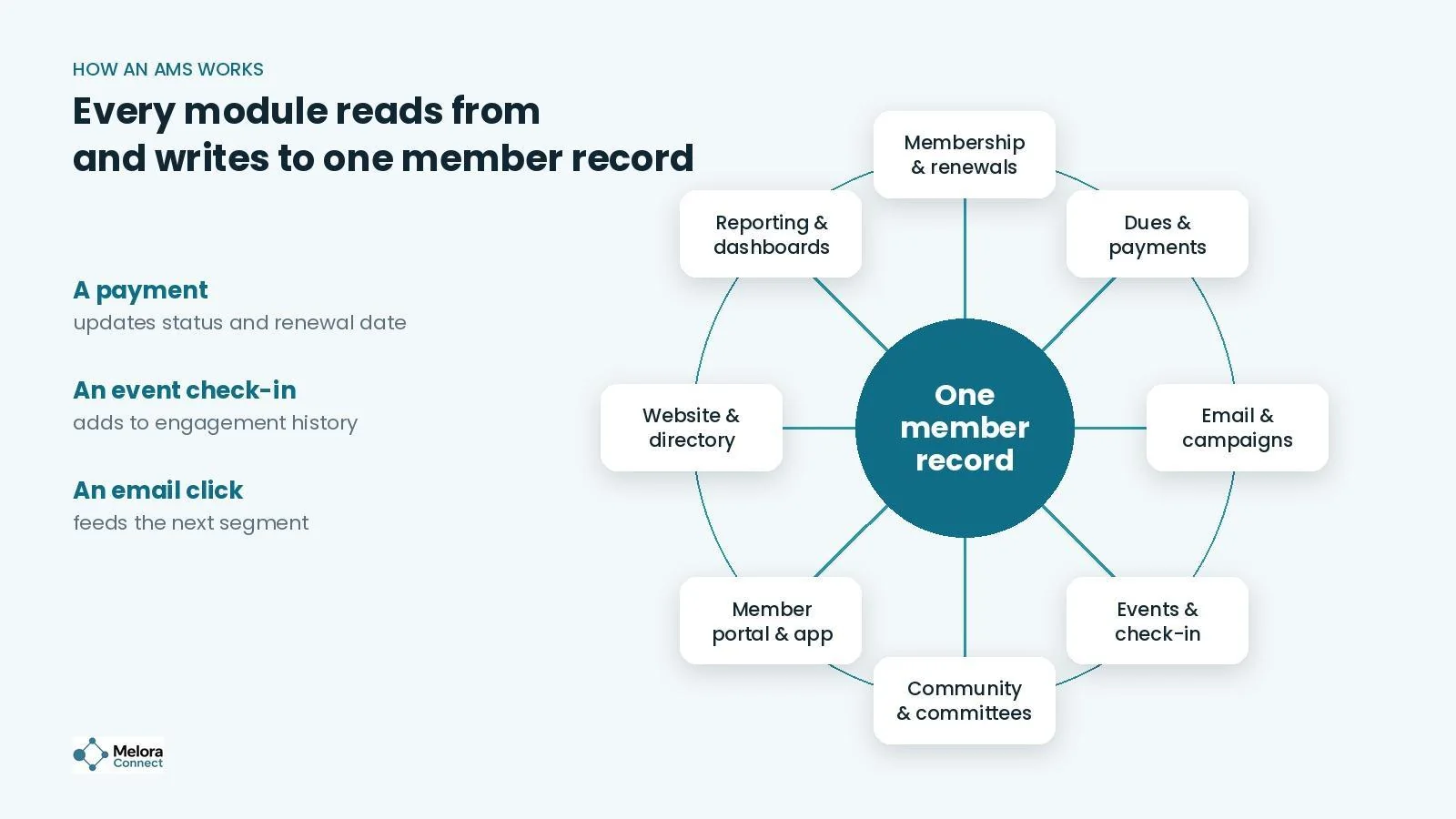
Most platforms are built from modules that share one database. Here is what each one handles:
| Module | What it handles |
|---|---|
| Member database | Profiles, membership status, tiers, history, notes, and households or company accounts |
| Joining and applications | Online join forms, approval workflows, and payment at signup |
| Dues and renewals | Invoices, recurring billing, reminders, grace periods, and lapsed-member follow-up |
| Payments and accounting | Card and ACH payments, receipts, refunds, and sync with accounting software |
| Events | Registration, ticketing, member pricing, check-in, badges, and virtual or hybrid sessions |
| Communications | Email, newsletters, segmented lists, and automated messages |
| Member portal and app | Self-service profiles, payments, event sign-ups, directories, and resources |
| Website | Public site and member-only pages connected to live member data |
| Reporting | Dashboards for growth, renewals, revenue, event participation, and engagement |
Larger platforms add modules for committees, chapters, continuing education and certifications, sponsorships, job boards, and fundraising. Smaller organizations rarely need all of them on day one. When you reach the demo stage, ask each vendor to show these modules working on one member record. Our AMS selection process guide has the demo script and scoring matrix to do it.
Who uses association management software?
Any organization whose business model is built on members. That includes professional associations (such as nurses, engineers, or accountants), trade associations, chambers of commerce, societies, federations, councils, alumni associations, clubs, and membership-based nonprofits.
Inside the organization, the AMS has several audiences at once: the membership director managing renewals, the events team running registrations, the finance lead reconciling payments, the executive director reporting to the board, and the members themselves using the portal.
Association management by the numbers
Why do so many associations move to an AMS? A few independent numbers explain the pressure on small teams.
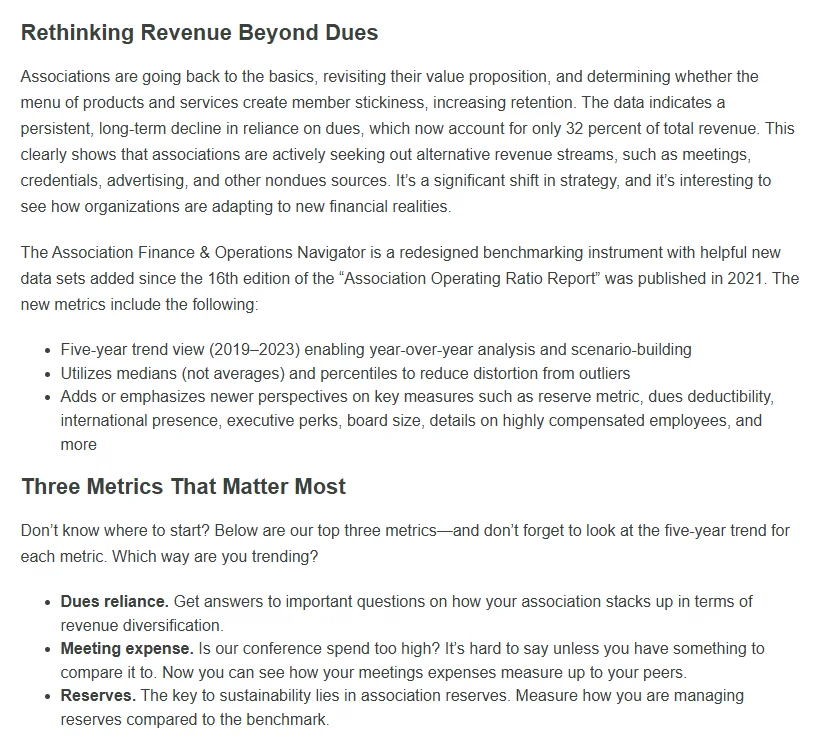
Dues no longer pay for everything. Dues now make up just 32% of total association revenue, according to ASAE’s 2026 Association Finance & Operations Navigator, which draws on the tax filings of more than 6,000 associations. ASAE describes a persistent, long-term decline in reliance on dues. The rest comes from events, education, sponsorships, and other programs, and an AMS has to track all of it against the same member record.
Year one decides retention. In the MGI 2026 Membership Marketing Benchmarking Report, based on input from nearly 500 association professionals, the median renewal rate was 82% for all members and 72% for first-year members.
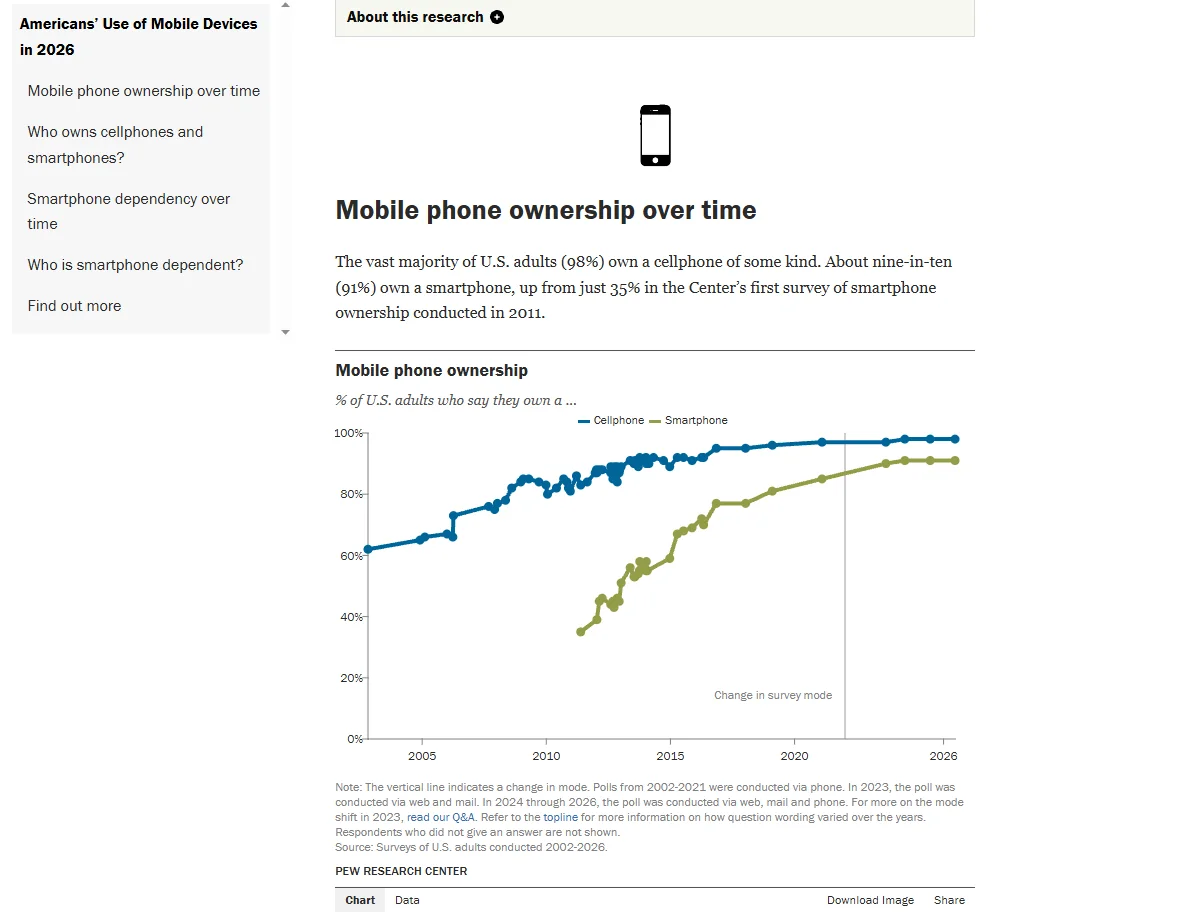
Members live on their phones. About nine in ten U.S. adults (91%) own a smartphone, according to the Pew Research Center, which is why a member portal that works on a phone is no longer optional.
Coordination eats the week. Leaders and teams lose 25% of their time just searching for answers, according to Atlassian’s State of Teams 2025 survey of 12,000 knowledge workers and 200 executives. In an association, much of that is hunting for member data across disconnected tools.
A day without an AMS vs. a day with one
Here is what an ordinary Tuesday can look like at a 600-member chamber of commerce. This is an illustrative scenario, but if you work at an association, parts of it will feel familiar.
| Time | Without an AMS | With an AMS |
|---|---|---|
| 8:30 am | The board chair asks for this month’s renewal numbers. Someone starts merging two spreadsheets. | The renewal rate is already on the dashboard. Link sent in two minutes. |
| 10:00 am | A new member joins through a web form. Staff copy the details into the database and send an invoice by hand. | The member joins and pays online. The welcome email goes out automatically. |
| 12:00 pm | Registration closes for the networking lunch. The attendee list is exported and checked against the member list for pricing errors. | Member pricing was applied at checkout. The list is ready, badges included. |
| 3:00 pm | A member emails to update her billing address. It goes on the to-do list. | She updated it herself in the member portal last week. |
| 4:30 pm | A sponsor asks how many members attended their session. Nobody knows until tomorrow. | Attendance is in the report. The sponsor gets an answer before 5. |
None of the “without” tasks is hard. Together, they quietly eat the hours your team could spend on members.
Mondays show the gap most clearly. Helen, the chamber’s membership director, starts each week by working out what needs her attention.
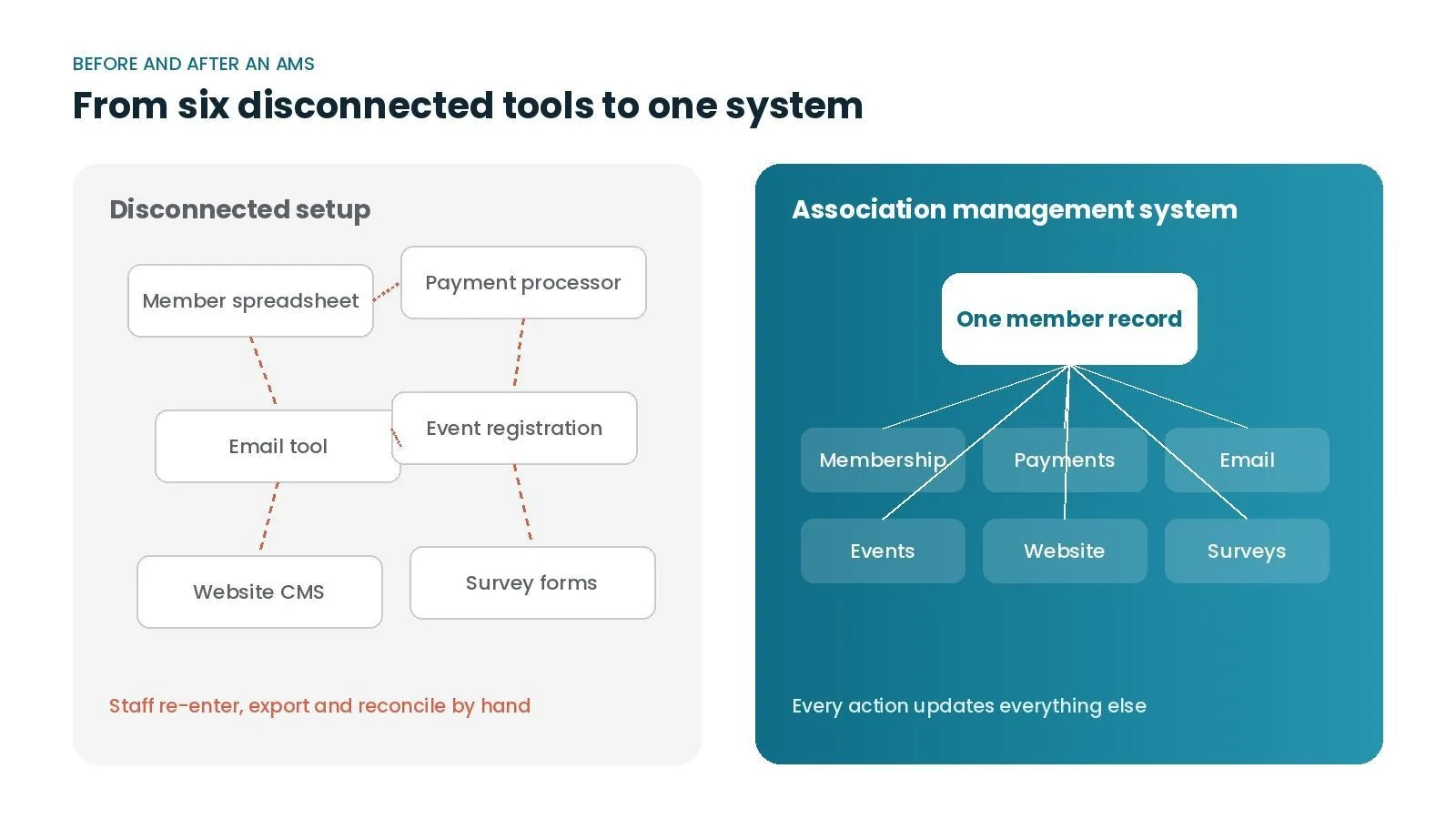
Without an AMS, Monday takes all morning. Helen exports last week’s payments and matches them against the member spreadsheet, copies new event registrations into another tab, and builds the renewal reminder list by hand. By lunch she knows what happened, but she has not spoken to a single member.
With an AMS, Monday takes a few minutes. A short briefing shows who joined, which renewals are overdue, and which members look at risk, so she spends the morning on the phone with members instead.
Same chamber, same staff, same members. The difference is whether the week starts with spreadsheets or with people.
Types of association management software
All-in-one vs. best-of-breed
An all-in-one AMS covers membership, events, email, payments, and the website in a single platform. A best-of-breed approach combines specialist tools (for example a separate event platform and email tool) connected through integrations. All-in-one is simpler to run and keeps data in one place. Best-of-breed offers depth in individual areas but needs more integration work and more logins.
Self-serve vs. managed service
With a self-serve AMS, you buy a subscription and your team configures the platform, migrates the data, and learns the system largely on its own. With a managed service, the vendor’s team sets up the platform around how your organization works, handles the migration, and stays involved after launch. Self-serve usually costs less up front; managed service usually gets you live faster and with fewer mistakes.
Small-organization vs. enterprise AMS
Platforms built for small and mid-sized organizations focus on ease of use and fast setup. Enterprise AMS platforms support complex structures (multiple chapters, certifications, custom integrations) but tend to come with longer implementations and higher costs. Choose for the organization you will be in three years, not the one you were three years ago. Our roundup of the best association management software shows which platforms sit at each end.
AMS vs. membership management software vs. CRM
In practice the line between an AMS and membership management software is blurry, and many products are sold under both names. Our guide to AMS vs. membership management software has the full comparison table and a short check to see which one you need. A CRM is a different tool: excellent for tracking prospects and deals, but not built to run dues, renewals, and member self-service. We compare the two in membership management vs. CRM.
Benefits of association management software
One source of truth. Member data lives in one place, so nobody has to ask which spreadsheet is current, or whether it is right: a 2024 review of spreadsheet research by Pak-Lok Poon and colleagues, published in Frontiers of Computer Science, reports that 94% of spreadsheets used in business decision-making contain errors.
Less manual work. Joining, invoicing, renewal reminders, receipts, and event confirmations run automatically.
Better retention. When event attendance, email activity, and payments sit on one profile, you can see which members are drifting away while there is still time to reach them. That matters: in the MGI 2026 Membership Marketing Benchmarking Report, the renewal rate was 82% across all members and 72% for first-year members.
A better member experience. Members join, pay, register, and update their details on their own, from their phone.
Clearer decisions. Leadership gets live numbers on growth, renewals, and revenue instead of a report assembled the night before the board meeting.
5 signs your organization needs an AMS
Check the statements that sound like your organization:
- Membership, events, and finance each keep their own list of members.
- Payments have to be matched against the member list by hand before anyone can say who has paid.
- You cannot easily tell which members attended events this year.
- Committee rosters, sponsor contacts, and event attendance live outside the member record.
- Members email staff to update their details or ask for a receipt.
If you checked two or more, an AMS will likely pay for itself in staff time alone. If you checked four or five, your current setup is probably costing you members too.
Not sure where to start? Get our free AMS readiness checklist: the questions to answer internally before you talk to any vendor. Open the AMS readiness checklist
How much does an AMS cost?
Prices range widely, and the pricing model matters as much as the headline number: per-contact pricing grows with your database, while tiered plans stay predictable. Implementation fees and add-ons can change the picture too. For real price ranges, hidden costs, and a three-year cost worksheet, see our guide to membership management software features, benefits and costs.
Where association management software is heading
Mobile first. Members increasingly expect to join, pay, and check in from an app, not a desktop portal.
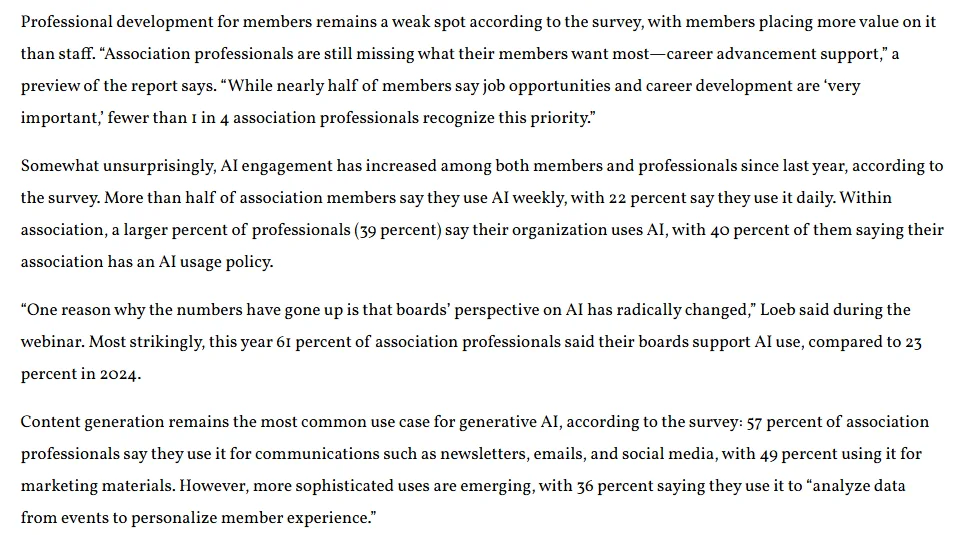
AI that helps staff act. The useful applications are practical: flagging members who are disengaging, drafting renewal messages, and summarizing activity before a board meeting. Adoption is moving quickly. In a 2025 Association Trends Study of more than 1,000 members and 200 association professionals, reported by Associations Now, 39% of professionals said their organization uses AI, and 61% said their board supports AI use, up from 23% a year earlier.
Events and membership in one record. Events are often the most visible member benefit. Platforms are treating attendance as engagement data rather than a separate silo.
More service, not just software. Small association teams do not have time to become system administrators. Vendors that configure, migrate, and stay involved after launch are gaining ground over “here is your login, good luck.”
How Melora Connect approaches AMS
Melora Connect is a membership operating system for associations, chambers of commerce, professional societies, and membership nonprofits.
What makes it different is the model. You get a team, not a login. We configure the platform around how your organization actually runs, migrate your data, and keep it running with you after launch, at every plan level. Most organizations go live in about 30 days from signed agreement.
The core AMS modules share one member record with smart segments for new, at-risk, and lapsed members. Renewals, reminders, and invoice runs are automated, payments run by card and ACH through MeloraPay into your own Stripe account, and events come with ticket tiers, members-only events, and check-in at the door. Because our team comes from event production, events are treated as a core part of membership, not an add-on.
Chapters and CE credits are live, so chapter-based associations and certification programs run on the same member record. HubSpot, Slack alerts, and Microsoft Teams alerts are connected today, QuickBooks Online and Desktop exports keep finance in step, and online events carry their own join link (Zoom, Teams, or Google Meet), sent with each confirmation. Member and staff apps and a website builder are coming soon. Plans start at $3,000 a year; see Melora Connect pricing for the tiers.
See how it would work for your organization. Book a walkthrough built around your current workflows. Book a demo
AMS glossary: 12 terms to know
| Term | Meaning |
|---|---|
| AMS | Association management software (or system): the platform that runs an association’s core operations |
| Member record | The single profile holding a member’s details, payments, events, and activity |
| Membership tier | A membership category with its own price and benefits, such as individual, corporate, or student |
| Dues | The recurring fee members pay to belong |
| Renewal rate | The share of members up for renewal who renew |
| Lapsed member | A former member whose membership expired without renewal |
| Non-dues revenue | Income from sources other than dues, such as events, sponsorships, and education |
| Chapter | A local or regional branch of a larger association |
| Member portal | The self-service area where members manage their profile, payments, and registrations |
| CE credits | Continuing education credits members earn to keep professional licenses or certifications |
| Engagement score | A number summarizing how active a member is across events, email, and other activity |
| Data migration | Moving member records and history from old systems into a new AMS |
Frequently asked questions about AMS
What is association management software?
Association management software (AMS) is a platform that runs a membership organization’s core operations in one system, including member records, dues, renewals, events, communications, payments, and reporting.
What does AMS stand for?
AMS stands for association management software, also called an association management system.
Who uses an AMS?
Professional and trade associations, chambers of commerce, societies, federations, alumni associations, clubs, and membership-based nonprofits.
How long does it take to implement an AMS?
It depends on how much data needs migrating and how complex your setup is. As a rough industry estimate, small and mid-sized associations take 6 to 16 weeks, and large ones can take 4 to 9 months. With Melora Connect, the typical time is about 30 days from signed agreement to live. See how long it takes to migrate membership software for the detail, and our AMS migration checklist for every step.
The bottom line
An AMS is not just a database for members. It is the system that connects everything an association does for them, so that every payment, event, and email adds to one clear picture of each relationship.
You do not need the biggest platform on the market. You need one that fits how your organization works today, can grow with you, and comes with people who will help you get it right.